
Gran Torino


Clint Eastwood directs and stars in the drama “Gran Torino,” marking his first film
role since his Oscar®-winning film “Million Dollar Baby.” Eastwood portrays Walt
Kowalski, an iron-willed and inflexible Korean War veteran living in a changing world,
who is forced by his immigrant neighbors to confront his own long-held prejudices.
Retired auto worker Walt Kowalski fills his days with home repair, beer and
monthly trips to the barber. Though his late wife’s final wish was for him to take
confession, for Walt—an embittered veteran of the Korean War who keeps his M-1 rifle
cleaned and ready—there’s nothing to confess. And no one he trusts enough to confess
to other than his dog, Daisy.
The people he once called his neighbors have all moved or passed away,
replaced by Hmong immigrants, from Southeast Asia, he despises. Resentful of virtually
everything he sees—the drooping eaves, overgrown lawns and the foreign faces
surrounding him; the aimless gangs of Hmong, Latino and African American teenagers
who all think the neighborhood belongs to them; the callow strangers his children have
grown up to be—Walt is just waiting out the rest of his life.
Until the night someone tries to steal his `72 Gran Torino.
Still gleaming as it did the day Walt himself helped roll it off the assembly line
decades ago, the Gran Torino brings his shy teenaged neighbor Thao (Bee Vang) into
his life when Hmong gangbangers pressure the boy into trying to steal it.
But Walt stands in the way of both the heist and the gang, making him the
reluctant hero of the neighborhood—especially to Thao’s mother and older sister, Sue
(Ahney Her), who insist that Thao work for Walt as a way to make amends. Though he
initially wants nothing to do with these people, Walt eventually gives in and puts the boy
to work fixing up the neighborhood, setting into motion an unlikely friendship that will
change both their lives.
Through Thao and his family’s unrelenting kindness, Walt eventually comes to
understand certain truths about the people next door. And about himself. These
people—provincial refugees from a cruel past—have more in common with Walt than he
1


has with his own family, and reveal to him parts of his soul that have been walled off
since the war…like the Gran Torino preserved in the shadows of his garage.
Warner Bros. Pictures presents, in association with Village Roadshow Pictures, a
Double Nickel Entertainment, a Malpaso Production, “Gran Torino.” The film is directed
by Clint Eastwood from a screenplay by Nick Schenk, story by Dave Johannson & Nick
Schenk. Eastwood, Robert Lorenz and Bill Gerber are the producers, with Jenette
Kahn, Adam Richman, Tim Moore and Bruce Berman serving as executive producers.
The film stars Clint Eastwood, Bee Vang, Ahney Her, Christopher Carley, John Carroll
Lynch, Brian Haley, Geraldine Hughes, Brian Howe and William Hill.
The creative behind-the-scenes team is led by Eastwood’s longtime
collaborators: director of photography Tom Stern, production designer James J.
Murakami, editors Joel Cox and Gary D. Roach, and costume designer Deborah
Hopper. The music is by Kyle Eastwood and Michael Stevens, orchestrated and
conducted by Lennie Niehaus.
“Gran Torino” will be distributed worldwide by Warner Bros. Pictures, a Warner
Bros. Entertainment Company, and in select territories by Village Roadshow Pictures.
The film has been rated R by the MPAA for “language throughout and some
violence.” 

ABOUT THE PRODUCTION
THEY DON’T MAKE THEM LIKE THEY USED TO
Clint Eastwood, an actor and director whose body of work encompasses some of
the most enduring and iconic films of all time, has not been in front of the camera since
his 2004 Oscar®-winning film, “Million Dollar Baby.” “I hadn’t planned on doing much
more acting, really,” he says. “But this film had a role that was my age, and the
2
character seemed like it was tailored for me, even though it wasn’t. And I liked the
script. It has twists and turns, and also some good laughs.”
“Gran Torino” came to Eastwood’s producing company, Malpaso, from first-time
screenwriter Nick Schenk, who wrote the script from a story he conceived with Dave
Johannson. “This was based on their experience in Minnesota and people they knew,”
comments Eastwood’s longtime producer and trusted partner, Robert Lorenz. “We got
the script from Bill Gerber, who had received it from Jeanette Kahn. I read it fast, not
necessarily thinking that it was something for Clint to act in, but about half-way through I
slowed down and started to take it in. It was actually very good, so I read it a second
time and just really liked it. I’ve learned never to oversell anything with Clint, so I gave it
to him, saying, ‘I don’t know if you’ll want to make this or be in it, but you’ll enjoy reading
it.’ And he called me and said, ‘I really liked that script.’ And it went from there.”
Schenk says the character of Walt Kowalski wasn’t written with a specific actor in
mind, noting, “Walt’s a little bit of everybody’s shop teacher, or even your dad when he’s
watching you reassemble your bike and screwing it all up. I think everybody knows
someone like that.”
Originally from Minnesota, Schenk drew on his time working at a factory job with
a number of Hmong families—the little-known culture from Laos and other parts of Asia
that allied with the U.S. during the Vietnam War—that had settled there. “The Hmong
culture is somewhat invisible,” he attests.
Walt, who slings racial slurs like most people use nouns and verbs, appears to
be an unrepentant racist, but as he makes tenuous human connections with the Hmong
people that have moved into his neighborhood, the layers of hostility peel away. “Walt
did things in Korea that haunt him, and he sees those faces in his neighbors,” Schenk
remarks. “To Walt, all Asians are the same, all mixed in a blender. And so it just
happens that here’s another culture that has no face, and as he learns more about them,
he begins to reflect on what happened to him in his own experiences in Korea.”
Producer Bill Gerber notes that “Gran Torino” bears echoes of the relationships
explored throughout Eastwood’s body of work. “Clint has always dealt with complex
issues of race, religion and prejudice in an honest way, which can sometimes be
politically incorrect but is always authentic,” he says. “But because of your familiarity
with Clint, you understand that there’s more to Walt than what’s on the surface. You
start in a fairly dark place, and then you begin to see who he is underneath because of
his relationship with these people.”
3

“In retrospect, I can’t imagine anyone besides Clint Eastwood making this movie
or playing this character,” adds Dave Johannson. “As a filmmaker Clint is very sparing
and also doesn’t flinch, no matter how uncomfortable the subject matter. As an actor, it
took a certain level of fearlessness to play Walt, who, to put it mildly, isn’t a very
sympathetic character at first. Walt’s bigotry is something he has held onto for 60 years,
and having the courage to change something about yourself that is so ingrained,
particularly later in life, is a rare and difficult thing. Walt is a physically brave man, but
the story forces him to show emotional courage.”
The story unfolds after the death of Walt’s wife, Dorothy, when he has reached
the final chapter of a life that has in many ways been defined by haunting experiences in
Korea and his 50 years at the local Ford plant. But now the war is long since over, the
factory has been shut down, his wife has passed away, and his grown children barely
have time for him. “Walt has worked hard and his sons have been reasonably
successful,” says Eastwood. “He’s lost his wife, and he’s estranged from his grown
children. They’ve gone off and left him, and he’s just kind of in the way. But in their
defense, Walt’s not an easy case to handle because he’s so cantankerous, and, of
course, the grandchildren have piercings and things, and he doesn’t approve of all that.”
“Walt’s very tough to have as a dad,” says Brian Haley, who plays Mitch
Kowalski. “Mitch is the opposite of his dad. Walt is a hardworking blue-collar guy, and
his son is a shallow suburban yuppie. They have a complex relationship. Walt doesn’t
know how to talk to his son, and Mitch doesn’t know how to break through to his dad.”
Complicating Walt’s desire to be left alone is his late wife’s priest, Father
Janovich, who is persistent in pursuing her final wish to have Walt take confession. “I
joke that my part is basically to show up to the door and have Clint Eastwood slam it in
my face,” says Christopher Carley, who plays the priest. “Father Janovich is trying to
break through to Walt without any real knowledge of how to do it, or how to get Walt to
even have a conversation with him. Walt is not impressed by the fact that he’s a man of
the cloth. He just thinks of him as a ‘27-year-old over-educated virgin.’ Walt makes it
clear to him that the regular way of dealing with people is not going to fly with him.”
“Walt is probably prejudiced against the priest for lots of different reasons, but
mostly because he looks like a kid,” says Eastwood. “He’s trying very hard to get Walt to
confession, but Walt just thinks he’s a guy right out of seminary school with a book of
‘how-tos,’ and so it makes for a very one-way relationship. The ‘padre,’ as he calls him,
is a determined young fellow, but in the end, Walt does it his way.”
4

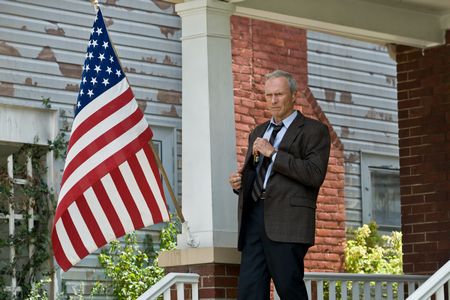
One of Walt’s only real pleasures in life is shining up his Ford Gran Torino, built
in 1972 and lovingly preserved beneath a silk tarp in his garage all these years. In fact,
Walt himself installed its steering column during his time at the Ford plant. “The Gran
Torino is his pride and joy,” Eastwood attests. “Walt sort of is the Gran Torino. He
doesn’t do anything with it except let it sit in the garage. But every once in a while he
takes it out and shines it up. Walt with a glass of beer, watching his car – that’s about as
good as it gets for him at this stage in life.”
In the midst of a run-down street of modest two-story houses, Walt’s home
stands out, with its pristine paint job, neatly trimmed bushes and the American flag
proudly displayed. He’s not happy with the turn the rest of his neighborhood has taken.
“Walt’s a guy who is very, very disturbed about the way his world has gone,” says
Eastwood. “He was raised in a neighborhood in Michigan that was populated with
automobile people like he was, probably a high percentage of Polish Americans, like he
is. So, when he sees his neighborhood changing, it discourages him.”
As the neighboring homes have deteriorated, Walt’s has been scrupulously
maintained by a man used to working with his hands. “He’s the holdout in the
community,” says Lorenz. “He’s somewhat stuck in the past in many ways. And
emotionally, we learn that he has been stuck on something that hasn’t allowed him to
progress as a human being. This dilemma is mirrored in every aspect of his life.”
Equally isolated is Walt’s neighbor, 16-year-old Thao, who is living in a house
with his mother, grandmother and older sister. “He’s the only male in the household with
no male role model to look up to or learn from,” describes Bee Vang, a first-time actor
who won the role of Thao. “He’s awkward and unsure of himself as a guy because he’s
surrounded by all these females who are domineering. He’s in need of a role model and
finds this in Walt.”
Thao is a shy kid, out of high school but without a job, who finds himself
pressured into joining an ad-hoc Hmong gang, led by a teen called Smokie and Thao’s
cousin, who goes by the name Spider. “Everywhere Thao goes, somebody picks on
him,” says Sonny Vue, who plays Smokie. “He can’t stick up for himself, so the gang
would be there to back him up. Becoming a gang was really so they could protect each
other from other gangs in the neighborhood. But things get out of hand when they feel
threatened by Walt—they think they have to get tougher, that it will make them more
manly.”
5


As first-generation Hmong Americans, Smokie and Spider don’t have their elders
to guide them the way past generations of Hmong have, because their elders are having
a harder time assimilating than they are. “You’re trying to live in two different cultures,”
says Doua Moua, who plays Spider. “So there’s a lot of rebellion, and that makes a lot
of male teens come together and create a group to try to assimilate in the world around
them. A lot of the girls are more bonded to home and family, where their mothers can
guide them, and they don’t have to rebel as much against their culture or their parents.”
The gang initiation Smokie and Spider devise for Thao is to steal Walt’s prized
Gran Torino. “Thao is trying to prove that he can be manly and trying to find where he
belongs,” says Vang. But the heist is short-lived, as Walt surprises Thao midway
through it, scaring the teen off without seeing his face. “He fails pathetically at this
attempt,” Vang adds, “and ends up being even more scared and humiliated by the time
its over.”
Not long after, the gang comes back for Thao, resulting in a fight that spills over
onto Walt’s front lawn. Wielding his M-1 rifle, left over from his combat days in Korea,
Walt issues a warning to all involved: “Stay off my lawn.” “He goes back into his war
mindset,” Eastwood offers. “That’s when he really starts to see the problems with the
Hmong community, mainly the kids who join gangs.”
Walt’s unwitting bravery makes him the neighborhood hero, and his Hmong
neighbors soon shower him with unwelcome gifts of food, flowers and plants. “He
doesn’t want to have anything to do with these people,” Eastwood says. “He changes
when he realizes they are intelligent and they’re very respectful of others, and I think he
admires that. He has one line in the film where he says, ‘I have more in common with
these people than I do with my own spoiled, rotten children’ and that kind of sums it up.
It’s interesting, and often funny, how he starts out with a lot of prejudice, and then works
his way out of it through these relationships.”
The only one to break through Walt’s prickly exterior is Thao’s spirited older
sister, Sue, who is more Americanized than the rest of her family. “Walt is the kind of
guy who will call you any names that he wants to,” says Ahney Her, who plays Sue. “He
doesn’t care what race you are. He’ll say whatever he feels.” Her describes Sue as “a
really brave character. She always talks nice to him, even though she does tease him
with nicknames like ‘Wally,’ but ultimately she’s the person who is able to connect Walt
and Thao together. I think Sue wants her little brother to become friends with Walt
because if it goes the other way and he gets in with the gang members, he’s just going
6


to mess up his life. She sees that Walt can be like a father, and if Thao listens to Walt,
he could probably be led to a better life and a better way of growing up.”
Walt and Sue form an easy and light rapport. “She seems to genuinely care
about him in a real way, not a phony way, like some of his family members who seem to
be just going through the motions and doing what they’re supposed to do,” Lorenz says.
“I think her sincerity appeals to him and he allows himself to get to know her a little bit.”
Eventually, Sue is able to lure Walt over to her house for a family celebration,
where an encounter with a Hmong shaman puts words to the unspoken truths Walt has
been living with all these years. “The thing about the Hmong family—which comes
completely into focus in that exchange with the shaman—is that they’re willing to say
what has been unspoken in Walt’s own family,” Lorenz notes. “They’re willing to draw
attention to some things and ask him probing questions that make him reflect on himself
more than anyone else has challenged him to do before. That’s the heart of his
racism—a selfish inability to look at himself. Instead, he projects outward at everyone
around him, trying to see his problems as things that others have caused, rather than
looking inward to see how he can change and adapt, and these folks force him to do that
in some way.”
To make amends for the near-theft of Walt’s car, Thao’s mother and sister
pressure him into helping out Walt with odd jobs for a couple of weeks. “They want him
to make restitution,” says Eastwood. “That’s part of their family pride.”
Walt’s initial response is to call the boy a litany of racist names, deliberately
misspeaking his name as “Toad.” But as the boy earnestly throws himself into Walt’s
missions to fix up the deteriorating houses peppering the street, Walt begins to glimpse
something in the young man worthy of more than his scorn. “You start to see that their
relationship is evolving,” says Vang. “Walt starts to appreciate him as things begin to
develop with Thao, who is obviously growing and changing from the young boy he was
when they first met. And now, with Thao having calluses all over his hands, he’s proud
that he has finally accomplished something useful—that he is useful.”
The purpose of Walt’s work with Thao, continues Vang, is to “man him up. Walt’s
not there just to teach him how to work, but also how to stand up for himself so that he
doesn’t have to join a gang to feel like a man. Walt is the man who is helping Thao
develop more of a backbone.”
Walt’s ultimate goal becomes to empower the aimless kid to get a job and stay
out of trouble so he can have a future, but their oddball relationship also ends up
7


changing Walt himself. “Thao doesn’t have a father figure to rely on and give him
guidance, and Walt never had a real connection with his own sons that might have given
him that satisfaction of fatherhood,” says Lorenz. “It’s sort of a perfect fit for each of
them. Walt is also searching. He clearly knows that he’s in the last chapter of his life,
and he’s searching for someone or something to make sense of it all and to calibrate the
value of his life.”
Through it all, Smokie and the gangbangers continue to harass Thao and his
family, ratcheting up the threat of violence, and forcing the old warrior to take on an
entirely new and unexpected mission. “If you just do something half-way, then it
becomes a Hollywood bailout,” says Eastwood. “And if you’re gonna play this kind of
guy, you can’t go soft with it. You gotta go all the way.”
THE STRANGERS NEXT DOOR
“Gran Torino” marks the first major motion picture to portray characters from the
Hmong community—an ethnic tribe of 18 clans spread among the hills of Laos, Vietnam,
Thailand, and other parts of Asia—who made a difficult transition to the United States
following their involvement in the Vietnam War. “I didn’t know too much about them,”
admits Eastwood. “Because they had helped the Americans during the conflict, they
were brought here as refugees after the end of the Vietnam War.”
“Part of the tragedy is that a lot of people don’t understand the role the Hmong
people played in the Vietnam War,” says Paula Yang, a Hmong adviser the filmmakers
consulted early on. “How we came to the United States, and how many of our soldiers
and civilians were lost during the war, remains a secret. The elders don’t talk about it.
They’re so humble and there are so many sad stories.”
Eastwood points out that the Hmong identify themselves as a culture with its own
unique heritage, as opposed to a nationality. “They have their own religions, their own
language, and they consider themselves their own people,” he explains. “A lot of them
have been through many hardships following the Vietnam War. Things weren’t very
pleasant for them over there, and so the Lutheran church and a lot of individual
organizations worked hard to get them over here. But they withstood a lot of sadness,
so they’re tough, very determined people.”
Eastwood wanted to portray the Hmong in “Gran Torino” as authentically as
possible, starting with casting an exclusively Hmong cast for those roles in the film. But
8

casting director Ellen Chenoweth soon discovered there weren’t many professional
Hmong actors listed at SAG.
Chenoweth and her casting associates Geoffrey Miclat and Amelia Rasche cast
a wide net and researched on the internet to find hubs of the Hmong community. They
made contacts and distributed flyers in Fresno, California; St. Paul, Minnesota; Warren,
Michigan; and throughout other areas of the U.S. “This involved a lot of digging,” notes
Chenoweth, “a lot of getting to know the Hmong communities, making inroads, gaining
their trust, and finding out who wanted to be in a movie. It wasn’t done through the
normal channels. This was really going to them and opening ourselves up to them.”
Hmong cultural advisor Cedric Lee helped the casting team with outreach
throughout the community. “We’d go to places where Hmong people hung out,” he
remembers. “We went to Father’s Day parties. We went to church events. There’s a
language barrier, especially for the elders, so we would speak Hmong and then translate
to the casting directors. With the youth it’s a lot easier, because a lot of them are
English-speaking.”
Chenoweth and her team started with community leaders in St. Paul and Fresno,
and then conducted a series of open casting calls everywhere that Hmong had settled,
culminating in a huge, day-long open audition in St. Paul.
Word spread of Eastwood’s film through Hmong communities online, through
newspapers, youth groups and word of mouth. “People were so excited,” says Paula
Yang. “It was Clint Eastwood, so people were going to do whatever they could. We had
old kids, young kids, old grandmas and grandpas. People were excited because Clint
was making this opportunity for our Hmong people.”
Soon they had hundreds of auditions on tape. “After we visited each city, we
would come back to Los Angeles to go over all the tapes with Clint,” Chenoweth
explains. “We’d put them up on the screen in his editor’s room and started narrowing
down our choices until we had several candidates for each role, and then he made his
decisions.”
From hundreds of prospects, Eastwood cast 16-year-old Bee Vang from St. Paul
in the central role of Thao. Chenoweth remembers, “Amelia found him through his
school, and on his picture I wrote, ‘I heart Bee Vang.’ I just loved his face. He had very
little acting experience, but had this quality that was so open and sweet. You just
wanted him to be okay. When I called Bee Vang and told him we wanted him for Thao,
9
he couldn’t even talk for a while. I think it was something that he hadn’t ever really
dreamed of.”
At 5’5”, Bee Vang’s Thao stands in stark contrast to Eastwood’s 6’2” Walt. “Thao
is literally always looking up to Walt,” says Vang. The Fresno-born teen attended a
private audition for the film in the Twin Cities. When he found out he’d won the key role
of Thao, “I got down on my knees and started crying,” he relates. “The whole thing was
really life-changing. I couldn’t believe this was happening to me.”
Though initially intimidated, Vang soon grew comfortable with Eastwood’s low-
key style. “Growing up, I’d seen him in Westerns and other films, like ‘Dirty Harry,’ but I
never imagined that I’d ever even meet this guy, and then there he was,” he says. “Mr.
Eastwood likes things to be as natural as they can be. It has to be real. I like that style.
He’s a really nice guy, too, a really humble guy. I loved every minute working with him
and the rest of the crew. I will never forget this.”
Sixteen-year-old Ahney Her beat out hundreds who auditioned for the role of
Sue. Amelia Rasche had set up a booth at a Hmong fair in the Detroit area, with a big
sign on it saying, “Hmong Movie Casting.” “Ahney and her family walked by and Amelia
literally ran over and grabbed her and said, ‘Do you want to try out for a movie?’”
Chenoweth recounts.
Her’s confidence and humor made her a natural for the role of the Thao’s older
sister. “We wanted the sister to have a slightly tougher edge. She’s protective of Thao,
who is more vulnerable,” says Chenoweth. “Ahney definitely had that along with a great
kind of youthfulness about her that we all loved.”
Her’s rapport with Eastwood was not much different from Sue’s and Walt’s,
giving the acting novice added confidence in her first big role. “He’s very humble and
easygoing,” she says. “He likes to make you comfortable and is not the type to tell you
exactly what to do. He wants you to do whatever you feel is right, and if it’s not right in
his eyes, then he’ll tell you. He’s a great man, and it was amazing to work with him.”
“Bee and Ahney both seemed to take to acting very naturally because they had
great natural qualities anyway,” says Eastwood. “I’d like to take a lot of credit for it, but it
really wouldn’t be justified.”
The role of Vu, the single mother of Thao and Sue, is played by Brooke Chia
Thao, who was born in Laos and settled in Visalia, California. Chia Thao had no acting
training, and was actually bringing her own kids to the audition when she was cast. “She
just happened to be there, so we asked her to audition and she landed the role,” recalls
10
Cedric Lee. “The funny thing is she’s pretty Americanized, but when you see her as the
mother, it’s like two completely different people.”
For Chia Thao, the film represents a chance to shine a light on her people. “The
movie doesn’t really represent the whole Hmong culture, but it gives a little taste of it,”
she says. “I hope that people start to see us in a more unique way, who we are and how
we helped in the war. My own father was recruited to fight for the U.S. when he was
only 14.”
Chee Thao, the 61-year-old who plays the family grandmother, was born in Laos
and now lives in St. Paul. “Casting the grandmother was an interesting challenge
because the character spoke entirely in Hmong,” says casting associate Geoffrey Miclat.
“A lot of it was just personality. Grandma is a very funny character, and there was this
quality about Chee that made her perfect for the role.”
Thao felt a special bond with Eastwood, and spent time talking with the
actor/director, with her granddaughter serving as translator. Having lived through a
tragic past, she poured her heart and soul into her performance. “Chee Thao said that it
was no trouble for her to get into this character because it was her,” says Lorenz. “She
has had all these struggles that are portrayed in the film. So when she was out there,
basically ad-libbing her way through a lot of the scenes—because a lot of the Hmong
dialogue wasn’t spelled out—it was no trouble. She just said all the right things; she
brought her own story to it.”
Five Hmong actors from several states and different clans of Hmong were cast
as the boys who make up the gangbangers that menace Thao and his family in the film.
“There was just a realness about these guys and they had such great faces,” says
Miclat. “Once we saw Doua Moua in New York, and Sonny Vue in St. Paul, we had a
pretty good feeling that they would be our Spider and Smokie. And Doua Moua was
actually one of our few Hmong cast members with acting training, so we knew he was
going to fit somewhere.”
Moua, who moved to New York City when he was 18 to pursue an acting career,
was cast as Thao and Sue’s cousin, Fong, who now calls himself Spider. Born in
Thailand, Moua grew up in Minnesota and was one of the only Hmong cast members
with acting experience. “‘Gran Torino’ is a dream come true for me,” he says. “I
appreciated every moment that I was on set. Clint was amazing to work with, really laid
back.”
11
Sonny Vue, born in Fresno and now from St. Paul, plays the leader of their
group, Smokie. At 19 years old, Vue had never been in front of a camera before but was
such a natural the casting directors grabbed him from the front desk. “I was talking to
the lady at the front counter, and Amelia [Rasche] came up out of nowhere,” he recalls.
“She was like, ‘Do you want to audition for the role?’ So, I tried, and I got the part.”
The other members of the Hmong gang are played by: Lee Mong Vang, from
Toledo, Ohio; Jerry Lee, from St. Paul; and Elvis Thao, who lives in Milwaukee and is a
member of the hip hop group RARE. Elvis Thao was also thrilled that Eastwood used
one of RARE’s songs on the “Gran Torino” soundtrack.
Outside of the Hmong cast members, one of the key roles was that of Father
Janovich, the earnest Catholic priest who tries to break through to Walt to fulfill Walt’s
late wife’s dying wish.
Cast in the role, Christopher Carley seemed to embody the qualities Eastwood
sought for the priest. “When we saw Christopher Carley, he just looked like a priest,”
Chenoweth explains. “He had this open Irish face, red hair. I thought he was really
good, and when I showed his tape to Clint, he said, ‘He looks like a young Spencer
Tracy.’ I knew he was going to cast him at that point. Clint didn’t care about having an
established star in that role; he’s just really open to giving a chance to people who are
perhaps less well-known in the industry.”
“I do like to give people a break,” says Eastwood. “I like to see new people come
along, and have opportunities. But, by the same token, it’s important to do whatever
suits the film. If somebody who’s well known fits the role, then I go for it. If I can use
somebody lesser-known who happens to suit the role, then that’s fine, too. There’s no
real rule to it. Every picture has its own structure, and its own personality.”
Carley’s impression of Eastwood’s working style mirrors that of his fellow cast
members. “He’s very calm and focused, and there’s a large element of trust on the set
between Clint and the actors,” Carley describes. “You feel like it’s a safe place to show
up, being prepared and knowing that whatever choice you make, you’re not going to
have to fit into some tiny little box that has been pre-designed.”
Rounding out the cast are John Carroll Lynch as Martin, Walt’s barber, who
trades good-natured racial epithets with Walt and helps coach Thao in the fine art of
“manning up”; Brian Haley as Walt’s elder son, Mitch; Geraldine Hughes as Mitch’s wife,
Karen; Brian Howe as Walt’s second son, Steve; and William Hill as construction
12
foreman Tim Kennedy, an old friend Walt enlists to help him give Thao better options in
his life.
The prized Gran Torino was played by the real thing, out of Vernal, Utah. “We
got lucky right off the bat because it was one that worked,” says transportation
coordinator Larry Stelling. “It was completely maintained and Clint really liked it. We did
a couple of things to it, like replacing bumpers and things like that, but other than that
just sparkled it up a little bit. The color was fine, great interior, and it ran great.”
The production purchased the car and brought it to Michigan for principal
photography, but its story may not end there. “We were talking about selling it locally
when we were finished, but as the movie progressed, we all became rather fond of the
car,” recalls Lorenz. “I asked Clint about it and he said, ‘Well, let’s hold on to this car. It
has done right by us, so let’s see what happens.’”
CAMERAS ROLL IN MOTOR CITY
Though the screenplay was initially set in Minneapolis, Eastwood felt Walt’s past
as a 50-year auto worker would resonate most as a resident of “Motor City”—Detroit,
Michigan. Production set down in locations including neighborhoods of Royal Oak,
Warren and Grosse Point, with the once affluent Highland Park standing in for Walt’s
own neighborhood.
“The neighborhood of Highland Park has changed,” Eastwood comments. “It
used to be a big neighborhood of all automobile people—families that were all
interconnected somehow when the automobile manufacturers were in their heyday. The
factories are now not as active as they used to be, but the new people that are moving in
are quite comfortable there. Highland Park has gone through its hard times, but there
are a lot of nice people living there.”
Rob Lorenz notes, “We were there for several weeks in this neighborhood doing
construction and so forth and then shooting, and we tried to have as little impact as
possible. The people we interacted with were thrilled to have us.”
Part of the economy and artistry of Eastwood’s films can be attributed to the
respect and loyalty the filmmaker inspires from his close team of collaborators. Though
he never raises his voice, never says, “Action,” and encourages autonomy, Eastwood is
always in control. “Clint is very comfortable in his own skin,” attests Tom Stern, making
13
his seventh film with Eastwood as director of photography, following many more as chief
lighting technician. “He told me before we started, ‘I am my age. This is who I am.’”
But his team considers his age and experience part of the alchemy that makes
him such a singular visionary filmmaker. His unique approach and the well-oiled
mechanism of his team allow him to move deftly through the production schedule.
Reuniting on “Gran Torino” are his other longtime collaborators: costume
designer Deborah Hopper, editor Joel Cox, and production designer James J. Murakami,
who worked with the legendary Henry Bumstead on Eastwood’s prior films before taking
the leading role as production designer on “Changeling.”
“I’m familiar with their work, they’re familiar with my work, so we don’t have a lot
of explaining to do,” Eastwood states. “It’s always built around eliminating as much
intellectualizing or discussion as possible. There’s enough discussion when you’re
making a film without adding more to it and making it more complicated than it is. I’m
not one of those guys who likes to show that there’s a lot of magic in it. If there is any
magic in filmmaking, it should be very subtle. But, for the most part, it’s just everybody
doing a good job and participating. It’s a fun process. When it’s not fun, you won’t see
me doing it anymore.”
“Gran Torino” also marks the seventh Clint Eastwood film Rob Lorenz has
produced, and fellow producer Bill Gerber attests, “Clint couldn’t ask for a better
producing partner than Rob. Looking at locations with the two of them and seeing the
stuff that Rob had pre-selected, there was so little back and forth. Rob just knew what
Clint wanted. They have a great relationship, and the Malpaso machine is an
extraordinary one. It purrs along well.”
“Clint is old school and he recognizes the value of the old ways of doing things,
because he has been around long enough to see them work,” Lorenz remarks. “At the
same time, he embraces new technology and wants to keep learning, moving forward
and progressing. That’s really what drives him, and I think that’s why he’s such a
pleasure to work with.”
An example of Eastwood’s innovations is a wireless portable video monitor he
had tailor-made for him to allow maximum efficiency in directing scenes in which he’s
also a player. “It allows me to actually see the scene as it’s going on, without having to
squint through the camera,” he explains. “I can be half a block up the street and see
what’s going on.”
14
For the two key houses in the story—Walt’s house and the home of Thao and
Sue next door—the location managers and production designer managed to find two
neighboring houses that fit all the requirements. “What we were looking for in Walt’s
house was a house that could look like a person had cared for it all his life,” Lorenz
describes. “We ‘aged’ the rest of the homes on that street to show the disrepair that had
taken over the houses around him. Jim’s sense of what both houses should look like
was so well-developed that he and his set decorator, Gary Fettis, set to work
immediately. By the time Clint got there to see it, he took a walk through each of the
houses and said, ‘I love it. Don’t change a thing.’ It was perfect.”
To inspire the design for Thao and Sue’s house, Murakami researched through
photographs and visited numerous Hmong households. “We brought in our technical
adviser and she was just in awe because everything made perfect sense,” says Lorenz.
“She had a couple of minor changes but overall told us, ‘You nailed it.’”
Likewise, costume designer Deborah Hopper did internet research and attended
a Hmong festival where she consulted numerous vendors to help ensure authenticity in
the Hmong costumes. “We attended the festival where the Hmong women would buy
their contemporary and traditional Hmong clothing,” Hopper notes. “One of the things I
learned is that the mothers teach their daughters how to make their traditional clothes.
In fact, Ahney Her brought in her own handmade costume for research for the film.”
In addition to the “Soul Calling” ceremonies at the house, Sue and Thao also
have occasion to wear their traditional ceremonial costumes to honor Walt. “They’re
very ornate,” Hopper describes. “They have coins hanging all over them, which signify
the wealth of the family. The ceremonial dress is also very colorful: the women wear
turbans and the men can wear a vest or cross-belts. I thought they were so unique and
beautiful. It was something I had never seen before.”
The blend of cultures in “Gran Torino” is also reflected in the music. Eastwood’s
own connection to music makes the score and soundtrack of particular importance to the
filmmaker, who conceives basic sounds and melodies for his films as he shoots them.
“You just hear different sounds for a picture, and then work them out on the piano, write
them down, or orchestrate them,” he explains. “Sometimes I’ll have somebody else do
it; sometimes I do it myself. There’s no rule there. It’s just when you hear it, it feels right.
“It’s nice when you get to the music part because you are no longer shooting the
film, the film is what it is,” Eastwood continues. “So, then, you’re enhancing the film.
You do music, sound effects, all that sort of thing. It’s exciting when all of a sudden you
15
go from working with 50, 60, 70 people down to one or two people in a room with an
Avid computer.”
The title song for “Gran Torino” is performed by British jazz singer/pianist Jamie
Cullum and Don Runner. It was co-written by Eastwood; Cullum; the director’s son, Kyle
Eastwood; and Kyle’s writing partner, Michael Stevens. “Together they came up with the
song,” Lorenz relates. “And then Kyle and Mike used that as an inspiration for the music
throughout the rest of the film.”
Kyle Eastwood and Michael Stevens composed the score, which was then
orchestrated and conducted by Lennie Niehaus, whose association with the director
dates back to the film “Tightrope.”
The soundtrack also includes Hmong and Latino rap, reflecting what the
characters are listening to, including one track by cast member Elvis Thao’s rap group,
RARE. “Some of the folks that came in to read were rappers,” says Lorenz. “Some did
get roles and some didn’t, but they all submitted their music. It was so appropriate, so
we put as much as we could throughout the movie.”
In every aspect of production, the Hmong community as a whole ultimately
provided tremendous support to help bring a unique and truthful coloration to the project.
In addition to casting, Hmong advisers assisted with dialogue, customs and design
elements, and Eastwood hired numerous Hmong artisans and assistants to work as part
of the crew.
“They wanted to be a part of this film and were so generous to us,” Eastwood
states. “It was a real pleasure for me to work with them. I hope the Hmong people are
happy with the way the film tells some of their story through Walt’s eyes.”
With “Gran Torino,” Eastwood adds Walt Kowalski to his legacy of indelible
characters. “Clint is always interested in progressing and not doing something that he
has already done,” Lorenz reflects. “This script seemed to offer just that. It suited him in
terms of his age and his character, and it seemed to draw from his past, his life as Dirty
Harry and the outlaw, the hard-edged, uncompromising character. And yet it advances
further. It takes him into a little bit darker territory, but also allows him, through his
character’s redemption, to explore something new.”
# # #
16
ABOUT THE CAST
CLINT EASTWOOD (Walt Kowalski) – See bio in Filmmakers section.
BEE VANG (Thao Lor) makes his professional acting debut in “Gran Torino” as a
timid teenaged boy who develops an unlikely friendship with his neighbor, a crusty war
veteran played by Clint Eastwood.
Born in Fresno, California and raised in the Minneapolis area, the 17 year old
was taking classes at the University of Minnesota with plans of going pre-med when he
auditioned for “Gran Torino.” His only previous acting experience was membership in a
drama club, but he won the role of Thao over hundreds of other young men who were
seen in open casting calls. A longtime fan of Clint Eastwood’s, Vang was
understandably stunned and thrilled to be cast opposite the screen icon.
Vang is also a talented musician and plays classical piano, oboe, viola and flute.
He has now put his plans for medical school on hold to pursue his acting career.
AHNEY HER (Sue Lor) makes her feature film debut in “Gran Torino” as the self-
assured young woman who makes an effort to befriend her surly next-door neighbor,
Walt Kowalski, played by Clint Eastwood.
A native of Lansing, Michigan, Her was 16 years old when she won the role of
Sue. Although she had not acted professionally, she loved performing and had trained
for three years in a local drama school.
Her is an avid student and plans to attend college and study both photography
and interior design.
CHRISTOPHER CARLEY (Father Janovich) was recently seen in a supporting
role in Robert Redford’s “Lions for Lambs.” He has also appeared in a number of
independent features, including Zach Braff’s “Garden State.” He counts the part of
Father Janovich, the priest who tries to help Clint Eastwood’s character face his past, as
his first lead role in a feature film. He next co-stars with Leslie Bibb and Adam Goldberg
in the independent comedy “Miss Nobody.”
On the small screen, Carley has guest starred on such series as “The Sopranos,”
“Law & Order: Special Victims Unit,” “Numb3rs” and “House M.D.”
17
Born and raised in New York, the son of a New York City police detective, Carley
received his training at NYU and honed his skills with David Mamet’s esteemed Atlantic
Theatre Company.
Beginning his career on the stage, Carley appeared in a wide range of regional
theatre and off-Broadway productions. He made his Broadway debut in the Tony
Award-winning production of Martin McDonagh’s “The Beauty Queen of Leenane.”
ABOUT THE FILMMAKERS
CLINT EASTWOOD (Director/Producer) most recently directed and produced
the drama “Changeling,” starring Angelina Jolie in the true story of an infamous 1928
kidnapping case that rocked the LAPD. The film was nominated for a Palme d’Or and
won a Special Award when it premiered at the 2008 Cannes Film Festival. Eastwood
will next direct and produce an historical drama about post-apartheid South Africa,
starring Matt Damon and Morgan Freeman, who will portray Nelson Mandela.
In 2007, Eastwood earned dual Academy Award® nominations, in the categories
of Best Director and Best Picture, for his acclaimed World War II drama “Letters from
Iwo Jima,” which tells the story of the historic battle from the Japanese perspective. In
addition, the film won the Golden Globe and Critics’ Choice Awards for Best Foreign
Language Film, and also received Best Picture honors from a number of film critics
groups, including the Los Angeles Film Critics and the National Board of Review.
“Letters from Iwo Jima” is the companion film to Eastwood’s widely praised drama “Flags
of Our Fathers,” which tells the story of the American men who raised the flag on Iwo
Jima in the famed photograph.
In 2005, Eastwood won Academy Awards® for Best Picture and Best Director –
his second in both categories – for “Million Dollar Baby.” He also earned a nomination
for Best Actor for his performance in the film. In addition, Hilary Swank and Morgan
Freeman won Oscars®, for Best Actress and Best Supporting Actor, respectively, and
the film was also nominated for Best Adapted Screenplay and Best Editing.
Eastwood’s critically acclaimed drama “Mystic River” debuted at the 2003
Cannes Film Festival, earning him a Palme d’Or nomination and the Golden Coach
18
Award. “Mystic River” went on to earn six Academy Award® nominations, including two
for Eastwood for Best Picture and Best Director. Sean Penn and Tim Robbins won
Oscars® in the categories of Best Actor and Best Supporting Actor, while the film was
also nominated for Best Supporting Actress and Best Screenplay.
In 1993, Eastwood’s foreboding, revisionist Western “Unforgiven,” received nine
Academy Award® nominations, including three for Eastwood, who won for Best Picture
and Best Director and was nominated for Best Actor. The film also won Oscars® in the
categories of Best Supporting Actor (Gene Hackman) and Best Editor, and was
nominated for Best Original Screenplay, Best Cinematography, Best Art Direction, Best
Editing and Best Sound. Eastwood was also honored with the Academy’s Irving
Thalberg Memorial Award in 1995.
Eastwood was first recognized by the Golden Globes in 1971 with the Henrietta
Award for World Film Favorite. In 1988, he was awarded the Cecil B. DeMille Lifetime
Achievement Award. The following year he won his first Best Director Golden Globe, for
“Bird,” and in 1993, he again received the Best Director Award, for “Unforgiven.”
Nominated in 2004 for his direction of “Mystic River,” Eastwood took home his third Best
Director Golden Globe the following year for “Million Dollar Baby.” He was also
nominated in 2005 as the composer of the score for that film.
Eastwood’s films have also been honored internationally by critics and at film
festivals, including Cannes, where he served as the president of the jury in 1994. In
addition, he has garnered Palme d’Or nominations for “White Hunter Black Heart” in
1990; “Bird,” which also won the award for Best Actor and an award for its soundtrack at
the 1988 festival; and “Pale Rider” in 1985.
In addition to the Thalberg Award and DeMille Award, Eastwood’s many other
lifetime career achievement awards include tributes from the Directors Guild of America,
the Producers Guild of America, the Screen Actors Guild, the American Film Institute,
the Film Society of Lincoln Center, the French Film Society, the National Board of
Review, the Henry Mancini Institute (Hank Award for distinguished service to American
music), the Hamburg Film Festival (Douglas Sirk Award), and the Venice Film Festival
(Career Golden Lion). He is also the recipient of a Kennedy Center Honor, awards from
the American Cinema Editors and the Publicists Guild, an honorary doctorate in Fine
Arts from Wesleyan University, and is a five-time winner of Favorite Motion Picture Actor
from the People’s Choice Awards. In 1991, Eastwood was Harvard’s Hasty Pudding
19
Theatrical Society’s Man of the Year and, in 1992, he received the California Governor’s
Award for the Arts.
Clint Eastwood Filmography
“Gran Torino” (2008) – directed, produced, stars
“Changeling” (2008) – directed, produced
“Letters from Iwo Jima” (2006) – directed, produced
“Flags of Our Fathers” (2006) – directed, produced
“Million Dollar Baby” (2004) – directed, produced, starred
“Mystic River” (2003) – directed, produced
“Blood Work” (2002) – directed, produced, starred
“Space Cowboys” (2000) – directed, produced, starred
“True Crime” (1999) – directed, produced, starred
“Midnight in the Garden of Good and Evil” (1997) – directed, produced
“Absolute Power” (1997) – directed, produced, starred
“The Stars Fell on Henrietta” (1995) – produced
“The Bridges of Madison County” (1995) – directed, produced, starred
“A Perfect World” (1993) – directed, produced, starred
“In the Line of Fire” (1993) – starred
“Unforgiven” (1992) – directed, produced, starred
“The Rookie” (1990) – directed, starred
“White Hunter Black Heart” (1990) – directed, produced, starred
“Pink Cadillac” (1989) – starred
“Thelonius Monk: Straight, No Chaser”(1988) – executive produced
“Bird” (1988) – directed, produced
“The Dead Pool” (1988) – starred
“Heartbreak Ridge” (1986) – directed, produced, starred
“Pale Rider” (1985) – directed, produced, starred
“City Heat” (1984) – starred
“Tightrope” (1984) – produced, starred
“Sudden Impact” (1983) – directed, produced, starred
“Honkytonk Man” (1982) – directed, produced, starred
“Firefox” (1982) – directed, produced, starred
“Any Which Way You Can” (1980) – starred
“Bronco Billy” (1980) – directed, starred
“Escape from Alcatraz” (1979) – starred
“Every Which Way But Loose” (1978) – starred
“The Gauntlet” (1977) – directed, starred
“The Enforcer” (1976) – starred
“The Outlaw Josey Wales” (1976) – directed, starred
“The Eiger Sanction” (1975) – directed, starred
“Thunderbolt and Lightfoot” (1974) – starred
“Magnum Force” (1973) – starred
“Breezy” (1973) – directed
“High Plains Drifter” (1973) – directed, starred
“Joe Kidd” (1972) – starred
“Dirty Harry” (1971) – starred
“Play Misty for Me” (1971) – directed, starred
20
Starred:
“The Beguiled” (1971)
“Kelly’s Heroes” (1970)
“Two Mules for Sister Sara” (1970)
“Paint Your Wagon” (1969)
“Where Eagles Dare” (1968)
“Coogan’s Bluff” (1968)
“Hang ‘Em High” (1968)
“The Witches” (1967)
“The Good, the Bad, and the Ugly” (1966)
“For a Few Dollars More” (1965)
“A Fistful of Dollars” (1964)
Appeared:
“Lafayette Escadrille” (1957)
“Ambush at Cimarron Pass” (1957)
“Escapade in Japan” (1957)
“Star in the Dust” (1956)
“The First Traveling Saleslady” (1956)
“Away All Boats” (1956)
“Never Say Goodbye” (1956)
“Tarantula” (1955)
“Lady Godiva” (1955)
“Francis in the Navy” (1955)
“Revenge of the Creature” (1955)
Television:
“Amazing Stories” (1985) directed segment, “Vanessa in the Garden”
“Rawhide” (1959-1966) starred
“Mister Ed” (1962) guest
“Maverick” (1959) guest
“Highway Patrol” (1958) guest
“West Point” (1957) guest
ROBERT LORENZ (Producer) has worked alongside Oscar®-winning filmmaker
Clint Eastwood since 1994. He currently oversees all aspects of the motion picture
projects produced at Eastwood’s company, Malpaso Productions, encompassing
development, production, post-production, marketing and distribution.
In 2007, Lorenz received an Academy Award® nomination for his work on
Eastwood’s acclaimed World War II saga “Letters from Iwo Jima,” which he produced
with Eastwood and Steven Spielberg. The companion film to “Flags of Our Fathers” and
shot almost entirely in Japanese, “Letters from Iwo Jima” also won the Los Angeles Film
Critics and National Board of Review Awards for Best Picture, and the Golden Globe
and Critics Choice Awards for Best Foreign Language Film. Lorenz had earlier garnered
21
an Oscar® nomination as a producer on Eastwood’s “Mystic River.” In addition, he
served as an executive producer on the Academy Award®-winning Best Picture “Million
Dollar Baby” and on the thriller “Blood Work.”
Lorenz most recently produced Eastwood’s drama “Changeling,” with fellow
producers Ron Howard and Brian Grazer. The film stars Angelina Jolie as Christine
Collins, a woman who challenged the LAPD in the true-life story of a notorious 1928
kidnapping. He and Eastwood are currently working on a drama about South Africa after
the fall of apartheid, starring Matt Damon and Morgan Freeman, who portrays Nelson
Mandela.
Lorenz grew up in the suburbs of Chicago and moved to Los Angeles to start his
film career in 1989. He began his association with Eastwood as an assistant director on
the 1994 film “The Bridges of Madison County.” Their subsequent collaborations include
“Space Cowboys,” “True Crime,” “Midnight in the Garden of Good and Evil” and
“Absolute Power.”
BILL GERBER (Producer) has produced a wide range of films under his Gerber
Pictures banner. His credits as a producer include “American Outlaws,” starring Colin
Farrell; the basketball comedy “Juwanna Mann”; “What a Girl Wants,” starring Amanda
Bynes and Colin Firth; “The In-Laws,” starring Michael Douglas and Albert Brooks; the
skateboarding comedy “Grind”; the hit film version of “The Dukes of Hazzard,” starring
Johnny Knoxville, Seann William Scott and Jessica Simpson; and the Broken Lizard
comedy “Beerfest.”
In addition, Gerber served as an executive producer on “Get Carter,” “Queen of
the Damned” and “A Very Long Engagement.” He also earned an Emmy nomination for
Outstanding Made for Television movie for his work as an executive producer on the
biopic “James Dean.” The telefilm earned a remarkable 11 Emmy nominations in all,
including one for James Franco, who also won a Golden Globe for his performance in
the title role.
Gerber began his entertainment career in the music business, promoting
concerts in Los Angeles. In 1979, he joined Elliot Roberts’ Lookout Management, where
he oversaw the careers of Devo, The Cars, Heaven 17, and ABC. In 1984, Gerber
began his producing career with projects at Warner Bros. and Paramount and, in 1985,
formed Gerber/Rodkin, a management/production company that represented Judd
Nelson, Robert Downey Jr., Billy Zane, Sarah Jessica Parker and Dan Hartman.
22
In 1986, Gerber left his firm to join Warner Bros. as Vice President of Theatrical
Production. He remained there for twelve years and was promoted to President of
Worldwide Theatrical Production in 1996. While at Warner Bros., Gerber oversaw such
films as “L.A. Confidential,” “Unforgiven,” “Twister,” “Selena,” “Reversal of Fortune,” “A
Little Princess,” “Goodfellas,” “Heat,” “JFK,” “Disclosure,” “Grumpy Old Men,” “Grumpier
Old Men,” “You’ve Got Mail” and “Analyze This.” He was also involved in the
development of several projects, including “The Perfect Storm” and “Space Cowboys.”
In 1998, Gerber ventured out to form his own production company, Gerber
Pictures, which has a first-look deal at Warner Bros. Pictures.
NICK SCHENK (Screenwriter) hails from Minnesota, where he earned a fine arts
degree from the Minneapolis College of Art and Design. He began writing and
performing with a group of friends, teaming up with them on a local cable access show.
Schenk and one member of the group, Rich Kronfeld, later partnered and started
writing and producing for local and cable television, including a short-lived PBS comedy
series called “Ozone Radio” and the Comedy Central show “Let’s Bowl.” It was their
agent who encouraged Schenk to focus on his screenwriting.
“Gran Torino” marks Schenk’s first motion picture writing credit.
DAVE JOHANNSON (Story) is from Minnesota, where he met Nick Schenk. The
two initially developed the story for “Gran Torino,” which marks Johannson’s first credit.
A graduate of the University of Minnesota, Johannson now makes his home in
St. Paul with his wife, Dianna.
JENETTE KAHN (Executive Producer) is currently partnered with Adam
Richman in Double Nickel Entertainment, the production company they co-founded in
2003. The company’s first film release was the thriller “The Flock,” starring Richard
Gere and Claire Danes. They also have a wide range of film projects in development.
Kahn formed Double Nickel following 27 years heading up DC Comics. At the
age of 28, she became publisher of DC Comics, a division of Warner Bros. and Time
Warner, and home to over 5,000 characters, including Superman, Batman and Wonder
Woman. Five years later, she became President and Editor-in-Chief of DC, and when its
founder Bill Gaines died, President and Editor-in-Chief of MAD Magazine, as well. She
23
was the youngest person in the company to become president of a division, and also the
first woman.
Considered the doyenne of the comic book industry, and one of the most
talented and respected women in the entertainment industry, Kahn is renowned for
transforming comics from a children’s medium to a visually stylish and sophisticated art
form for adults. Under her aegis, DC broke new ground with comic books and graphic
novels, including Ronin, The Dark Knight Returns, Hellblazer (Constantine), Watchmen,
Road to Perdition, A History of Violence, Books of Magic, V for Vendetta, Sandman and
100 Bullets, many of which have been made or are currently in development as feature
films. Kahn also broke ground by championing and implementing extensive rights for
creators in an industry where there were none.
Kahn oversaw the launch of the acclaimed Vertigo imprint, now in its 15th year,
and also of Milestone Comics, a minority-founded and ethnically diverse line of comic
books that DC published for several years (and from which Static Shock, the animated
show on The WB, was developed). Kahn is also credited with reinventing the classic DC
characters, overseeing in the process the death and rebirth of Superman, which was the
largest-selling comic book series in DC’s 70-year history. In addition, under Kahn’s
leadership, DC became known for pushing boundaries in subject matter by addressing
issues of domestic violence, sexual preference, gun violence, homelessness, racism,
and AIDS in the company’s mainstream titles.
Before joining DC Comics, Kahn created three seminal magazines for young
people. The original publication, KIDS, was entirely written and illustrated by and for
children. Although KIDS was published in the early '70s, it tackled subjects that are
relevant today: drug abuse, diversity, animal protection and the environment. Kahn's
second magazine was Dynamite. Created for Scholastic Inc., it changed the fortunes of
the company, becoming the most successful publication in its history and inspiring two
similar periodicals for Scholastic: WOW and Bananas. Kahn followed with another
magazine, Smash, for Xerox Education Publications.
President Reagan honored Kahn for her work on drug awareness, and she has
been honored by the Clinton White House, Secretary of State Madeleine Albright, the
United Nations, and the Department of Defense for her work on landmines. The FBI
honored Kahn for her efforts on gun control, as did former Governor Wilder of Virginia,
who credited her with helping to pass stricter gun control legislation in his state. She has
also been honored by the World Design Foundation for outstanding creative
24
achievements. In addition, Kahn created The Wonder Woman Foundation in honor of
Wonder Woman’s 40th Anniversary. In its three years of existence, the foundation gave
out more than $350,000 in grants to women over 40 in categories that exemplified the
inspirational characteristics of the DC heroine: women taking risks, women pursuing
equality and truth, women striving for peace, women helping other women.
Kahn serves on the boards of Exit Art and Harlem Stage, and is an advisor to the
Bill T. Jones/Arnie Zane Dance Company. She is a founding member of The Committee
of 200, a nationwide forum of key women in business.
Kahn graduated Harvard with honors with a degree in Art History. Her first book,
In Your Space, was published by Abbeville Press in the spring of 2002.
ADAM RICHMAN (Executive Producer) co-founded Double Nickel Entertainment
in 2003 with his partner, Jenette Kahn. Double Nickel’s first film release was the thriller
“The Flock,” starring Richard Gere and Claire Danes, and they currently have several
diverse projects in various stages of development.
Richman previously served as Senior Vice President of Production and
Development for Motion Picture Corporation of America (MPCA), where he directly
supervised more than 30 projects in development. He was also in charge of all
acquisitions for the company and was integrally involved in the marketing and
distribution of all films. Richman also represented MPCA at various film festivals,
including Cannes, Sundance, Toronto, and the Aspen Comedy Festival, and was
actively involved in international co-productions and financing, including private equity
and film funds. In addition, he was instrumental in building the company’s television
roster: during Richman’s tenure, MPCA produced many films at various networks,
including HBO, Starz/Encore, Sci-Fi Channel and Fox Family. After almost four years,
Richman left MPCA with producing credits on ten films, including the critically acclaimed
“Joe and Max” and “The Breed.” He was responsible for overseeing the marketing,
distribution and production/development on all ten of these projects.
Prior to MPCA, Richman was at United Talent Agency, where he was a part of
the training program and assisted in the domestic and international distribution sales of
three independently produced features, including the Sundance Film Festival’s
centerpiece premiere of Allison Anders’ “Sugar Town,” sold to October Films, and the
world premiere of Jim Fall’s “Trick,” purchased by Fine Line. He brought in a roster of
entrepreneurial financing/production entities for the agency to use as alternative financial
25
sources for projects. In addition, he developed various tracking groups and contacts at
major studios, networks, agencies, management companies and production companies
internationally.
Richman grew up in Port Washington, New York. He graduated with honors from
Tufts University with a double major in English and Drama, and later received his MBA
from the Harvard Business School. During this time, Richman also began his producing
career when he founded the equity company Next Stage Productions, Inc. at age 19. He
produced 38 productions, directing 14, and developed 12 new scripts. After college, he
also worked at HBO as a line producer in the Visitor Information Network Group.
He has also served as a consultant for various game and publishing entities,
including The Onion and the Strat-O-Matic Game Company, where he executed the
company’s hugely successful 40th anniversary campaign and closed large-scale digital
content deals with such companies as The Sporting News. More recently, he created
and produced Building Career Foundations, a longitudinal documentary film study
tracking the careers of 10 Harvard Business School graduates over 30 years, with
updates filmed every five years. Published through Harvard Business School Press,
multi-media products from Building Career Foundations have been taught at and sold to
universities around the world. A long-form documentary is currently in the works.
He was recently married to Yadey-Yawand Wossen. The couple lives in Harlem.
TIM MOORE (Executive Producer) has overseen the physical production of Clint
Eastwood’s last five films: the true-life drama “Changeling”; “Mystic River,” which earned
six Oscar® nominations, including one for Best Picture; “Million Dollar Baby,” which won
four Academy Awards®, including Best Picture; and the dual World War II epics “Flags of
Our Fathers” and the award-winning “Letters from Iwo Jima,” which was also Oscar®nominated
for Best Picture. Moore also served as the co-producer on “Flags of Our
Fathers” and “Letters from Iwo Jima.” In addition, he was a co-producer on Alison
Eastwood’s directorial debut, “Rails & Ties.”
Moore has also worked several times with director Rowdy Herrington over the
last two decades, most recently producing the ESPY-nominated biopic “Bobby Jones:
Stroke of Genius.” Their earlier collaborations include the films “A Murder of Crows,”
“Road House” and “Jack’s Back.”
Moore’s other producing credits include Steve Buscemi’s “Animal Factory,”
starring Willem Dafoe, and Arne Glimcher’s “The White River Kid.” For television, Moore
26
was the production manager on the telefilm “Semper Fi” and produced the telefilm
“Stolen from the Heart.”
Before starting his film career, Moore attended UCLA, where he met fraternity
brother John Shepherd. The two have gone on to produce four independent features
together: “Eye of the Storm,” “The Ride,” “The Climb” and “Bobby Jones: Stroke of
Genius.”
Moore and his wife, Bobbe, are actively engaged in a number of animal rescue
organizations.
BRUCE BERMAN (Executive Producer) is Chairman and CEO of Village
Roadshow Pictures. The company has a successful joint partnership with Warner Bros.
Pictures to co-produce a wide range of motion pictures, with all films distributed
worldwide by Warner Bros. and in select territories by Village Roadshow Pictures.
The initial slate of films produced under the pact included such hits as “Practical
Magic,” starring Sandra Bullock and Nicole Kidman; “Analyze This,” teaming Robert De
Niro and Billy Crystal; “The Matrix,” starring Keanu Reeves and Laurence Fishburne;
“Three Kings,” starring George Clooney; “Space Cowboys,” directed by and starring Clint
Eastwood; and “Miss Congeniality,” starring Sandra Bullock and Benjamin Bratt.
Under the Village Roadshow Pictures banner, Berman has subsequently
executive produced such wide-ranging successes as “Training Day,” for which Denzel
Washington won an Oscar®; “Ocean’s Eleven” and its sequels, “Ocean’s Twelve” and
“Ocean’s Thirteen”; “Two Weeks’ Notice,” pairing Sandra Bullock and Hugh Grant;
Eastwood’s “Mystic River,” starring Sean Penn and Tim Robbins in Oscar®-winning
performances; “The Matrix Reloaded” and “The Matrix Revolutions”; Tim Burton’s
“Charlie and the Chocolate Factory,” starring Johnny Depp; the Oscar®-winning
animated adventure “Happy Feet”; Neil Jordan’s “The Brave One,” starring Jodie Foster;
the blockbuster “I Am Legend,” starring Will Smith; the hit comedy “Get Smart,” teaming
Steve Carell and Anne Hathaway; and the romantic drama “Nights in Rodanthe,” starring
Richard Gere and Diane Lane. He most recently served as an executive producer on
the comedy “Yes Man,” starring Jim Carrey.
Village Roadshow’s upcoming film projects include “Where the Wild Things Are,”
based on the beloved classic by Maurice Sendak and directed by Spike Jonze; and Guy
Ritchie’s “Sherlock Holmes,” starring Robert Downey Jr. as the legendary detective.
27
Berman got his start in the motion picture business working with Jack Valenti at
the MPAA while attending Georgetown Law School in Washington, DC. After earning
his law degree, he landed a job at Casablanca Films in 1978. Moving to Universal, he
worked his way up to production Vice President in 1982.
In 1984, Berman joined Warner Bros. as a production Vice President, and was
promoted to Senior Vice President of Production four years later. He was appointed
President of Theatrical Production in September 1989 and, in 1991, was named
President of Worldwide Theatrical Production, where he served through May 1996.
Under his aegis, Warner Bros. Pictures produced and distributed such films as
“Presumed Innocent,” “GoodFellas,” “Robin Hood: Prince of Thieves,” the Oscar®winning
Best Picture “Driving Miss Daisy,” “Batman Forever,” “Under Siege,” “Malcolm
X,” “The Bodyguard,” “JFK,” “The Fugitive,” “Dave,” “Disclosure,” “The Pelican Brief,”
“Outbreak,” “The Client,” “A Time to Kill” and “Twister.”
In May of 1996, Berman started Plan B Entertainment, an independent motion
picture company at Warner Bros. Pictures. He was named Chairman and CEO of
Village Roadshow Pictures in February 1998.
TOM STERN (Director of Photography) has had a long association with Clint
Eastwood, most recently lensing the director’s fact-based drama “Changeling.” He also
served as the cinematographer on Eastwood’s World War II dramas “Flags of Our
Fathers” and “Letters from Iwo Jima”; the Oscar®-winning dramas “Million Dollar Baby”
and “Mystic River”; and “Blood Work,” which marked Stern’s first film as a director of
photography.
Stern’s collaborations with other directors include Susanne Bier’s “Things We
Lost in the Fire,” Christophe Barratier’s “Paris 36,” Alison Eastwood’s “Rails & Ties,”
Tony Goldwyn’s “The Last Kiss,” John Turturro’s “Romance & Cigarettes,” Scott
Derrickson’s “The Exorcism of Emily Rose” and Rowdy Herrington’s “Bobby Jones:
Stroke of Genius.”
A 30-year industry veteran, Stern has worked with Clint Eastwood for more than
two decades, going back to when Stern was a gaffer on such films as “Honkytonk Man,”
“Sudden Impact,” “Tightrope,” “Pale Rider” and “Heartbreak Ridge.” Becoming the chief
lighting technician at Malpaso Productions, he worked on a wide range of films, including
Eastwood’s “The Rookie,” “Unforgiven,” “A Perfect World,” “True Crime” and “Space
Cowboys.” As a chief lighting technician, he also teamed with other directors, including
28
Michael Apted on “Class Action,” and Sam Mendes on “American Beauty” and “Road to
Perdition,” among others.
JAMES J. MURAKAMI (Production Designer) most recently served as the
production designer on Clint Eastwood’s period drama “Changeling,” set in 1928. His
first film with Eastwood as a production designer was the acclaimed World War II drama
“Letters from Iwo Jima.” He had previously collaborated with Eastwood’s longtime
production designer Henry Bumstead, first as a set designer on “Unforgiven” and later as
an art director on “Midnight in the Garden of Good and Evil.”
In 2005, Murakami won an Emmy Award for his work as an art director on the
acclaimed HBO series “Deadwood.” He had earned his first Emmy Award nomination
for his art direction on the series Western the year prior.
Murakami was the production designer on Alison Eastwood’s directorial debut
feature “Rails & Ties.” His many feature film credits as an art director include the Tony
Scott films “Enemy of the State,” “Crimson Tide,” “True Romance” and “Beverly Hills Cop
II”; David Fincher’s “The Game”; Peter Hyam’s “The Relic”; Martin Brest’s “Midnight Run”
and “Beverly Hills Cop”; Barry Levinson’s “The Natural”; and John Badham’s
“WarGames.” He has also served as a set designer on such films as “The Scorpion
King,” “The Princess Diaries,” “The Postman,” “Head Above Water,” “I Love Trouble” and
“Sneakers,” as well as the television series “Charmed.”
JOEL COX (Editor) won an Academy Award® for Best Editing for his work on
Clint Eastwood’s “Unforgiven.” He received another Oscar® nomination for his editing
work on Eastwood’s “Million Dollar Baby.” Cox has worked with Eastwood for more than
30 years, most recently editing the “Changeling” and the companion World War II
dramas, “Flags of Our Fathers” and “Letters from Iwo Jima.”
Cox previously edited the Eastwood-directed films “Mystic River,” “Blood Work,”
“Space Cowboys,” “True Crime,” “Midnight in the Garden of Good and Evil,” “Absolute
Power,” “The Bridges of Madison County,” “A Perfect World,” “The Rookie,” “White
Hunter Black Heart,” “Bird,” “Heartbreak Ridge,” “Pale Rider” and “Sudden Impact.”
Cox has spent his entire career at Warner Bros., most notably on Clint Eastwood
films. The relationship began in 1975 when Cox worked as an assistant editor on “The
Outlaw Josey Wales.” Since then, Cox has worked in the editing room on more than 25
films that have, in some combination, been directed or produced by or starred Eastwood.
29
Early in his career, Cox worked alongside his mentor, editor Ferris Webster, as a
co-editor on such films as “The Enforcer,” “The Gauntlet,” “Every Which Way But Loose,”
“Escape from Alcatraz,” “Bronco Billy” and “Honkytonk Man.” His additional credits as
an editor include “Tightrope,” “The Dead Pool,” “Pink Cadillac” and “The Stars Fell on
Henrietta.”
GARY D. ROACH (Editor) has worked with Clint Eastwood since 1996.
Beginning as an apprentice on “Absolute Power,” Roach quickly moved up to assistant
editor on the films “Midnight in the Garden of Good and Evil,” “True Crime,” “Space
Cowboys,” “Blood Work,” “Mystic River,” “Million Dollar Baby” and “Flags of Our
Fathers.”
The award-winning World War II drama “Letters from Iwo Jima” marked Roach’s
first full editor credit, shared with longtime Eastwood collaborator Joel Cox. Roach
gained his first solo editor credit on Alison Eastwood’s directorial debut film, “Rails &
Ties.” He most recently continued his collaboration with Clint Eastwood and Joel Cox as
an editor on the drama “Changeling.”
In addition, Roach was a co-editor on the Eastwood-directed “Piano Blues,” a
segment of “The Blues” documentary series produced by Martin Scorsese. Continuing
his documentary work, Roach went on to co-edit a film about Tony Bennett called “Tony
Bennett: The Music Never Ends.”
DEBORAH HOPPER (Costume Designer) has collaborated with filmmaker Clint
Eastwood for nearly 25 years, most recently creating the period costumes for the true-
life drama “Changeling.” She was recently named Costume Designer of the Year 2008
from the Hollywood Film Festival. Hopper previously designed the costumes for the
Eastwood-directed films “Letters from Iwo Jima,” “Flags of Our Fathers,” “Million Dollar
Baby,” “Mystic River,” “Blood Work” and “Space Cowboys.”
Hopper began her association with Eastwood as the woman’s costume
supervisor on the 1984 film “Tightrope,” which Eastwood produced and starred in. She
held the same post on the films “The Rookie,” “Pink Cadillac,” “The Dead Pool,” “Bird,”
“Heartbreak Ridge” and “Pale Rider,” before overseeing all costumes on Eastwood’s
“True Crime,” “Midnight in the Garden of Good and Evil” and “Absolute Power.”
Earlier in her career, Hopper was awarded an Emmy for her work as a women’s
costumer on “Shakedown on the Sunset Strip,” a telefilm set in the 1950s. Her other
30
credits as either a costume supervisor or women’s costume supervisor include the films
“Mulholland Falls,” “Dear God,” “Strange Days,” “Showgirls,” “Exit to Eden,” “Chaplin,”
and “Basic Instinct,” among others.
KYLE EASTWOOD (Composer), with his longtime collaborator Michael Stevens,
composed the score for the World War II drama “Letters from Iwo Jima,” directed by his
father, Clint Eastwood. He has also written both songs and music for the Eastwooddirected
films “Flags of Our Fathers,” “Million Dollar Baby” and “Mystic River.” In
addition, Kyle and Stevens co-wrote the score for Alison Eastwood’s directorial debut
feature, “Rails & Ties.” In addition to co-composing the score for “Gran Torino,” he also
co-wrote the film’s title song.
Growing up in Carmel, California, Kyle Eastwood inherited his love of jazz from
his father, who took him to the Monterey Jazz Festival and introduced him to the music
of such jazz greats as Duke Ellington, Count Basie and Miles Davis. By the age of 18,
Kyle was jamming with his schoolmates in Pebble Beach. In 1986, two years into film
studies at USC, Eastwood took off for what he thought would only be a year to pursue
music and never looked back.
After years of paying his dues in gigs in and around New York and Los Angeles,
Eastwood struck a deal with Sony, which released his first album, From There to Here,
in 1998. An upbeat collection of jazz standards and original music, the critically praised
album features vocals by the legendary Joni Mitchell.
In 2004, Eastwood signed with one of the leading independent jazz labels in the
UK, Candid Records. Through Candid, he came in contact with Dave Koz’s label,
Rendezvous Entertainment, which signed on to release his future albums in the U.S.
In 2005, Eastwood released his second album, Paris Blue, includes contributions
from his father and his daughter, who wrote and recorded the introduction to the title
track when she was only nine years old. The album climbed to number one on the
French Jazz charts. In Fall 2006, Eastwood released his next album, NOW, which was
considered his most ambitious. His latest album, titled Metropolitan, is due out in May
2009.
MICHAEL STEVENS (Composer), together with Kyle Eastwood, previously
composed the score for Clint Eastwood’s award-winning World War II drama “Letters
from Iwo Jima.” He has also teamed with Kyle Eastwood to write both music and songs
31
for Clint Eastwood’s “Flags of Our Fathers,” “Million Dollar Baby” and “Mystic River.”
They also collaborated on the score for “Rails & Ties,” directed by Alison Eastwood.
In addition, Stevens co-wrote and produced the title song for “Gran Torino,” and
previously produced the title song for the film “Grace is Gone,” both performed by Jamie
Cullum. He also scored the documentary “An Unlikely Weapon,” about Pulitzer Prizewinning
photographer Eddie Adams, which won the award for Best Documentary at the
2009 Avignon Film Festival in France.
Growing up in the Chicago suburb of Palatine, Stevens began playing piano at
age five. After a few years, he switched to drums, which prompted his father to buy him
a classical guitar in the hope of quieting the incessant percussion in the house. That
instrument set the course for Stevens’ life as a musician.
At the age of 17, Stevens left Chicago to study classical guitar with the renowned
Cuban guitarist Juan Mercadal at the University of Miami in Florida. While pursuing his
studies, he began writing original songs, two of which were recorded by The Bee Gees
for their ESP album, but were unfortunately dropped from the record before its release.
Transferring to the University of Southern California in 1987, Stevens met an upand-
coming bass player named Kyle Eastwood. The two formed a band and recorded
an album entitled Magnetic Vacation. As the band’s musicianship matured, Clint
Eastwood invited them to write an original song for his film “The Rookie,” marking
Stevens’ entry into film music.
In 1990, Stevens began working with legendary film composer Hans Zimmer.
Over the next six years, he performed, produced and recorded his music on the
soundtracks of more than 20 films, including the Oscar®-winning “The Lion King.” In
1998, Stevens landed a development deal as a singer/songwriter with DreamWorks, and
signed a publishing deal with Chrysalis Music.
In 2004, Stevens reunited with Kyle Eastwood to produce and co-write
Eastwood’s critically acclaimed album Paris Blue, followed by his latest album, NOW.
Continuing their collaboration, Stevens most recently produced Eastwood’s upcoming
album, titled Metropolitan, due out in May 2009.
# # #
32
Clint Eastwood dirige y actúa el drama “Gran Torino”. Esta es su primera
interpretación tras haber actuado en el filme ganador del Oscar® “Million Dollar Baby”.
Eastwood encarna a Walt Kowalski, un inflexible veterano de la Guerra de Corea, con
voluntad de hierro. El mundo en el que vive está cambiando, y sus vecinos que son
inmigrantes, lo fuerzan a enfrentar sus viejos prejuicios.
Walt Kowalski es un obrero automotriz ya retirado. Ahora ocupa sus días haciendo
reparaciones del hogar, tomando cerveza y yendo una vez por mes a lo de su barbero.
El último deseo de su finada esposa, había sido que él se confiese. Pero para
Walt, un amargado veterano de la guerra de Corea, que tiene su rifle M-1 limpio y listo
para usar, no hay nada que confesar. Además, a excepción de su perra Daisy, él no
confía en nadie lo suficiente como para confesar nada.
Sus viejos vecinos ya no están. Se han mudado o se murieron. Ahora los
reemplazan inmigrantes Hmong, del sudeste de Asia, y él los desprecia. Detesta casi
todo lo que vé: los aleros caídos, los pastos crecidos, las caras extranjeras que lo rodean;
las pandillas Hmong que actúan sin un porqué, los adolescentes latinos y africanos que
se piensan dueños del barrio; sus hijos, convertidos en verdaderos extraños para él. Walt
simplemente deja pasar su vida esperando el fin.
Eso es hasta que alguien intenta robarle su auto Gran Torino del’72.
El auto reluce tanto como el día en que Walt mismo ayudó a sacarlo de la cadena
de montaje, décadas atrás. Cuando una banda de pandilleros Hmong presiona a Thao
(Bee Vang), el adolescente y tímido vecino de Walt, a que robe el Gran Torino, el
muchacho entra en su vida.
Pero Walt no va a permitir eso. Se interpone, evita el robo y enfrenta a la pandilla.
Así se vuelve el héroe del barrio – sin demasiado entusiasmo para él – especialmente de
la madre y de la hermana mayor de Thao, Sue (Ahney Her), que insisten en que Thao
trabaje para él, a manera de retribución. Si bien al principio Walt no quiere nada de esa
gente, eventualmente acepta, y pone al chico a trabajar arreglando cosas en el barrio. Así
comienza una inesperada amistad que cambiará la vida de ambos.
A través de la incansable amabilidad de Thao y su familia, Walt eventualmente
comienza a comprender algunas verdades de la gente que vive al lado suyo, y sobre sí
mismo. Esas personas – refugiados provincianos con un pasado cruel – tienen más en
común con Walt que él con su propia familia. Ellos le revelan parte de su alma, a cual él
le había antepuesto una pared a partir de la Guerra… y que al igual que el Gran Torino,
aún se conserva entre las sombras de su garaje.
Warner Bros. Pictures en sociedad con Village Roadshow Pictures, presenta una
producción de Double Nickel Entertainment y Malpaso, “Gran Torino”. El film estuvo
dirigido por Clint Eastwood a partir de un guión de Nick Schenk. Historia de Dave
Johannson & Nick Schenk. Eastwood, Robert Lorenz y Bill Gerber fueron los productores,
y Jenette Kahn, Adam Richman, Tim Moore y Bruce Berman fueron los productores
ejecutivos. Los protagonistas son Clint Eastwood, Bee Vang, Ahney Her, Christopher
Carley, John Carroll Lynch, Brian Haley, Geraldine Hughes, Brian Howe y William Hill.
Tras las imágenes, el equipo creativo estuvo liderado por los colaboradores de
largos años del director: Tom Stern como director de fotografía; James J. Murakami,
diseñador de producción; Joel Cox y Gary D. Roach en el montaje; y los diseños de
vestuario son de Deborah Hopper. Música de Kyle Eastwood y Michael Stevens,
orquestada y dirigida por Lennie Niehaus.
“Gran Torino” será distribuida mundialmente por Warner Bros. Pictures, una
compañía Warner Bros. Entertainment, y en territorios selectos por Village Roadshow
Pictures.
Esta película ha sido clasificada R (Restricted =Restringida -menores de 17 años
deben estar acompañados por un adulto) por la asociación MPAA (Motion Picture
Association of America) por el “lenguaje usado a lo largo de la película y por cierta
violencia”.
www.thegrantorino.com
Para descargar información general de prensa y fotos de
“Gran Torino” del Internet, por favor visite: press.warnerbros.com
2
SOBRE LA PRODUCCIÓN
YA NO LOS HACEN COMO ANTES
Clint Eastwood, es actor y director de cine, y entre sus trabajos están algunas de
las películas más icónicas que perduran a lo largo del tiempo. No ha trabajado frente a
las cámaras desde que lo hizo en el filme ganador del Oscar® 2004 “Million Dollar Baby”.
-“Realmente, ya no planeo actuar mucho más”-dice –“Pero esta película tenía un
personaje de mi edad, que parecía hecho a mi medida, aunque no lo estaba. Además me
gustaba el guión. Tiene sus vueltas, pero también sus partes graciosas”.
“Gran Torino” fue producida por la compañía productora de Eastwood, Malpaso,
a partir del guión del escritor debutante Nick Schenk, que lo escribió a partir de una
historia ideada junto con Dave Johannson. -“Está basado en sus experiencias en
Minnesota y en mucha gente que ellos conocen”-explica el productor de años de
Eastwood y socio confiable Robert Lorenz- “Bill Gerber nos presentó el guión, que a su
vez lo había recibido de Jenette. Lo leí rápidamente, sin pensar necesariamente en que
era algo en lo que podía actuar Clint. Ya iba por la mitad cuando comencé a prestar más
atención. En verdad era bueno. Entonces lo leí de vuelta y me gustó. Tengo la
experiencia no tratar de forzar nada a Clint. Así que se lo dí para leer, y le dije: -No sé si
querrás simplemente hacer esto o actuar también en el film. Pero léelo, te va a gustar.
Luego me llamó y me dijo: -Me gusto ese guión. Y allí empezó todo”.
Schenk cuenta que el personaje de Walt Kowalski no había sido escrito pensando
en ningún actor en especial. -“Walt es un poco el maestro de todos, como un padre, que
te mira armar tu bicicleta y arruinar todo. Pienso que todos conocemos a alguien así”.
Schenk es de Minnesota, y se inspiró en la época en la que trabajaba en una
fábrica, donde había familias Hmong. Esta cultura de Laos y otras partes de Asia es poco
conocida. Ellos se aliaron a los Estados Unidos durante la guerra de Vietnam, que tuvo
lugar allí. -“La cultura Hmong es como invisible”, dice el escritor.
Walt, dice cosas racistas al igual que otras personas farfullan otras cosas, y no se
arrepiente de ser racista. Pero a medida que se va relacionando humanamente con la
gente Hmong que vive ahora en su barrio, esas capas de hostilidad se van
desvaneciendo. -“Las cosas que hizo Walt en Corea lo acosan. Una y otra vez vé esas
caras en las caras de sus vecinos” – explica Schenk -“Para Walt, todos los asiáticos son
3
iguales. Entonces sucede que encuentra una cultura sin cara, y comienza a aprender
sobre ellos, y a pensar en lo que le pasó a él cuando estaba en Corea”.
El productor Bill Gerber hace notar que el filme “Gran Torino” es una
reminiscencia de las relaciones exploradas en el total de las películas de Eastwood. “
Clint siempre trató complicados temas raciales, religiosos y prejuiciosos de manera
honesta, lo cual a veces puede llegar a ser políticamente incorrecto, pero es siempre
auténtico” – dice Gerber -“Pero si uno conoce las películas de Clint, sabe que en Walt hay
mucho más de lo que se muestra. Uno comienza sin saber demasiado, y de a poco, a ver
quién es él verdaderamente por su relación con esta gente”.
-“En retrospectiva, no puedo imaginar a otra persona que a Clint Eastwood hacer
o actuar en esta película”-agrega el autor de la historia, Dave Johannson - “Clint es un
cineasta muy reservado, pero los temas incómodos no le atemorizan. Como actor,
necesitaba a una persona que no tuviera miedo de actuar el personaje de Walt, porque
para decirlo de una manera suave, no es exactamente simpático al principio. Walt fue
intolerante por más de 60 años, y hay que tener mucho espíritu para poder cambiar algo
que está tan adentro de uno. Especialmente en la tercera edad, es algo raro y difícil de
lograr. Walt es físicamente un hombre valiente, sin embargo, esta historia lo fuerza a
tener coraje emocionalmente”.
La historia se desarrolla tras la muerte de la esposa de Walt, Dorothy. El se
encuentra en la última etapa de su propia vida. Vive atormentado por sus experiencias
durante la guerra de Corea y sus 50 años de servicio en la planta automotriz de Ford. La
guerra terminó hace mucho ya, la fábrica cerró, su esposa murió, y sus hijos ya crecidos
apenas tienen tiempo para él. -“Walt trabajó mucho y sus hijos han tenido bastante éxito”dice
Eastwood -“Luego perdió a su esposa, y se fue alejando de sus hijos ya adultos. Se
fueron y lo dejaron, y para ellos, él se convirtió un poco en una incomodidad. Pero en
defensa de los hijos, digo que Walt no es una persona fácil. Es un cascarrabias. Además,
sus nietos tienen aros y perforaciones por todos lados, cosa que él no aprueba para
nada”.
-“Como padre, Walt era muy duro con nosotros”-dice Brian Haley, quien interpreta
el papel de Mitch Kowalski -“Mitch es lo opuesto de su padre. Walt es un trabajador de
clase media, y su hijo un nuevo rico superficial, que vive en la ciudad. Su relación es
compleja. Walt no sabe cómo hablarle a su hijo, y Mitch no sabe cómo acercarse a su
padre”.
4
Walt quiere que lo dejen tranquilo. Pero el cura de su finada esposa, el Padre
Janovich, lo persigue, para que cumpla con el deseo final de su esposa: que se confiese.
-“Yo digo – en broma-que mi parte básicamente es tocar a la puerta de Walt, y
que Clint Eastwood me la cierre en la cara” -dice Christopher Carley, que interpreta al
sacerdote -“El Padre Janovich quiere llegar a Walt y no sabe cómo lograrlo en verdad. Ni
siquiera sabe cómo hablarle. A Walt no le importa que el cura sea un religioso. Para él se
trata de un virgen de 27 años con demasiada educación. Así que Walt le aclara que los
métodos que utiliza el cura con la mayoría de la gente, con él, no van a funcionar”.
-“Estoy seguro de que Walt tiene prejuicios en cuanto al cura por muchas y
distintas razones, pero la principal es que su apariencia es la de un muchachito”-dice
Eastwood -“El trata con todo para que Walt se confiese, pero Walt piensa de él que acaba
es un recién salido de la escuela religiosa, donde estudió de libro de “cómo lograr que”.
Así que la relación entre ellos es unilateral: la del cura solamente. El “padre” como le
gusta llamarlo, es un muchacho con mucha determinación, pero al final Walt se sale con
la suya”.
Uno de los verdaderos gustos en la vida de Walt, es lustrar su auto Ford Gran
Torino, hecho en 1972 y conservado durante todos esos años en su garaje,
cuidadosamente guardado bajo una funda de seda. De hecho, Walt mismo instaló el eje
del volante cuando trabajaba en la fábrica Ford. -“El Gran Torino es su orgullo y alegría”asegura
Eastwood -“De alguna manera Walt es el Gran Torino. Walt no hace nada con su
auto, simplemente lo tiene en el garaje. Una que otra vez lo saca y lo lustra. Walt, con
una cerveza en mano, se para a admirar su auto. Y eso es la felicidad para él en esta
etapa de su vida”.
La casa de Walt, ubicada en la mitad de una calle de modestas casitas de dos
pisos, se destaca por su perfecta pintura, arbustos podados, y la bandera americana
flameando con orgullo. Walt no está contento con el resto de su barrio. -“Walt está muy
preocupado por el giro que tomaron las cosas en el mundo de hoy” – dice Eastwood -“El
había crecido en un barrio de Michigan habitado por trabajadores de la industria
automotriz, como él, probablemente un gran porcentaje de polacos-americanos como él.
Por eso ver su barrio le desagrada”.
Las casas vecinas se han deteriorado, pero Walt mantiene la suya detalladamente
en forma, ya que es un hombre habituado a trabajar con sus manos.
-“Es el que persiste en su comunidad” – dice Lorenz -“De muchas formas se
quedó estancado en el pasado. Uno vé que emocionalmente se quedó atorado con algo
5
que no lo dejó progresar como ser humano. Ese dilema se refleja en cada aspecto de su
vida”.
Igualmente de aislado está el vecino de Walt, de 16 años, Thao. El vive en una
casa con su madre, su abuela y su hermana mayor. -“Es el único varón de la casa, sin
modelo para copiar o de quien aprender”-explica Bee Vang, actor primerizo que ganó el
papel de Thao -“Es torpe e inseguro, porque está rodeado de todas estas mujeres
dominantes. Necesita un ejemplo a quien copiar, y eso lo encuentra en Walt”.
Thao es un muchacho tímido, que terminó la escuela superior y no tiene trabajo.
Se vé forzado a ser parte de una pandilla de muchachos Hmong, liderada por un
muchacho llamado Smokie y por el primo de Thao, al que llaman Spider. -“Donde sea
que vaya Thao, alguien se las agarra con él” -dice Sonny Vue, quien hace el papel de
Smokie -“El no puede sobresalir por sí mismo, pero tiene la pandilla para respaldarlo. En
realidad formaron la pandilla para protegerse el uno al otro, contra las otras pandillas del
barrio. Pero las cosas se desbordan cuando se sienten amenazados por Walt. Deciden
que deben ser más duros, porque así serán más hombres”.
Smokie y Spider son la primera generación de Hmong americanos. La gente
mayor de su familia no los puede guiar, como fue con otras generaciones Hmong. Eso se
debe a que la gente mayor tiene más problemas para adaptarse a su nuevo entorno que
ellos. -“Uno trata de vivir en dos culturas diferentes” -dice Doua Moua, quien hace el
papel de Spider -“Entonces hay mucha rebelión, lo que hace que varios de los
muchachos adolescentes se junten y creen grupos, para tratar de asimilarse al mundo
que los rodea. Muchas de las muchachas están más unidas a la familia, y sus madres
pueden aconsejarlas. Ellas no tiene que rebelarse contra la cultura o sus padres, como
los varones”.
Smokie y Spider idean la prueba de inicio para que Thao pueda entrar en la
pandilla: debe robar el preciado Gran Torino de Walt. -“Thao trata de probar que es
bastante hombre para ser aceptado, y poder ser parte de algo” – dice Vang –“Pero la
prueba termina muy pronto cuando Walt sorprende a Thao con las manos en la masa, y
asusta al muchacho sin verle la cara. Thao ha fracasado en su intento” – agrega Vang “
Al terminar todo, está aún más humillado y asustado”.
Al poco tiempo la pandilla vuelve por Thao, lo cual termina en una pelea frente al
jardín de Walt. Con su rifle M-1 en mano – que le quedó de sus días de combate en
Corea, Walt les advierte a todos ellos: -“¡Fuera de mi jardín! -dice tomando una actitud
6
aguerrida” – explica Eastwood -“Y allí comienza a darse cuenta de los problemas entre la
comunidad Hmong, especialmente los de los jovenzuelos y las pandillas”.
La valentía involuntaria de Walt lo convierte en el héroe del barrio. Pronto sus
vecinos Hmong lo llenan de regalos como comida, flores y plantas, que no son bien
recibidos. -“El no quiere tener nada que ver con esa gente”-aclara Eastwood -“Pero
cambia cuando se da cuenta que son inteligentes y muy respetuosos de los demás. Creo
que él admira eso. Walt tiene una línea en el guión en la que dice: -Tengo más que ver
con esta gente que con mis propios hijos malcriados. Creo que eso aclara todo. Es
interesante y a veces muy gracioso ver cómo comienzan con un montón de prejuicios,
pero luego se van abriendo camino a través de estas relaciones”.
La única que puede traspasar el espinoso exterior de Walt, es la vivaracha
hermana mayor de Thao, Sue, que está más americanizada que el resto de su familia. “
Walt es el tipo de persona que te insulta si quiere”-dice Ahney Her, quien hace el papel
de Sue -“A él no le importa de qué raza es la otra persona. Dice exactamente lo que
quiere y siente”. Her describe a su personaje Sue, como -“Valiente. Ella siempre es
amable con Walt, si bien bromea llamándolo con diminutivos como Wally. Pero al final, es
ella quien logra conectar a Walt y a Thao. Creo que Sue quiere que su hermano menor se
haga amigo de Walt, porque sino, podría juntarse con las pandillas, volverse uno de ellos
y arruinar su vida. Ella puede vislumbrar que Walt puede ser como un padre para Thao, y
si logra que su hermano escuche a Walt, posiblemente tenga una vida mejor y una
manera de crecer más adecuada”.
Walt y Sue tienen una relación buena y fácil. -“Parece que a ella sinceramente le
importa Walt, de manera verdadera, no impuesta. Porque parecería que algunos
miembros de su propia familia simplemente hacen lo que se suponen que tienen que
hacer”-dice Lorenz -“Creo que la sinceridad de Sue atrae a Walt, y entonces se permite
conocerla mejor”.
Eventualmente, Sue se las arregla para conseguir llevar a Walt a su casa, para
una celebración familiar. Allí él se encuentra con un shaman Hmong, que pone palabras a
las verdades nunca dichas que Walt vivió todos esos años. -“Lo que sucede con la familia
Hmong – que se vé claramente en el intercambio con el shaman – es que quieren decir lo
que nunca se dijo en la familia de Walt” -dice Lorenz -“Ellos quieren hacerlo notar cosas
y hacerle preguntas profundas para hacer que reflexione sobre él mismo, desafiándolo de
una manera como nadie antes se atrevió a hacerlo antes. Ese es el centro de su racismo,
su egoísta falta de capacidad para mirarse a sí mismo. En vez, él proyecta todo hacia
7
afuera, hacia el mundo que lo rodea, tratando de ver que sus problemas fueron causados
por los demás, en vez de buscar en sí mismo cómo cambiar o adaptarse. Esta gente lo
fuerza a hacer eso de cierta manera”.
Para tratar de arreglar el intento de robo del auto de Walt, la madre y la hermana
de Thao, fuerzan a Thao a trabajar para Walt por algunas semanas. -“Ellas quieren
compensarlo de alguna forma” -dice Eastwood -“Esa es la parte del orgullo de familia”.
La primera reacción de Walt es llamar al muchacho con una lista de insultos
racistas, y haciendo juego de palabras con su nombre en vez de Thao, lo llama “Toad”,
que significa sapo en inglés. Pero cuando el muchacho seriamente efectúa las tareas que
Walt le encomienda, y comienza a arreglar las deterioradas casas de su calle, Walt
comienza a vislumbrar algo en el muchacho, digno de otra cosa que su desprecio. -“Uno
comienza a ver que su relación se está surgiendo”-dice Vang -“Walt comienza a apreciar
a Thao, quien obviamente está creciendo y cambiando, y es muy distinto del muchacho
que era en su primer encuentro. Ahora Thao, con ampollas y callos en sus manos, está
orgulloso de haber hecho algo útil, y notar que él es útil”.
-“El propósito del trabajo que Walt encarga a Thao”-dice Vang continuando –“es
volverlo hombre. Walt no sólo le enseña a trabajar, sino a defenderse a sí mismo, para
que no se vea forzado a unirse a una pandilla para sentirse hombre. Walt es el hombre
que ayuda a Thao a ser valiente”.
Walt quiere lograr darle fuerzas al chico, que no tiene objetivos, para que consiga
un trabajo y no se meta en problemas. Así tendrá un futuro. Pero la extraña relación
termina cambiando a Walt también. -“Thao no tiene la figura de un padre para
relacionarse, o para que lo guíe, y Walt nunca tuvo una verdadera relación con sus
propios hijos, que podrían haberle dado esa satisfacción paternal”-dice Lorenz -“Son
perfectos el uno para el otro. Walt también busca. Sabe claramente que está en la última
etapa de su vida, y busca algo o alguien que le dé sentido a todo, para calibrar el valor de
su vida”.
A través de todo ello, Smokie y los pandilleros siguen amenazando a Thao y su
familia, incrementando las amenazas de violencia, lo que fuerza al viejo guerrero a tomar
una nueva e inesperada misión. -“Si uno hace las cosas a medias, entonces las cosas no
suceden en Hollywood” -dice Eastwood -“No se puede actuar a este personaje a medias.
Para hacerlo, es todo o nada”.
8
LOS RAROS DE AL LADO
“Gran Torino” es la primera película de cine con personajes de la comunidad
Hmong, una tribu étnica de 18 clanes, que viven entre las colinas de Laos, Vietnam,
Tailandia, y otras partes de Asia. Tras la guerra de Vietnam, muchos de ellos tuvieron
una difícil transición hacia los Estados Unidos. -“Yo no sabía mucho de ellos”-admite
Eastwood -“de cómo ellos ayudaron a los norteamericanos durante el conflicto, y que
fueron traídos como refugiados a los Estados Unidos, al fin de la guerra con Vietnam”.
-“Parte de la tragedia es que mucha gente no entiende el papel que jugaron los
Hmong durante la guerra del Vietnam”-dice Paula Yang, asesora que los cineastas
consultaron sobre la cultura-“No saben cómo llegamos a los Estados Unidos, o cuántos
soldados o civiles murieron durante la guerra. Eso permanece en secreto. Nuestra gente
mayor no quiere hablar de eso. Son humildes, y muchas de sus historias son muy tristes”.
Eastwood señala que los Hmong se identifican como una cultura de herencia
única, a diferencia de una nacionalidad. -“Tienen sus propias religiones y lenguajes, y se
consideran a sí mismos como un pueblo”-explica Eastwood -“Muchos de ellos han
pasado por muchas privaciones tras la guerra de Vietnam. Las cosas no eran fáciles para
ellos allí. Por eso la iglesia luterana y muchas otras organizaciones individuales
trabajaron juntos para traerlos aquí. Pero ellos pasaron por mucha tristeza, por eso son
duros, gente con mucha determinación”.
Eastwood quería retratar a los Hmong en “Gran Torino”, tan fielmente como
fuera posible, empezando con la elección de actores, que debían ser exclusivamente
Hmong para esos papeles del film. La directora de casting Ellen Chenoweth pronto
descubrió que no había muchos actores profesionales que fueran Hmong en las listas del
Gremio de Actores de Cine.
Los socios de Chenoweth en casting, Geoffrey Miclat y Amelia Rasche
extendieron sus redes, y buscaron en el Internet para encontrar gente de la comunidad
Hmong. Hicieron contactos y distribuyeron volantes por Fresno, California; St. Paul,
Minnesota; Warren, Michigan; y otras áreas de los Estados Unidos. -“Tuvimos que buscar
profundamente”-comenta Chenoweth -“tuvimos que conocer a las comunidades Hmong
haciendo incursiones, ganando su confianza para saber si alguien quería estar en una
película. No lo hicimos de la manera común. Tuvimos que ir a ellos y abrirnos a ellos”.
Cedric Lee, asesor cultural Hmong, ayudó al equipo de casting a conectarse a la
comunidad. -“Fuimos a lugares donde se junta la gente Hmong”-dice Lee recordando –
9
“Fuimos a fiestas del Día del Padre, a eventos en iglesias. Pero también estaba la barrera
del idioma, especialmente con la gente mayor. Entonces les hablábamos en Hmong, y
luego traducíamos para los directores de casting. Con los jóvenes fue más fácil, porque
muchos de ellos hablan inglés”.
Chenoweth y su equipo comenzaron con los líderes de la comunidad en St. Paul y
en Fresno. Luego hicieron llamadas de casting en todos los asentamientos de gente
Hmong, la cual culminó con un largo día de selección en St. Paul.
La noticia de que se buscaba gente Hmong para una película de Eastwood, corrió
por la comunidad del Internet, por medio de diarios, grupos de jóvenes y boca a boca. “
La gente estaba fascinada”-dice Paula Yang -“Se trataba de Clint Eastwood, así que la
gente iba a hacer todo lo posible. Se presentaron muchachos, niños, abuelos y abuelas.
La gente estaba feliz, porque Clint ofrecía esta oportunidad a los Hmong”.
Pronto hubo cientos de pruebas filmadas de actores. -“Tras visitar cada ciudad,
volvíamos a Los Ángeles, para ver las pruebas con Clint” -cuenta Chenoweth -“Las
pasamos en la pantalla del cuarto de edición, y comenzamos a reducir la selección, hasta
que hubo varios candidatos para cada papel. Luego Clint tomó su decisión”.
Entre cientos de postulantes, Eastwood eligió a Bee Vang, de 16 años,
proveniente de St. Paul, para el papel de Thao. Chenoweth recuerda: -“Amelia lo
encontró a través de su escuela, y en su foto escribí “Me inclino por Bee Vang”. Me
encantaba su cara. Tenía muy poca experiencia en actuación, pero su manera de ser era
abierta y dulce. Uno quería que estuviera bien. Cuando llamé a Bee Vang y le dije que
quería que fuera Thao, se quedó mudo por un rato. Creo que fue algo que jamás siquiera
soñó”.
Bee Vang mide 1.60 metros de altura, y encarnando a su personaje Thao, hacía
gran contraste al lado de los casi 2 metros del Walt de Eastwood. -“Thao literalmente
siempre está buscando a Walt” -dice Vang. El adolescente nacido en Fresno se presentó
en una audición privada para la película, en Twin Cities. –“Cuando nos enteramos que
había ganado el papel de Thao”-dice el actor-“caí de rodillas y me puse a llorar. Esto
cambió mi vida. No podía creer que en verdad estaba sucediendo”.
Si bien al principio Vang estaba un poco intimidado, pronto comenzó a sentirse
cómodo con el estilo simple de Eastwood. -“Cuando crecía lo ví en muchas películas, de
vaqueros y otras, como “Dirty Harry”, pero nunca me imaginé que en verdad iba a
conocer a este tipo, y de pronto, allí estaba”-dice Vang- “Al señor Eastwood le gusta que
las cosas sean lo más naturales posible. Que sean reales. Me gusta ese estilo. En verdad
10
es un buen tipo, y muy humilde. Me encantó cada minuto que trabajé con él y el resto de
su equipo. Nunca me voy a olvidar de todo esto”.
Ahney Her, de 16 años, sobresalió entre cientos de muchachas que se
presentaron para el papel de Sue. Amelia Rasche había instalado un puestito en una feria
Hmong del área de Detroit, con un cartel que decía, “Casting de Actores para Película
Hmong”. –“Ahney y su familia se acercaron al puesto, y Amelia literalmente corrió y
agarró a Her y le dijo: ¿Te gustaría hacer una prueba para una película?”, dice
Chenoweth recordando.
Su confianza y sentido del humor la convirtió en la elección natural para el papel
de la hermana mayor de Thao. -“Queríamos una hermana que fuera un poco más dura.
Ella proteje a Thao, que es más vulnerable”-dice Chenoweth -“Ahney tenía todo eso
definitivamente, y una gran juventud que hizo que nos gustara”.
Su relación con Eastwood no fue más diferente que la de Sue con Walt, dada la
confianza en sí misma que tenía la novel actriz en su primer gran papel. -“Clint es muy
humilde y fácil de tratar”-dice Her-“Hace que una se sienta cómoda. No es el tipo de
persona que te dice lo que tienes que hacer exactamente. El te pide que hagas lo que
pienses que está bien, y si no lo vé bien, entonces te lo dice. Es un gran hombre, y para
mí, trabajar con él fue extraordinario”.
-“Para Bee y Ahney, actuar fue una cosa natural, porque tenían cualidades
naturales”-dice Eastwood -“Me gustaría darme crédito por ello, pero no sería justo”.
El papel de Vu, la madre soltera de Thao y Sue, fue interpretado por Brooke Chia
Thao, nacida en Laos, y asentada en Visalia, California. Chia Thao nunca había actuado,
y ella en realidad había llevado a sus propios hijos a la audición, y en vez la eligieron a
ella. -“Como ella estaba allí, le pedimos que hiciera una prueba, y se llevó el papel” dice
Cedric Lee recordando -“Lo gracioso es que ella está muy americanizada, pero cuando
uno la vé en el papel de la madre, es como si fueran dos personas distintas”.
Para Chia Thao, la película fue una oportunidad de echar luz sobre su gente. –“La
película en verdad no representa a toda la cultura Hmong, pero brinda un sabor de ella”dice
la actriz-“Espero que la gente comience a vernos de manera especial, quiénes
somos, y cómo ayudamos durante la guerra. Mi propio padre fue reclutado para luchar
por los Estados Unidos, cuando tenía tan solo 14 años”.
Chee Thao, de 61 años de edad, hace el papel de la abuela de la familia. Ella
nació en Laos, y ahora vive en St. Paul. -“Buscar la actriz para el papel de la abuela fue
difícil, porque el personaje sólo habla Hmong” – dice el agente de casting Geoffrey Miclat
11
-“Mucho de ello fue personalidad. La abuela es un personaje gracioso, y Chee tenía las
cualidades especiales que la hacían perfecta para el papel”.
Thao sintió una unión especial con Eastwood, y pasó tiempo conversando con el
actor/director, mientras que su nieta servía de traductora. Como ella vivió un pasado
trágico, volcó su alma en su actuación. -“Chee Thao dice que para ella no fue difícil
interpretar este papel, porque esa era ella”-dice Lorenz -“Ella pasó por todos los
problemas que se presentan en el film. Por eso, cuando estaba en el set, prácticamente
Thao improvisó muchas de las escenas, porque mucho del diálogo Hmong no estaba
escrito. Pero no tuvo ningún problema. Dijo todas las cosas correctas, y puso su historia
en ello”.
Otros cinco actores Hmong fueron elegidos en distintos estados, y entre diferentes
clanes Hmong. Ellos encarnarían a los muchachos de la pandilla que amenaza a Thao y
su familia en el film. -“Estos muchachos parecían muy reales, tenían unas cara
fabulosas”-dice Miclat -“Cuando vimos a Doua Moua en Nueva York, y a Sonny Vue en
St. Paul, supimos casi con seguridad que teníamos a los actores para nuestros Spider y
Smokie. Doua Moua era uno de los pocos actores Hmong que tenía experiencia en
actuación, así que sabíamos que en algún lugar lo íbamos a poner”.
Moua, se mudó a la ciudad de Nueva York a los 18 años, para intentar una
carrera como actor. Fue elegido para el papel de Fong, el primo de Thao y Sue, que
ahora se hace llamar Spider. Moua nació en Tailandia, creció en Minnesota. -““Gran
Torino” es un sueño hecho realidad”-dice –“Aprecio cada momento que estuve en el
escenario. Fue maravilloso trabajar con Clint, realmente es muy tranquilo”.
Sonny Vue, nació en Fresno y ahora vive en St. Paul. El actúa como Smokie, el
jefe de su grupo. Con 19 años de edad, Vue nunca había estado frente a las cámaras,
pero era tan natural que los directores de casting lo agarraron mientras estaba en la
recepción de las oficinas. -“Yo estaba hablando con la recepcionistas, cuando Amelia
[Rasche] apareció de la nada”-dice recordando -“Me dijo, ¿quieres hacer una prueba
para el papel? Probé y me lo dieron”.
Los otros miembros de la pandilla Hmong fueron interpretados por: Lee Mong
Vang, de Toledo, Ohio; Jerry Lee, de St. Paul; y Elvis Thao, que vive en Milwaukee y es
miembro del grupo de hip hop “RARE”. Elvis Thao estaba fascinado de que Eastwood
usara canciones de su grupo “RARE” en la banda sonora de “Gran Torino”.
12
Además de los actores que serían los miembros Hmong, uno de los papeles
principales era el del Padre Janovich, el cura católico que trata seriamente de llegar a
Walt para cumplir el último deseo de su difunta esposa.
Christopher Carley fue elegido para el papel, y parecía ser la encarnación de las
cualidades que Eastwood quería para el cura. -“Cuando vimos a Christopher Carley,
parecía un cura” – cuenta Chenoweth -“Tenía una cara irlandesa, y era pelirrojo. Me
pareció muy bueno, y cuando le mostré su video a Clint, dijo: Parece un joven Spencer
Tracy. Ahí nomás supe que le iba a dar el papel. A Clint no le importaba tener una estrella
conocida en el papel. Es muy abierto para darle oportunidades a gente menos conocida
en la industria”.
-“Me gusta darle a la gente un descanso”-dice Eastwood -“Me gusta que nueva
gente llegue y tenga oportunidades. Al mismo tiempo, es necesario hacer lo necesario
para la película. Si alguien muy conocido es justo para el papel, pues se lo doy. Si puedo
usar a alguien que es menos conocido, pero que es bueno para el papel, pues está bien
también. No hay reglas estrictas para eso. Cada película tiene su propia estructura, su
propia personalidad”.
La impresión de Carley en cuanto al estilo de trabajo de Eastwood es igual a la de
los otros miembros del reparto. -“Es muy calmo y enfocado. Existe mucha confianza entre
los actores y Clint en el set” -detalla Carley -“Uno se siente seguro estando allí, estando
preparado y sabiendo que no importa cuál sea la elección que haga, no lo van a
encasillar de una u otra forma”.
Completando el reparto están John Carroll Lynch como Martin, el barbero de Walt,
quien intercambia unos cuantos epítetos raciales con Walt, y ayuda a entrenar a Thao a
“volverse hombre”; Brian Haley como el hijo mayor de Walt, Mitch; Geraldine Hughes
como la esposa de Mitch, Karen; Brian Howe como el segundo hijo de Walt, Steve; y
William Hill como el capataz de construcción Tim Kennedy, el viejo amigo de Walt que lo
ayuda a darle mejores opciones de vida a Thao.
El preciado Gran Torino fue interpretado por uno real, proveniente de Vernal,
Utah. -“Tuvimos mucha suerte, porque era uno que funcionaba”-dice el coordinador de
transportes Larry Stelling -“Estaba muy bien mantenido y a Clint le gustó mucho. Le
dimos unos pocos toques, como cambiarle el guardabarros y cosas por el estilo, pero
más allá de eso, solamente lo lustramos. El color estaba bien, tenía el interior muy bueno,
y corría un montón”.
13
El equipo de producción compró el auto y lo transportó a Michigan para el rodaje
principal. Seguramente su historia no va a terminar allí. -“Al principio pensábamos
venderlo localmente, al terminar el rodaje, pero según avanzaba el rodaje, nos gustaba
más y más”-recuerda Lorenz-“Le pregunté a Clint y me dijo, Bueno, quedémonos con el
auto. Hizo un buen trabajo. Ya veremos qué sucede”.
LAS CAMARAS RUEDAN EN LA CIUDAD DE LOS AUTOS
Si bien el guión situaba la historia en Minneapolis, Eastwood pensó que dado el
pasado de Walt como obrero automotriz por 50 años, tenía más sentido si era residente
en la “Ciudad de los autos” Detroit, Michigan. Se rodó en barrios como Royal Oak,
Warren y Grosse Point, y se eligió la alguna vez rica Highland Park para el barrio de Walt.
-“La zona de Highland Park ha cambiado” – comenta Eastwood - “antes era una
gran barrio lleno de gente de la industria de los autos, familias que de alguna forma
estaban conectadas, en los mejores años de la industria automotriz. Ahora esas fábricas
no son tan activas como solían ser, y la gente nueva que se muda allí vive muy cómoda.
Highland Park pasó por tiempos duros, pero hay mucha gente buena viviendo allí”.
Rob Lorenz cuenta: -“Estuvimos construyendo y haciendo otras cosas en el barrio
por varias semanas, y luego rodamos. Tratamos de molestar lo menos posible. La gente
con la que interactuamos estaba feliz de tenernos allí”.
Parte de la economía y el arte de los filmes de Eastwood, se pueden atribuir al
respeto y a la lealtad que el cineasta inspira a la gente de su equipo. Eastwood nunca
levanta la voz, nunca dice “acción”, fomenta la autonomía, y tiene control de todo. “Clint
se siente cómodo consigo mismo”-asegura Tom Stern, que contando “Gran Torino”, es
la séptima película que realiza con Eastwood como director de fotografía. Previamente
había trabajado por muchos años más como técnico de iluminación. -“Antes de comenzar
me dijo: Tengo la edad que tengo, este soy yo”.
Sin embargo la gente de su equipo considera que su edad y su experiencia son
parte de la química que lo hace un cineasta visionario sin igual. Si perspectiva única del
aceitado mecanismo del funcionamiento de su equipo, le permite mover los tiempos de
producción hábilmente.
El rodaje de “Gran Torino” reunió a otros de sus antiguos colaboradores: la
diseñadora de vestuario Deborah Hopper, el editor Joel Cox, y el diseñador de
14
producción James J. Murakami. Murakami había trabajado en el pasado con el legendario
Henry Bumstead, en los anteriores filmes de Eastwood. Luego, pasó a ser el diseñador
de producción principal en el filme “Changeling”.
-“Estoy familiarizado con su trabajo, y ellos están familiarizados con el mío.
Entonces no tenemos mucho que discutir” – afirma Eastwood -“Nuestro trabajo se
desarrolla eliminando en lo más posible intelectualizar demasiado y sin discutir en lo
posible. Ya hay bastante discusión al hacer una película y no se necesita agregar más y
hacerlo más complicado de lo que es. No soy uno de esos tipos que le gusta decir que
hay mucha magia en la realización de una película. Si hay magia, debe ser muy sutil. En
su mayoría, se trata de que todos hagan un buen trabajo y que participen. Es un proceso
divertido. Cuando no sea divertido, pues ya no me verán hacerlo”.
Asimismo, “Gran Torino” es el séptimo filme de Clint Eastwood que Rob Lorenz
produjo, y su colega también productor, Bill Gerber dice: -“Clint no podía pedir un socio
productor mejor que Rob. Al investigar lugares para filmar junto con ellos, y ver lo que
Rob había pre-seleccionado, me dí cuenta que había muy poco que cambiar. Rob
simplemente sabía lo que Clint quería. Tienen una gran relación, y la máquina de
Malpaso es extraordinaria. Funciona como terciopelo”.
-“Clint es de la vieja escuela, y reconoce el valor de hacer las cosas a la antigua.
Tiene demasiados años de experiencia, y sabe qué cosas funcionan”-dice Lorenz -“al
mismo tiempo, acepta la nueva tecnología y quiere seguir aprendiendo, adelantando y
progresando. Eso es lo que lo mueve, y creo que a eso se debe que es un placer trabajar
con él”.
Un ejemplo de las innovaciones de Eastwood es un video monitor portátil sin
cable, hecho a medida para él, para permitirle máxima eficiencia al dirigir las escenas en
el que él actúa. -“Me permite ver la escena mientra sucede, sin tener que mirar por el
lente de la cámara” – explica Eastwood -“Puedo estar a una cuadra de distancia y ver lo
que sucede”.
En cuanto a las dos casas de la historia, la de Walt y la de sus vecinos Thao y
Sue, los jefes de lugares de exteriores para la producción, consiguieron encontrar dos
casas juntas en un vecindario, que cumplían con los requisitos de la historia. -“Para la
casa de Walt, buscábamos una casa que mostrara que sus dueños la habían mantenido
toda su vida” – cuenta Lorenz -“Luego, envejecimos el resto de las casas de esa calle,
para que se vieran poco cuidadas en comparación con la casa de él. La idea de Jim de
cómo debían verse ambas casas, estaba tan bien desarrollada que él y su decorador de
15
escenarios, Gary Fettis, se pusieron a trabajar inmediatamente. Cuando Clint llegó allí
para verlas, caminó por cada una de ellas y dijo Me encanta. No cambien nada. Estuvo
perfecto”.
Para inspirarse para el diseño de la casa de Thao y Sue, Murakami buscó
fotografías, y visitó varias casas Hmong. -“Trajimos a nuestra asesora técnica, y ella
estaba fascinada porque todo tenía sentido” – dice Lorenz -“Ella sugirió unos pocos
cambios, pero en general nos dijo ¡acertaron!’”.
De igual manera, la diseñadora de vestuario Debora Hopper, buscó en el Internet,
y asistió a un festival Hmong, en donde consultó con varios vendedores, quienes la
ayudaron a conseguir la autenticidad del vestuario Hmong. –“Fuimos al festival Hmong en
donde las mujeres compran la tradicional ropa Hmong” – detalla Hopper –“Una de las
cosas que aprendí, es que las madres les enseñan a sus hijas cómo hacer las ropas
tradicionales. De hecho, Ahney Her trajo uno de sus trajes verdaderos personales,
hechos a mano, en la etapa de investigación para la película.
Además de las ceremonias del “Llamado de las almas” en la casa, Sue y Thao
tuvieron la oportunidad de usar sus trajes ceremoniales tradicionales para honrar a Walt.
-“Tienen muchos adornos” -describe Hopper -“Tienen monedas colgando de todos lados,
lo cual significa la riqueza de la familia. El vestido ceremonial también es muy colorido.
Las mujeres usan turbantes y los hombres pueden usar chalecos o cinturones cruzados.
Me parecieron muy originales y hermosos. Nunca antes los había visto”.
La mezcla de culturas en “Gran Torino” también se refleja en su música. La
propia conexión de Eastwood con la música, hace que la banda original tenga
importancia para el cineasta. El crea sonidos y melodías básicas para las películas
mientras las filma. -“Uno escucha distintos sonidos para el filme, luego los toca en el
piano, escribe la música y la hace orquestar”-explica él -“A veces alguien lo hace para
mí, otras lo hago yo mismo. No hay reglas, simplemente cuando uno la escucha sabe si
está bien”.
-“Es bueno llegar a la parte de la música, porque entonces uno ya no está
rodando, es lo que hay” – continúa diciendo Eastwood -“Ahora uno trata de mejorar el
filme. Se crea la música, los efectos de sonido, todas esas cosas. Es apasionante cuando
uno pasa de trabajar con 50, 60, 70 personas durante el rodaje, a trabajar con una o dos
solamente, en una habitación con una computadora Avid”.
La canción del título “Gran Torino” la toca una banda británica de jazz con el
cantante y pianista Jamie Cullum, y Don Runner. Fue co-escrita por Eastwood; Cullum; el
16
hijo del director, Kyle Eastwood; y el socio de Kyle, Michael Stevens. -“Juntos idearon la
canción”-cuenta Lorenz -“Luego, Kyle y Mike utilizaron eso como inspiración para la
música del resto del filme”.
Kyle Eastwood y Michael Stevens compusieron la música, que luego fue
orquestada y dirigida por Lennie Niehaus, que ya trabaja con el director desde la
realización de la película “Tightrope”.
La banda sonora también incluye un rap Hmong y Latino, que refleja lo que los
personajes escuchan, entre ellas una de las canciones fue del grupo “RARE”, de uno de
los miembros del reparto, Elvis Thao. -“Algunos de los tipos que vinieron a leer eran
rappers”-dice Lorenz -“Algunos de ellos tuvieron partes en el film, otros no, pero todos
presentaron su música. Era apropiada, por eso incluimos todas las que pudimos en el
film”.
Para cada aspecto de la producción, la gente de la comunidad Hmong aportó gran
ayuda, para crear una película única y verdaderamente colorida. Además de los actores,
asesores Hmong ayudaron con el diálogo, vestuario y elementos de diseño. Eastwood
contrató varios artesanos Hmong y asistentes para trabajar como parte del equipo.
-“Querían ser parte de este filme, y fueron generosos con nosotros”-dice
Eastwood -“Para mí, fue todo un placer trabajar con ellos. Espero que la gente Hmong
esté contenta por la manera en que la película cuenta su historia a través de los ojos de
Walt”.
Con “Gran Torino”, Eastwood agrega a Walt Kowalski a su legado de
inolvidables personajes. -“Clint siempre está interesado en progresar, y no en hacer algo
que ya está hecho”-comenta Lorenz -“Este guión ofrecía justo eso. Era perfecto para su
edad y su carácter, y parecía salir de su pasado, de su vida como Dirty Harry, el
personaje duro e inflexible. Y va aún más lejos, lo lleva a un territorio un poco más
oscuro, pero que le permite, a través de la redención del personaje, explorar algo nuevo”.
###
17
SOBRE LOS ACTORES
CLINT EASTWOOD (Walt Kowalski) – Ver biografía en la sección de realizadores.
BEE VANG (Thao Lor) debuta profesionalmente con “Gran Torino” como el
tímido adolescente que traba amistad con su vecino, un viejo veterano de guerra,
interpretado por Clint Eastwood.
Vang nació en Fresno, California, y creció en el área de Minneapolis. El muchacho
de 17 años de edad, estaba estudiando en la Universidad de Minnesota, planeaba en
comenzar sus estudios en la carrera de medicina cuando se presentó a la audición de
“Gran Torino”. Su única experiencia anterior en actuación fue como miembro de un
drama club. Pero ganó el papel de Thao entre cientos de jóvenes muchachos que se
presentaron a la llamada de casting. Vang era gran admirador de Clint Eastwood, y
estaba maravillado y asombrado de haber sido elegido para actuar junto a un ícono de la
pantalla.
Vang es también un músico talentoso y toca el piano, el oboe, la viola y la flauta.
Por ahora sus planes de seguir una carrera de medicina quedaron en suspenso, para
intentar hacer una carrera como actor.
AHNEY HER (Sue Lor) debuta en cine con “Gran Torino” interpretando a la muy
segura jovencita que trata de hacerse amiga de su amargado vecino, Walt Kowalski,
interpretado por Clint Eastwood.
Her es nativa de Lansing, Michigan, y tenía 16 años al ganar el papel de Sue. Si
bien nunca antes había actuado profesionalmente, le gusta actuar, y había tomado
cursos de actuación durante 3 años en una escuela de artes dramáticas local.
Her es una buena estudiante y planea ir a la universidad para estudiar fotografía y
diseño de interiores.
CHRISTOPHER CARLEY (Padre Janovich) hace poco se lo pudo ver en un papel
secundario en “Lions for Lambs” de Robert Redford. También apareció en un par de
películas independientes, entre ellas “Garden State” de Zach Braff. Para él, su papel del
Padre Janovich, cura que trata de ayudar a enfrentar su pasado al personaje de Clint
Eastwood, es su primer papel principal en una película de cine. Próximamente co
18
protagonizará la comedia independiente “Miss Nobody”, junto a Leslie Bibb y Adam
Goldberg.
En la pantalla chica, Carley fue artista invitado en series como “The Sopranos”,
“Law & Order: Special Victims Unit”, “Numb3rs” y “House M.D”.
Carley nació y se crió en Nueva York y es hijo de un detective de policía de la
Ciudad de Nueva York. Estudió en la Universidad de Nueva York, y pulió su estilo como
actor en la conocida compañía teatral Atlantic de David Mamet.
Carley comenzó su carrera en teatro, y se lo pudo ver en una cantidad diversa de
obras teatrales de barrio. Debutó en Broadway con la producción ganadora del Premio
Tony “The Beauty Queen of Leenane” de Martin McDonagh.
SOBRE LOS REALIZADORES
CLINT EASTWOOD (Director/ Productor) recientemente dirigió y produjo el drama
“Changeling”, protagonizado por Angelina Jolie, que trata del caso del nefasto secuestro
que conmocionó a la policía de Los Ángeles en el año 1928. El filme fue postulado para la
Palma de Oro del Festival de Cine de Cannes 2008, y ganó un Premio Especial del
Jurado en su première. Próximamente, Eastwood producirá y dirigirá un drama sobre la
época post-apartheid de Sudáfrica, protagonizado por Matt Damon y Morgan Freeman,
encarnando a Nelson Mandela.
En el año 2007, Eastwood recibió los Premios de la Academia® a la Mejor
Película y al Mejor Director, por el aclamado drama de la Segunda Guerra Mundial,
“Letters from Iwo Jima”, el cual cuenta la historia de la famosa batalla, pero desde el
punto de vista japonés. El filme ganó además los premios Globo de Oro y Critics’ Choice
a la Mejor Película Extranjera, y galardones a la Mejor Película otorgados por varios
círculos de críticos de cine, entre ellos el Círculo de Críticos de Los Ángeles y La Junta
Nacional de Críticos. “Letters from Iwo Jima” es la película compañera del drama
grandemente elogiado “Flags of Our Fathers”, también de Eastwood, el cual cuenta la
historia de los hombres que levantaron la bandera americana en Iwo Jima, y fueron
retratados en una célebre fotografía.
En el año 2005, Eastwood recibió los Premios de la Academia® a la Mejor
Película y al Mejor Director – por segunda vez en ambas categorías – por “Million Dollar
19
Baby”. Eastwood fue candidato al premio al Mejor Actor por su actuación en ella. Además
Hilary Swank (Mejor Actriz) y Morgan Freeman (Mejor Actor de Reparto) ganaron sendos
Oscar® respectivamente, y la película misma fue candidata a los premios al Mejor
Montaje y al Guión Mejor Adaptado.
En el año 2003, “Mystic River”, el aclamado film dramático de Eastwood, hizo su
presentación debut en el Festival de Cine de Cannes, recibiendo una nominación a la
Palma de Oro y a los Premios Golden Coach. “Mystic River” fue seis veces postulada a
los Premios de la Academia®, entre ellos dos candidaturas de Eastwood a la Mejor
Película y al Mejor Director. Sean Penn y Tim Robbins ganaron los Oscar® al Mejor Actor
y al Mejor Actor de Reparto respectivamente, y también hubo postulaciones a la Mejor
Actriz de Reparto y Mejor Guión por el mismo film.
En 1993 “Unforgiven”, el premonitorio y revisionista Western de Eastwood mereció
nueve nominaciones a los premios de la Academia®: entre ellos tres para Eastwood, al
Mejor Director, Mejor Actor, y Mejor Película, ganando en esta última categoría. Asimismo
el filme ganó los Oscar® al Mejor Actor de Reparto por Gene Hackman, y al Mejor
Montaje; y fue postulado para el premio en las categorías Mejor Guión Original, Mejor
Fotografía, Mejor Dirección de Arte, Mejor Edición y Mejor Sonido. Eastwood también
recogió el Premio de la Academia “Irving Thalberg Memorial” 1995.
En 1971 Eastwood fue honrado por primera vez en la entrega de los Globos de
Oro con un Premio Henrietta al Favorito del Cine Mundial. En 1988 fue reconocido con el
Premio Cecil B. DeMille a los Logros de Toda Una Vida. Al año siguiente, fue honrado
con el Globo de Oro al Mejor Director por “Bird” y en 1993, nuevamente fue premiado
como Mejor Director por “Unforgiven”. Nominado en 2004 por su dirección en “Mystic
River”, Eastwood se llevó a casa su tercer Globo de Oro al Mejor Director y al año
siguiente, en el 2005 otro tanto por “Million Dollar Baby”. Ese mismo año también fue
candidato al premio como compositor por su música original para dicha película.
Las películas de Eastwood también han sido galardonadas internacionalmente,
tanto por la crítica como en festivales de cine. Entre ellos está el del Festival de Cine de
Cannes, donde fue presidente del jurado en 1994. Además, fue postulado al premio
Palma de Oro por “White Hunter, Black Heart” en 1990; por “Bird”, que ganó el Premio al
Mejor Actor y el premio por su música original en el festival de 1988; y por “Pale Rider” en
1985.
Además del Premio Thalberg y el Premio DeMille, los reconocimientos que
Eastwood ha acumulado a lo largo de los años de su carrera, incluyen tributos de: el
20
Gremio de Directores de América, del Gremio de Productores de América, el Gremio de
Actores de Cine, el del Instituto de Cine Americano, la Asociación de Cine del Lincoln
Center, la Asociación Francesa de Cine, la Junta Nacional de Críticos, del Instituto Henry
Mancini (el Premio Hank por su distinguido servicio a la música americana), el Festival de
Cine de Hamburgo (Premio Douglas Sirk), y del Festival de Cine de Venecia (León de
Oro a su carrera). También recibió el Kennedy Center Honor, premios de los Editores de
Cine de América y del Gremio de Publicistas, un doctorado ad Honorem en Artes de la
Universidad Wesleyan, y fue ganador en cinco ocasiones -en la categoría de Actor de
Cine Favorito -de los Premios People’s Choice. En 1999 Eastwood fue candidato al
mismo premio en la categoría de Estrella de Cine Favorita de Todos los Tiempos. En
1991 Eastwood fue elegido Hombre del Año por la Sociedad Teatral de Harvard “Hasty
Pudding” y en 1992, recibió el Premio de las Artes del Gobernador de California.
Filmografía de Clint Eastwood
“Gran Torino” (2008) -dirigida, producida, protagonizada.
“Changeling” (2008) – dirigida, producida
“Letters from Iwo Jima” (2006) – dirigida, producida.
“Flags of Our Fathers” (2006) – dirigida, producida.
“Million Dollar Baby” (2004) – dirigida, producida, protagonizada.
“Mystic River” (2003) – dirigida, producida.
“Blood Work” (2002) – dirigida, producida, protagonizada.
“Space Cowboys” (2000) – dirigida, producida, protagonizada.
“True Crime” (1999) – dirigida, producida, protagonizada.
“Midnight in the Garden of Good and Evil” (1997) – dirigida, producida.
“Absolute Power” (1997) – dirigida, producida, protagonizada.
“The Stars Fell on Henrietta” (1995) – producida.
“The Bridges of Madison County” (1995) – dirigida, producida, protagonizada.
“A Perfect World” (1993) – dirigida, producida, protagonizada.
“In the Line of Fire” (1993) – protagonizada.
“Unforgiven” (1992) – dirigida, producida, protagonizada.
“The Rookie” (1990) – dirigida, protagonizada.
“White Hunter Black Heart” (1990) – dirigida, producida, protagonizada.
“Pink Cadillac” (1989) – protagonizada.
“Thelonius Monk: Straight, No Chaser” (1988) – producción ejecutiva.
“Bird” (1988) – dirigida, producida.
“The Dead Pool” (1988) – protagonizada.
“Heartbreak Ridge” (1986) – dirigida, producida, protagonizada.
“Pale Rider” (1985) – dirigida, producida, protagonizada.
“City Heat” (1984) – protagonizada.
“Tightrope” (1984) – producida, protagonizada.
“Sudden Impact” (1983) – dirigida, producida, protagonizada.
“Honkytonk Man” (1982) – dirigida, producida, protagonizada.
“Firefox” (1982) – dirigida, producida, protagonizada.
21
“Any Which Way You Can” (1980) – protagonizada.
“Bronco Billy” (1980) – dirigida, protagonizada.
“Escape from Alcatraz” (1979) – protagonizada.
“Every Which Way But Loose” (1978) – protagonizada.
“The Gauntlet” (1977) – dirigida, protagonizada.
“The Enforcer” (1976) – protagonizada.
“The Outlaw Josey Wales” (1976) – dirigida, protagonizada.
“The Eiger Sanction” (1975) – dirigida, protagonizada.
“Thunderbolt and Lightfoot” (1974) – protagonizada.
“Magnum Force” (1973) – protagonizada.
“Breezy” (1973) – dirigida.
“High Plains Drifter” (1973) – dirigida, protagonizada.
“Joe Kidd” (1972) – protagonizada.
“Dirty Harry” (1971) – protagonizada.
“Play Misty for Me” (1971) – dirigida, protagonizada.
Protagonizada:
“The Beguiled” (1971)
“Kelly’s Heroes” (1970)
“Two Mules for Sister Sara” (1970)
“Paint Your Wagon” (1969)
“Where Eagles Dare” (1968)
“Coogan’s Bluff” (1968)
“Hang ‘Em High” (1968)
“The Witches” (1967)
“The Good, the Bad, and the Ugly” (1966)
“For a Few Dollars More” (1965)
“A Fistful of Dollars” (1964)
Apariciones:
“Lafayette Escadrille” (1957)
“Ambush at Cimarron Pass” (1957)
“Escapade in Japan” (1957)
“Star in the Dust” (1956)
“The First Traveling Saleslady” (1956)
“Away All Boats” (1956)
“Never Say Goodbye” (1956)
“Tarantula” (1955)
“Lady Godiva” (1955)
“Francis in the Navy” (1955)
“Revenge of the Creature” (1955)
Televisión:
“Amazing Stories” (1985) dirección del segmento “Vanessa in the Garden”
“Rawhide” (1959-1966) protagonizada.
“Mister Ed” (1962) invitado.
“Maverick” (1959) invitado.
“Highway Patrol” (1958) invitado.
“West Point” (1957) invitado.
22
ROBERT LORENZ (Productor) ha trabajado junto al cineasta ganador del Oscar®
Clint Eastwood desde 1994. Actualmente Lorenz supervisa todos los aspectos
concernientes a la producción de películas en Malpaso Productions, la compañía de
Eastwood; desde el desarrollo a la producción, post-producción, mercadeo y distribución.
En el año 2007, Lorenz fue postulado al premio de la Academia®, por su trabajo
en el aclamado filme de Eastwood sobre la Segunda Guerra Mundial, “Letters from Iwo
Jima”, la cual produjo junto con Eastwood y Steven Spielberg. El film estaba hablado casi
en su totalidad en japonés, y fue la película compañera de “Flags of Our Fathers”. “Letters
from Iwo Jima” asimismo ganó los premios a la Mejor Película, otorgados por el Círculo
de Críticos de Cine de Los Ángeles, y el de la Junta Nacional de Críticos. Recibió también
el Globo de Oro y el Premio Critics’ Choice a la Mejor Película Extranjera. Antes, Lorenz
había sido postulado al Oscar® como productor de la película de Eastwood “Mystic
River”. Fue productor ejecutivo de “Million Dollar Baby”, película ganadora del Premio de
la Academia® a la Mejor Película; y también lo fue del filme de policial “Blood Work”.
Lorenz recientemente produjo el drama “Changeling”, de Eastwood, junto con los
productores colegas Ron Howard y Brian Grazer. La película está protagonizada por
Angelina Jolie en el papel de Christine Collins, mujer que desafió al Departamento de
Policía de Los Ángeles. Es una historia de la vida real, sobre el famoso secuestro de
1928. Lorenz y Eastwood están ahora trabajando en un drama que trata sobre Sudáfrica
tras la caída del apartheid, protagonizado por Matt Damon y Morgan Freeman,
encarnando a Nelson Mandela.
Lorenz creció en los suburbios de Chicago y en 1989 se trasladó a Los Ángeles
para comenzar su carrera en el mundo del cine. En 1994 se unió a Eastwood, y trabajó
como su asistente de dirección en “The Bridges of Madison County”. A eso siguieron
otros trabajos juntos, como “Space Cowboys”, “True Crime”, “Midnight in the Garden of
Good and Evil” y “Absolute Power”.
BILL GERBER (Productor) ha producido una cantidad diversa de películas a
través de su empresa Gerber Pictures. Produjo títulos como: “American Outlaws”, con
Colin Farrell; la comedia sobre basketball “Juwanna Mann”; “What a Girl Wants”,
protagonizada por Amanda Bynes y Colin Firth; “The In-Laws”, con las estrellas Michael
Douglas y Albert Brooks; la comedia sobre patinetas “Grind”; la popular versión para cine
23
de “The Dukes of Hazzard”, con Johnny Knoxville, Seann William Scott, y Jessica
Simpson; y la comedia del grupo de cómicos Broken Lizard, “Beerfest”.
Además, Gerber fue productor ejecutivo de “Get Carter”, “Queen of the Damned” y
“A Very Long Engagement”. Fue postulado para el premio Emmy a la Película
Sobresaliente Hecha para Cine, por su trabajo como productor ejecutivo, en el film
biográfico “James Dean”. El telefilme fue postulado para 11 premios Emmy en total, entre
ellos uno por la actuación de James Franco, que también ganó un Globo de Oro por su
papel protagónico del personaje del título.
Gerber se inició en el mundo del entretenimiento en el campo de la música,
promoviendo conciertos en Los Ángeles. En 1979, comenzó a trabajar en Lookout
Management, compañía de Elliot Roberts, en donde supervisaba las carreras de Devo,
The Cars, Heaven 17, y ABC. En 1984, Gerber comenzó su carrera como productor con
proyectos para Warner Bros. y Paramount y, en 1985, fundó Gerber/Rodkin, una
compañía de administración/ producción, que representaba a artistas como Judd Nelson,
Robert Downey, Jr., Billy Zane, Sarah Jessica Parker y Dan Hartman.
En 1986, Gerber dejó su firma y pasó a trabajar para Warner Bros. como
Vicepresidente de Producciones Teatrales. Allí estuvo por doce años hasta que fue
promovido a Presidente de Producciones Teatrales Mundiales en 1996. Mientras que
estaba en Warner Bros., Gerber supervisó películas como “L.A. Confidential”,
“Unforgiven”, “Twister”, “Selena”, “Reversal of Fortune”, “A Little Princess”, “Goodfellas”,
“Heat”, “JFK”, “Disclosure”, “Grumpy Old Men”, “Grumpier Old Men”, “You’ve Got Mail” y
“Analyze This”. Asimismo participó en el desarrollo de varios proyectos, entre ellos las
películas “The Perfect Storm” y “Space Cowboys”.
En 1998, Gerber inició su propia compañía productora, Gerber Pictures, la cual
tiene un contrato de primera opción con Warner Bros. Pictures.
NICK SCHENK (Guionista) es procedente de Minnesota, en donde estudió Arte
en el Colegio de Arte y Diseño de Minneapolis. Comenzó a escribir y a actuar con un
grupo de amigos, en un show televisado por una estación de cable local.
Schenk y otro de los miembros del grupo, Rich Kronfeld, luego formaron una
sociedad, y comenzaron a escribir y producir para la televisión local y para la de cable.
Entre sus trabajos estaba un serie cómica llamada “Ozone Radio”, que tuvo corta vida en
el canal PBS, y el show del canal Comedy Central “Let’s Bowl”. El agente de Schenk lo
alentó a enfocarse en escribir guiones.
24
“Gran Torino” es el primer guión de Schenk hecho película.
DAVE JOHANNSON (Historia) es de Minnesota, en donde conoció a Nick
Schenk. Ambos dos inicialmente desarrollaron la historia de “Gran Torino”, primer
trabajo de Johannson.
Johannson se graduó de la Universidad de Minnesota, y ahora vive en St. Paul
con su esposa Dianna.
JENETTE KAHN (Productora Ejecutiva) es socia de Adam Richman en Double
Nickel Entertainment, compañía productora que co-fundaron en el año 2003. La primera
película de la empresa fue el policial “The Flock”, protagonizada por Richard Gere y
Claire Danes. Ahora tienen una diversidad de proyectos en desarrollo.
Kahn fundó Double Nickel tras 27 años de encabezar DC Comics. A sus 28 años,
fue editora de DC Comics, una división de Warner Bros. y de Time Warner, empresa a la
que pertenecen más de 5.000 personajes, entre ellos Súperman, Batman y Wonder
Woman. Cinco años más tarde, pasó a ser Presidente y Jefa Editora de DC. Cuando su
fundador Bill Gaines murió, Kahn se convirtió en Presidente y Jefa Editora de MAD
Magazine, también. Ella era la persona más joven de la compañía que se convirtió en
presidente de una división, y también la primera mujer.
Kahn es considerada como decana de la industria de los cómics, y es una de las
mujeres más talentosas y respetadas de la industria del entretenimiento. Kahn es
reconocida por haber transformado los cómics de un medio para niños en una forma de
arte visualmente estilizada y sofisticada para adultos. Bajo su teneduría en DC innovó las
revistas de cómics y las novelas gráficas, entre ellas “Ronin”, “The Dark Knight Returns”,
“Hellblazer” (Constantine), “Watchmen”, “Road to Perdition", “A History of Violence”,
“Books of Magic”, “V for Vendetta”, “Sandman” y“100 Bullets”, muchos de los cuales ya
estaba hechos película y otros estaban en desarrollo para serlo. Kahn fue innovadora
defendiendo e implementando amplios derechos para los creadores en una industria en
la que no existía ninguno.
Kahn supervisó el lanzamiento de la aclamada división editoral Vertigo, que ahora
tiene 15 años y también Milestone Comics, una línea editorial de libros de historietas
basada en minorías y diversidad étnica que DC publicó por varios años (a partir de la cual
se desarrolló el show animado del canal The WB “Static Shock” ). Kahn también se lleva
el crédito de haber reinventado los personajes clásicos de DC. Fue ella quien supervisó el
25
proceso de muerte y vuelta a la vida de Súperman, serie de historietas de más grande
venta en la historia de 70 años de existencia de DC. Además, el liderazgo de Kahn, DC
fue conocido por extender las fronteras de los temas editoriales, pues incluyeron en sus
publicaciones principales cuestiones como violencia doméstica, preferencias de sexo,
violencia con armas, gente sin hogar, racismo, y SIDA.
Antes de trabajar para DC Comics, Kahn había creado tres revistas para gente
joven. La publicación original para niños “KIDS”, estaba enteramente escrita por niños.
Aunque “KIDS” fue publicada al principio de la década de los ‘70, tocaba temas que son
importantes aún hoy, como por ejemplo: mal uso de drogas, diversidad, protección del
entorno y de los animales. La segunda revista de Kahn fue “Dynamite”. Fue creada por
Scholastic Inc., y cambió la suerte de la compañía al convertirse en la publicación más
exitosa de su historia, inspiradora de otros dos periódicos de Scholastic: “WOW” y
“Bananas”. Tras ello Kahn sacó otra revista, “Smash”, para las Publicaciones Educativas
de Xerox.
El Presidente Reagan honró a Kahn por su trabajo para la toma de consciencia
sobre las drogas, también fue honrada por la Casa Blanca de Clinton, por la Secretaria de
Estado Madeleine Albright, por las Naciones Unidas, y por el Departamento de Defensa
por su trabajo sobre las minas de tierra. El FBI honró a Kahn por su trabajo en cuanto al
control de armas, lo mismo hizo el ex gobernador Wilder, del estado de Virginia, quien le
dio crédito por haber ayudado a pasar legislación más estricta en cuanto al control de
armas. La fundación World Design también la honró por sus sobresalientes logros
creativos. Además, Kahn creó la Fundación Wonder Woman en honor al 40avo aniversario
del personaje Wonder Woman. En tres años de existencia la fundación otorgó más de
$350.000 dólares en donaciones a mujeres de más de 40 años, en categorías que
ejemplificaban las características inspiradoras de la heroína: mujeres que arriesgan,
mujeres que buscan igualdad y verdad, mujeres que se esfuerzan por lograr la paz, y
mujeres que ayudan a otras mujeres.
Kahn es parte de la Junta de Exit Art y Harlem Stage, y consejera de la compañía
de ballet de Bill T. Jones/ Arnie Zane. Es miembro fundadora del Committee of 200, un
foro nacional de mujeres de negocios clave.
Kahn se graduó de la Universidad de Harvard con honores, en Historia del Arte.
Su primer libro, “In Your Space”, fue publicado por Abbeville Press en la primavera del
2002.
26
ADAM RICHMAN (Productor Ejecutivo) en el año 2003, co-fundó Double Nickel
Entertainment junto con su socia Jenette Kahn. La primera película de Double Nickel fue
“The Flock”, protagonizada por Richard Gere y Claire Danes, y ahora tienen una
diversidad de proyectos en varias etapas de desarrollo.
Previamente a esta sociedad, Richman era Vicepresidente de Producción y
Desarrollo Senior en la Corporación de Cine de América (MPCA~Motion Picture
Corporation of America). Allí supervisó directamente el desarrollo de más de 30 películas.
Asimismo estaba encargado de todas las adquisiciones para la compañía, y también
trabajaba en el mercadeo y distribución de todos los filmes. Richman representó la MPCA
en muchos festivales, entre ellos en los de Cannes, Sundance, Toronto, y el Festival de
Comedia de Aspen. También trabajaba activamente en co-producciones internacionales,
y en financiamiento, que incluían acciones privadas y fondos para filmación. Además, su
actuación fue fundamental durante la formación del listado de televisión de la compañía:
durante la teneduría de Richman, MPCA produjo varios filmes para varias redes
televisivas, entre ellas HBO, Starz/ Encore, el canal Sci-Fi y Fox Family. Tras cuatro años
allí, Richman se fue de MPCA, con créditos en más de diez películas, entre las que cabe
mencionar la muy aclamada por la crítica “Joe and Max” y “The Breed”. El era el
responsable de supervisar el mercadeo, supervisión, producción y desarrollo de los diez
filmes.
Antes aún de trabajar en MPCA, Richman lo hizo para la agencia United Talent
Agency, donde era parte del programa de entrenamiento, y ayudaba en las ventas de
distribución nacional e internacional de tres filmes independientes. Uno de ellos era el
candidato central del Festival de Cine de Sundance, “Sugar Town”, de Allison Anders,
vendido a October Films; y otro era la première mundial de “Trick”, de Jim Fall, que fue
comprado por Fine Line. El aportó a la agencia una lista de entidades de financiamiento
de empresas y de producción, para usarlas como fuentes financieras alternativas para los
distintos proyectos. Además desarrolló varios grupos de rastreo y contactos con los
estudios más grandes, redes, agencias, compañías administrativas y de producción
internacional.
Richman se crió en Port Washington, Nueva York. Se graduó con honores de la
Universidad Tufts especializándose en Inglés y Drama. Más tarde hizo su maestría en
negocios en la Escuela de Negocios Harvard. Durante ese tiempo, Richman comenzó su
carrera de producción al encontrar la compañía de acciones Next Stage Productions, Inc.
27
a sus 19 años. Realizó 38 producciones, dirigió 14, y desarrolló 12 nuevos guiones. Tras
terminar la universidad, trabajó también para el canal HBO como productor activo en
Visitor Information Network Group.
Richman fue también consultor para varias entidades de juegos y publicaciones,
entre ellas The Onion, y la compañía de juegos Strat-O-Matic Game. Allí él ejecutó la
campaña grandemente exitosa del 40avo aniversario, y cerró tratos para contenidos
digitales de gran escala con compañías como “Sporting News”. Más recientemente
Richman creó y produjo “Levantado Bases para Carreras”, un largometraje documental
que sigue las carreras de 10 personas graduadas de la Escuela de Negocios Harvard
durante los últimos 30 años. Renueva las noticias cada 5 años. “Levantado Bases para
Carreras” fue publicada por la editora de la Escuela de Negocios Harvard. Los productos
para multimedia de “Levantado Bases para Carreras” se muestran y se venden en
universidades de todo el mundo. Ahora está trabajando en un documental para televisión.
Recientemente Richman se casó con Yadey-Yawand Wossen. La pareja vive en
Harlem.
TIM MOORE (Productor Ejecutivo) ha supervisado la producción física de las
cinco últimas películas de Clint Eastwood: el drama de la vida real drama “Changeling”;
“Mystic River”, la cual fue postulada para seis Oscar® incluyendo el de a la Mejor
Película; “Million Dollar Baby”, que ganó cuatro Premios de la Academia®, también el de
a la Mejor Película; y sendos filmes sobre la Segunda Guerra Mundial “Flags of Our
Fathers”, y la premiada “Letters From Iwo Jima”, que también fue candidata al Oscar® a
la Mejor Película. Moore fue también co-productor de “Flags of Our Fathers” y de “Letters
from Iwo Jima”. Asimismo fue co-productor de la película debut como directora de Alison
Eastwood, “Rails & Ties”.
A lo largo de las últimas dos décadas, Moore también ha trabajado varias veces
con el director Rowdy Herrington. Recientemente produjo el filme biográfico postulado al
premio deportivo ESPY, “Bobby Jones: Stroke of Genius”. También trabajaron juntos
anteriormente en las películas “A Murder of Crows”, “Road House” y “Jack’s Back”.
Moore también fue productor de: “Animal Factory” de Steve Buscemi,
protagonizada por Willem Dafoe; y “The White River Kid” de Arne Glimcher. En televisión,
Moore fue el Jefe de Producción del telefilme “Semper Fi” y también produjo la película
televisiva “Stolen from the Heart”.
28
Antes de comenzar su carrera, Moore estudió en la Universidad de California en
Los Ángeles, dónde conoció a su hermano de fraternidad John Shepherd. Shepherd y
Moore produjeron juntos cuatro largometrajes independientes que fueron premiados: “Eye
of the Storm”, “The Ride”, “The Climb” y “Bobby Jones: Stroke of Genius”.
Moore y su esposa Bobbe son miembros activos de varias organizaciones que
rescatan animales.
BRUCE BERMAN (Productor Ejecutivo) es Presidente y Director Ejecutivo de
Village Roadshow Pictures. La compañía tiene una exitosa sociedad con Warner Bros.
Pictures para co-producir una gran variedad de películas de cine. Todas ellas serán
distribuidas mundialmente por Warner Bros. Pictures, y en algunos territorios selectos por
Village Roadshow Pictures.
La lista inicial de películas producidas bajo ese acuerdo, incluía títulos que luego
resultaron muy exitosos, como por ejemplo “Practical Magic”, protagonizada por Sandra
Bullock y Nicole Kidman; “Analyze This” que puso juntos a Robert De Niro y a Billy
Crystal; “The Matrix”, con Keanu Reeves y Laurence Fishburne en los papeles
principales; “Three Kings” con George Clooney como estrella; “Space Cowboys” dirigida y
actuada por Clint Eastwood, y “Miss Congeniality” protagonizada por Sandra Bullock y
Benjamin Bratt.
Con la firma Village Roadshow Pictures, Berman luego fue productor ejecutivo de
películas inmensamente exitosas, como: “Training Day”, con la cual la estrella Denzel
Washington ganó un Oscar®; “Ocean’s Eleven”, y sus secuelas “Ocean’s Twelve” y
“Ocean’s Thirteen”; “Two Weeks Notice”, con Sandra Bullock y Hugh Grant; “Mystic
River”, dirigida por Clint Eastwood e interpretada por Sean Penn y Tim Robbins con
actuaciones que les valieron un Oscar®; “The Matrix Reloaded” y “The Matrix
Revolutions”; “Charlie and the Chocolate Factory”, dirigida por Tim Burton y
protagonizada por Johnny Depp; la película animada de comedia y aventuras ganadora
del Oscar® “Happy Feet”; “The Brave One”, dirigida por Neil Jordan y protagonizada por
Jodie Foster; la taquillera “I Am Legend”, con Will Smith; la exitosa comedia “Get Smart”,
con los actores Steve Carell y Anne Hathaway; y el drama romántico “Nights in
Rodanthe”, con las estrellas Richard Gere y Diane Lane. Hace poco fue productor
ejecutivo del drama “Yes Man”, protagonizado por Jim Carrey.
Entre las películas por venir de la casa productora Village Roadshow, se
encuentran: “Where the Wild Things Are”, basada en la querida historia clásica de
29
Maurice Sendak y dirigida por Spike Jonze; y “Sherlock Holmes” de Guy Ritchie,
protagonizada por Robert Downey Jr. en el papel del legendario detective.
Berman inició su carrera en el mundo del cine trabajando junto a Jack Valenti, en
la MPAA (Motion Picture Association of America-Asociación de Cine de América) en
Washington DC, mientras que estudiaba Derecho en la Universidad local Georgetown. Al
graduarse como abogado, comenzó a trabajar en Casablanca Films, en septiembre de
1978. Luego pasó a trabajar en Universal Pictures, donde fue escalando posiciones hasta
que en 1982 se convirtió en Vicepresidente de Producción.
En 1984 Berman se integró a Warner Bros. como Vicepresidente de Producción, y
fue promovido a Vicepresidente de Producción Senior cuatro años más tarde. Fue
nombrado Presidente de Producciones Cinematográficas en Septiembre de 1989, y
Presidente de Producciones Cinematográficas Mundiales en 1991, función que realizó
hasta Mayo de 1996. Bajo su teneduría, los estudios Warner Bros. Pictures produjeron y
distribuyeron títulos de la importancia de “Presumed Innocent”, “GoodFellas”, “Robin
Hood: Prince of Thieves”, “Driving Miss Daisy” ganadora del Oscar® a la Mejor Película,
“Batman Forever”, “Under Siege”, “Malcolm X”, “The Bodyguard”, “JFK”, “The Fugitive”,
“Dave”, “Disclosure”, “The Pelican Brief”, “Outbreak”, “The Client”, “A Time to Kill” y
“Twister”.
En mayo de 1996 Berman puso en marcha Plan B Entertainment, una compañía
independiente productora de películas con base en Warner Bros. Pictures. En febrero de
1998, Berman fue nombrado Presidente y Director Ejecutivo de Village Roadshow
Pictures.
TOM STERN (Director de Fotografía) hace largos años que está asociado a Clint
Eastwood. Recientemente dio lente al drama de la vida real “Changeling” de Eastwood.
Asimismo fue el camarógrafo de los dramas sobre la Segunda Guerra Mundial “Flags of
Our Fathers” y “Letters from Iwo Jima”; de los dramas ganadores del Oscar® “Million
Dollar Baby” y “Mystic River”; y de “Blood Work”, que fue la primera película de Stern
como director de fotografía.
Entre las películas que Stern filmó para otros directores, se encuentran: “Things
We Lost in the Fire” de Susanne Bier; “Paris 36” de Christophe Barratier; “Rails & Ties” de
Alison Eastwood, “The Last Kiss” de Tony Goldwyn, “Romance & Cigarettes” de John
Turturro, “The Exorcism of Emily Rose” de Scott Derrickson y “Bobby Jones: Stroke of
Genius” de Rowdy Herrington.
30
Stern es un veterano de la industria, que trabajó en ella por más de 30 años.
Realizó trabajos para Clint Eastwood durante dos décadas. Comenzó como electricista
en las películas “Honkytonk Man”, “Sudden Impact”, “Tightrope”, “Pale Rider” y
“Heartbreak Ridge”. Luego pasó a ser jefe técnico de iluminación en Malpaso
Productions, y como tal trabajó en gran variedad de filmes, como: “The Rookie”,
“Unforgiven”, “A Perfect World”, “True Crime” y “Space Cowboys”, todos ellos de
Eastwood. Fue jefe técnico de iluminación también para otros directores en las películas:
“Class Action” de Michael Apted, “American Beauty” y “Road to Perdition” ambas de Sam
Mendes, entre muchas otras.
JAMES J. MURAKAMI (Diseñador de Producción) hace poco diseñó la
producción del drama de época de Clint Eastwood, “Changeling”, que sucede en el año
1928. La primera película de Eastwood en la que trabajó como Diseñador de Producción
fue el aclamado drama sobre la Segunda Guerra Mundial “Letters from Iwo Jima”. Antes
de ello, había trabajado con el diseñador de producción Henry Bumstead, con quien
Eastwood había trabajado largos años. Primero fue como diseñador de escenarios, en
“Unforgiven”, y más tarde fue director de arte en “Midnight in the Garden of Good and
Evil”.
En el año 2005, Murakami ganó un Premio Emmy por su trabajo como director de
arte en la exitosa serie televisiva del canal HBO, “Deadwood”. El había sido postulado por
primera vez al Emmy por su dirección de arte de la serie “Western” el año anterior.
Murakami realizó el diseño de producción de la película debut como directora de
Alison Eastwood, “Rails & Ties”. Entre sus muchos trabajos como director de arte se
encuentras las películas: “Enemy of the State”, “Crimson Tide”, “True Romance” y
“Beverly Hills Cop II”, todas ellas de Tony Scott; “The Game” de David Fincher; “The
Relic” de Peter Hyam; “Midnight Run” y “Beverly Hills Cop” de Martin Brest; “The Natural”
de Barry Levinson; y “WarGames” de John Badham. Asimismo realizó trabajos como
diseñador de escenografía para las películas “The Scorpion King”, “The Princess Diaries,
“The Postman”, “Head Above Water”, “I Love Trouble” y “Sneakers”, y en la serie
televisiva “Charmed”.
JOEL COX (Montaje) ganó el Premio de la Academia ® al Mejor Montaje, por su
trabajo en la película de Clint Eastwood “Unforgiven”. Fue propuesto a otro Oscar® por el
montaje de “Million Dollar Baby”, también de Eastwood. Cox ha trabajado con Eastwood
31
por más de 30 años. Recientemente editó “Changeling”, y las dos películas sobre la
Segundo Guerra Mundial “Flags of Our Fathers” y “Letters from Iwo Jima”.
Antes de ello, Cox realizó el montaje de las películas dirigidas por Eastwood
“Mystic River”, “Blood Work”, “Space Cowboys”, “True Crime”, “Midnight in the Garden of
Good and Evil”, “Absolute Power”, “The Bridges of Madison County”, “A Perfect World”,
“The Rookie”, “White Hunter Black Heart”, “Bird”, “Heartbreak Ridge”, “Pale Rider” y
“Sudden Impact”.
Cox ha pasado toda su carrera en Warner Bros., y los momentos más notables
con las películas de Eastwood. Su relación comenzó en l975, cuando Cox trabajó como
ayudante de montaje en “The Outlaw Josey Wales”. Desde entonces, Cox ha empalmado
más de 25 películas en las que Clint Eastwood fue actor, director o productor, o cualquier
combinación de todo ello.
Al principio de su carrera, Cox trabajó como co-editor junto a su mentor, el editor
Ferris Webster, en películas como: “The Enforcer”, “The Gauntlet”, “Every Which Way But
Loose”, “Escape from Alcatraz”, “Bronco Billy” y “Honkytonk Man”. Otros trabajos de
edición los realizó en los filmes “Tightrope”, “The Dead Pool”, “Pink Cadillac” y “The Stars
Fell on Henrietta”.
GARY D. ROACH (Montaje) trabaja con Clint Eastwood desde 1996. Comenzó
como aprendiz en “Absolute Power”, y rápidamente pasó a ser asistente del editor en las
películas “Midnight in the Garden of Good and Evil”, “True Crime”, “Space Cowboys”,
“Blood Work”, “Mystic River”, “Million Dollar Baby” y “Flags of Our Fathers”.
El premiado filme sobre la Segunda Guerra Mundial “Letters from Iwo Jima”, fue el
primero en que Roach tuvo crédito como editor, el cual compartió con el Joel Cox, que ya
trabajaba con Eastwood por muchos años. Roach fue único editor en la película debut
como directora de Alison Eastwood, “Rails & Ties”. Más recientemente volvió a trabajar
como editor con Clint Eastwood y Joel Cox, en el drama “Changeling”.
Asimismo Roach fue co-editor en la película dirigida por Eastwood “Piano Blues”,
que era un segmento de “The Blues”, una serie de documentales producidos por Martin
Scorsese. Su siguiente trabajo con documentales fue la co-edición de una filme sobre
Tony Bennett llamado “Tony Bennett: The Music Never Ends”.
DEBORAH HOPPER (Diseñadora de Vestuario) comenzó a trabajar con Clint
Eastwood hace más de 25 años atrás. Recientemente fue nombrada Diseñadora de
32
Vestuario del Año 2008 por el Festival de Cine de Hollywood. Hopper había
anteriormente diseñado el vestuario de “Letters from Iwo Jima”, “Flags of Our Fathers”,
“Million Dollar Baby”, “Mystic River”, “Blood Work”, y “Space Cowboys”.
Hopper comenzó a trabajar con Eastwood en 1984, como supervisora del
vestuario femenino en “Tightrope”, filme en el cual Eastwood actuó y dirigió. Siguió en
ese mismo cargo en las películas “The Rookie”, “Pink Cadillac”, “The Dead Pool”, “Bird”,
“Heartbreak Ridge”, y “Pale Rider”. Luego pasó a supervisar todo el vestuario en los
filmes de Eastwood “True Crime”, “Midnight in the Garden of Good and Evil”, y “Absolute
Power”.
Al principio de su carrera, Hopper fue galardonada con un Premio Emmy por su
trabajo en el vestuario femenino de “Shakedown on the Sunset Strip”, un telefilme que
transcurría en la época de 1950. Entre otros trabajos de Hopper como supervisora de
vestuario y supervisora de vestuario femenino, cabe mencionar: “Mulholland Falls”, “Dear
God”, “Strange Days”, “Showgirls”, “Exit to Eden”, “Chaplin”, y “Basic Instinct”, entre otras.
KYLE EASTWOOD (Compositor) junto con Michael Stevens, con quien trabaja
hace ya largos años, compuso la música para el drama con tema de la Segunda Guerra
Mundial “Letters from Iwo Jima”, película dirigida por su padre Clint Eastwood. Asimismo
escribó las canciones y la música para los filmes dirigidos por Eastwood, “Flags of Our
Fathers”, “Million Dollar Baby” y “Mystic River”. Kyle y Stevens también co-escribieron la
música para la película debut como directora de Alison Eastwood, “Rails & Ties”. Además
de haber co-compuesto la música de la película “Gran Torino”, también co-escribió la
canción principal de la misma.
Kyle Eastwood creció en Carmel, California. Heredó el gusto por el jazz de su
padre, que lo llevaba al Festival de Jazz de Monterrey, y le hizo conocer la música de los
Grandes del jazz, como Duke Ellington, Count Basie y Miles Davis. A los 18 años, Kyle
tocaba jazz con sus compañeros de escuela en Pebble Beach. En 1986, tras dos años de
estudios de filmación en la Universidad del Sur de California, Eastwood se propuso
intentar entrar en el mundo de la música sólo un por año, pero se convirtió en una
carrera.
Tras años de hacer pequeños trabajos tanto en Nueva York como en Los
Ángeles, Eastwood fue contratado por Sony, compañía que publicó su primer álbum,
“From There to Here”, en 1998. El mismo, es una colección de alegres temas de jazz y
música original. La crítica alabó la voz del cantante del álbum, el legendario Joni Mitchell.
33
En el año 2004, Eastwood firmó contrato con la compañía independiente líder en
música de jazz en el Reino Unido, Candid Records. A través de Candid, conoció la
compañía grabadora Dave Koz, de Rendezvous Entertainment, con la cual firmó un
acuerdo para publicar su futuros álbumes en los Estados Unidos.
En el 2005, Eastwood sacó su segundo álbum, “Paris Blue”, que contiene partes
de su padre y su hija, que escribió y grabó la música de introducción de la pieza principal,
cuando tenía tan sólo nueve años. El álbum fue número uno en las listas de jazz de
Francia. En el otoño del 2006, Eastwood sacó otro álbum, “NOW”, considerado como uno
de sus mejores. Su más nuevo álbum, “Metropolitan”, saldrá a la venta en Mayo del 2009.
MICHAEL STEVENS (Compositor) junto con Kyle Eastwood, compuso la música
de la premiada película dramática de Clint Eastwood sobre la Segunda Guerra Mundial
“Letters from Iwo Jima”. Volvió a hacer equipo con Kyle Eastwood para escribir la música
y las canciones de “Flags of Our Fathers”, “Million Dollar Baby” and “Mystic River”
también de Clint Eastwood, y trabajaron juntos para hacer la banda sonora de “Rails &
Ties”, dirigida por Alison Eastwood.
Asimismo Stevens co-escribió y produjo la canción principal “Gran Torino”. Antes
de ello, había producido la canción central del filme “Grace is Gone”, ambas cantadas por
Jamie Cullum. Stevens también compuso la música de “An Unlikely Weapon”, película
que trata sobre el fotógrafo ganador del Premio Pulitzer Eddie Adams. El filme ganó el
Premio al Mejor Documental, en el Festival de Cine de Avignon 2009 en Francia.
Stevens se crió en Chicago, en el barrio Palatine. Comenzó a tocar piano a los
cinco años. Pasados unos años, cambió a tocar la batería, lo cual hizo que su padre le
comprara una guitarra clásica, para que no hiciera tanto ruido en la casa todo el tiempo.
El instrumento marcó el curso de la vida de Stevens para ser músico.
A los 17 años, Stevens se fue de Chicago para estudiar guitarra clásica con el
conocido guitarrista cubano Juan Mercadal, en la Universidad de Miami, en Florida.
Mientras que estudiaba, comenzó a escribir canciones, dos de las cuales fueron
grabadas por los Bee Gees en su álbum “ESP”, pero desafortunadamente se sacaron del
mismo antes de salir a la venta.
Stevens continuó luego estudiando en la Universidad del Sur de California, y en
1987, conoció a quien más tarde sería bajista, Kyle Eastwood. Entre los dos formaron un
conjunto y grabaron un disco llamado “Magnetic Vacation”. Cuando la música de ellos
comenzó a ser mejor, Clint Eastwood los invitó a escribir la canción original para su
34
película “The Rookie”. Así Stevens entró en el mundo de música para películas.
En el año 1990, Stevens comenzó a trabajar con el legendario compositor de
música para películas, Hans Zimmer. A lo largo de los próximos seis años, tocó, produjo y
grabó su música para las bandas sonoras de más de 20 películas, entre ellas la ganadora
del Oscar® “The Lion King”. En 1998, Stevens llegó a un arreglo con la compañía
productora DreamWorks, como cantor y músico, y firmó un contrato de publicaciones con
la compañía Chrysalis Music.
En el año 2004, Stevens trabajó junto con Kyle Eastwood para producir y coescribir
el álbum de Eastwood muy aclamado por la crítica, “Paris Blue”, y luego su álbum
más reciente “NOW”. Ellos siguen trabajando juntos. Hace poco Stevens produjo el álbum
por salir de Eastwood, llamado “Metropolitan”, el cual saldrá a la venta en Mayo del 2009.
35
WARNER BROS. PICTURES Presents
In association with VILLAGE ROADSHOW PICTURES
A DOUBLE NICKEL Entertainment
A MALPASO PRODUCTION
CAST
Walt Kowalski ..........................................................................CLINT EASTWOOD
Father Janovich ..............................................................CHRISTOPHER CARLEY
Thao....................................................................................................... BEE VANG
Sue ..................................................................................................... AHNEY HER
Mitch Kowalski..................................................................................BRIAN HALEY
Karen Kowalski...................................................................GERALDINE HUGHES
Ashley Kowalski........................................................................DREAMA WALKER
Steve Kowalski ................................................................................. BRIAN HOWE
Barber Martin..................................................................JOHN CARROLL LYNCH
Tim Kennedy.....................................................................................WILLIAM HILL
Vu ........................................................................................ BROOKE CHIA THAO
Grandma............................................................................................. CHEE THAO
Youa ................................................................................................... CHOUA KUE
Trey...............................................................................................SCOTT REEVES
Kor Khue................................................................................... XIA SOUA CHANG
Smokie................................................................................................ SONNY VUE
Spider ................................................................................................ DOUA MOUA
Bartender............................................................................... GREG TRZASKOMA
Al....................................................................................................... JOHN JOHNS
Darrell ...............................................................................................DAVIS GLOFF
Mel...................................................................................................TOM MAHARD
Duke .......................................................................................... CORY HARDRICT
Monk........................................................................................NANA GBEWONYO
Prez .................................................................................ARTHUR CARTWRIGHT
Daniel Kowalski ........................................................... AUSTIN DOUGLAS SMITH
David Kowalski ...........................................................CONOR LIAM CALLAGHAN
Josh Kowalski......................................................................MICHAEL KUROWSKI
Dr. Chang ................................................................................................ JULIA HO
Gee...............................................................................MAYKAO K. LYTONGPAO
Head Latino ....................................................................CARLOS GUADARRAMA
Latino Gangbangers .........................................................ANDREW TAMEZ-HULL
RÁMON CAMACHO, ANTONIO MIRELES
Hmong Flower Women..................................................................... IA VUE YANG
ZOUA KUE
Hmong Gangbangers ......................................................................... ELVIS THAO
JERRY LEE, LEE MONG VANG
Hmong Grandfather...............................................................................TRU HANG
Hmong Granddaughter..........................................................................ALICE LOR
Hmong Husband...........................................................................TONG PAO KUE
Hmong Man ...................................................................................... DOUACHA LY
Hmong Neighbor ...................................................................... PARNG D. YARNG
Hmong Wife....................................................................... NELLY YANG SAO YIA
Lawyer ........................................................................................MARTY BUFALINI
Muslim Receptionist ................................................... MY-ISHIA CASON-BROWN
Officer ................................................................................................ CLINT WARD
Officer Chang ................................................................................. STEPHEN KUE
Waitress.................................................................................ROCHELLE WINTER
White Woman Neighbor ........................................................CLAUDIA RODGERS
Tailor......................................................................................VINCENT BONASSO
FILMMAKERS
Directed and Produced by.......................................................CLINT EASTWOOD
Screenplay by..................................................................................NICK SCHENK
Story by......................................................DAVE JOHANNSON & NICK SCHENK
Produced by...............................................................................ROBERT LORENZ
BILL GERBER
Executive Producers..................................................................... JENETTE KAHN
ADAM RICHMAN
Executive Producers............................................................................TIM MOORE
And BRUCE BERMAN
Director of Photography................................................TOM STERN, A.F.C., A.S.C.
Production Designed by ...................................................... JAMES J. MURAKAMI
Edited by..................................................................................... JOEL COX, A.C.E.
GARY D. ROACH
Costumes Designed by ......................................................... DEBORAH HOPPER
Casting by............................................................................ ELLEN CHENOWETH
Unit Production Manager....................................................................TIM MOORE
First Assistant Director .............................................................DONALD MURPHY
Second Assistant Director .................................................................PETE DRESS
Music by.......................................... KYLE EASTWOOD and MICHAEL STEVENS
Orchestrated and conducted by ................................................ LENNIE NIEHAUS
Art Director.....................................................................................JOHN WARNKE
Set Decorator....................................................................................GARY FETTIS
Assistant Film Editor.........................................................................BLU MURRAY
Script Supervisor ...................................................... MABLE LAWSON McCRARY
Supervising Sound Editor.............................................. ALAN ROBERT MURRAY
Co-Supervising Sound Editor ............................................................. BUB ASMAN
Music Editor................................................................................CHRIS McGEARY
Sound Mixer.....................................................................................WALT MARTIN
Boom Operator ............................................................................... FLASH DEROS
Cable Person........................................................................GAIL CARROLL-COE
Camera / Steadicam Operator.................................... STEPHEN S. CAMPANELLI
“A” Camera 1st Assistant......................................................................... BILL COE
“A” Camera 2nd Assistant ................................................. ROBERT A. McMAHAN
Camera Loader.............................................................. TREVOR CARROLL-COE
Still Photographer .................................................................... TONY RIVETTI, JR.
Costume Supervisor .............................................. CHERYL PERKINS SCARANO
Set Costumers................................................................................ANN CULOTTA
DANNY DIRKS, DIANA EDGMON
KRISTYN MAHLE, MARIA SALLOUM
Ager / Dyer.............................................................................MARIA SMITH-BYRD
Make-up Department Head........................................................TANIA McCOMAS
Make-up Artists.................................................................................. JAY WEJEBE
DAWN BAKER, DEBBIE DARAKOLJIAN
Hair Department Head.......................................................CAROL A. O’CONNELL
Hairstylists ..................................................................................JAN ALEXANDER
CAROL BRANSTON, KEVIN EDWARDS
Chief Lighting Technician ....................................................... ROSS DUNKERLEY
Assistant Chief Lighting Technician .................................................... JOHN LACY
Rigging Gaffer............................................................................ BUZZY BURWELL
Rigging BestBoy........................................................................BRIAN MINZLAFF
Key Grip.................................................................................CHARLES SALDAÑA
Best Boy Grip...........................................................................DOUGLAS L. WALL
Dolly Grip...................................................................................... GREG BROOKS
Assistant to Mr. Eastwood...................................................................DEANA LOU
Assistant to Mr. Lorenz.................................................................JESSICA MEIER
Assistant to Mr. Gerber............................................................CARRIE GILLOGLY
Production Coordinator..................................................................... HOLLY HAGY
L.A. Production Coordinator........................................................KAREN E. SHAW
Assistant Production Coordinator......................................... CINDY M. ICHIKAWA
Art Department Coordinator ............................................MARK DAVID KATCHUR
Second Second Assistant Director................................................MICHAEL JUDD
Set Staff Assistants ......................................................................... CHUCK WEBB
MATT MILLER, STEPHANIE TULL
Production Secretary..............................................................MINDY SILBERMAN
Production Accountant ........................................................... JASON S. GONDEK
1st Asst. Production Accountant.................................................JOEL TOKARSKY
Assistant Accountants ................................................. STEPHANIE N. WHALLON
LANDON TRAWNY, RENEE TRAWNY
Property Master .................................................................................RICK YOUNG
Assistant Property Master ......................................................... MICHAEL SEMON
Armorer.............................................................................................DAVID FENCL
Construction Coordinator........................................... MICHAEL A. MUSCARELLA
General Foreman ..................................................................... LOREN NICKLOFF
Construction Foreman..............................................................ROBERT SILCOCK
Standby Painter ................................................................CHUCK ESKRIDGE, JR.
Greens Coordinator.....................................................................RICHARD BORIS
Location Manager..............................................................PATRICK O. MIGNANO
Key Assistant Location Manager...............................................EDDIE J. MERINO
Assistant Location Managers ...................... TARRANCE ALFRED, ALEX FIELDS
Hmong Cultural Advisors.....................................DYANE GARVEY, CEDRIC LEE
Special Effects Supervisor..............................................................STEVEN RILEY
Special Effects Foreman ............................................................DOMINIC V. RUIZ
Special Effects Technicians................................. DAVID A. POOLE, RYAN RILEY
MICHAEL V. De PIETRO, HANK ATTERBURY
Transportation Coordinator....................................................LARRY L. STELLING
Transportation Captains ...................................... ALANA STELLING-WEATHERS
DOM RODRIGUEZ, JOSEPH BANE
Picture Car Captain...................................................................NICK ACQUAVIVA
Video & Computer Graphics Supervisor .............................................LIZ RADLEY
Leadperson..........................................................................EDWARD J. PROTIVA
Set Dressers................................................................................. MISSY PARKER
KAI BLOMBERG, TOMMY CALLINICOS
STEVE-O LADISH, J.R. VASQUEZ
On Set Dresser.......................................................JAMES DANIEL FERNANDEZ
Casting Associates ................................................................ GEOFFREY MICLAT
AMELIA RASCHE, CSA
Local Casting.....................................................................................JANET POND
KATHY MOONEY
Extras Casting ................................................................................ JANET POUND
Supervising Dialogue Editor ......................................................... DAVID ARNOLD
Dialogue Editors .......................................................... LUCY COLDSNOW-SMITH
KATY WOOD, BETH STERNER
ADR Supervisor...............................................................................JUNO J. ELLIS
ADR Editor......................................................................................LISA J. LEVINE
Sound Effects Editors .........................................................................JASON KING
KEVIN R.W. MURRAY, BILL CAWLEY
Supervising Foley Editor.........................................................MICHAEL DRESSEL
Foley Editors..............................................................................JONATHAN KLEIN
SHAWN SYKORA
ADR Assistant Editor .................................................................RUPERT NADEAU
Foley Artists......................................................ROBIN HARLAN, SARAH MONAT
Music Scoring Mixer.............................................................BOBBY FERNANDEZ
Re-Recording Mixers.........................................JOHN REITZ, GREGG RUDLOFF
Mix Technician...............................................................................RYAN MURPHY
Foley Mixer...................................................................................RANDY SINGER
ADR Mixer .......................................................................THOMAS J. O’CONNELL
Digital Film Colorists........................................................................TONY DUSTIN
JILL BOGDANOWICZ
Digital Intermediate Producer...........................................................BOB PEISHEL
Digital Intermediate Editor .......................................................... MARK SAHAGUN
Staff Assistants........................................... TONY DEALE, DIMITRIOS ROGAKIS
C. WILLIAM SIMMONS, CHRIS M. YOUNG
DAVID S. COX, LAUREN A. MUSCARELLA
HAILEY MURRAY, JENNA LEVINE
Caterer............................................................................TONY’S FOOD SERVICE
Craft Service...................................................................................NANCY JAMES
BRIAN K. STUART, BRYCE COE
Set Medics.......................................................................................MIKE O’BRIEN
ERIN O’BRIEN, MICHAEL WOODARD
Animal Wrangler ...................................................................... SUE CHIPPERTON
SPECIAL VISUAL EFFECTS by PACIFIC TITLE and ART STUDIO
Visual Effects Supervisor MARK FREUND
Visual Effects Producer DARIN MILLETT
Visual Effects Coordinator Lead Compositor 3D
JOHN CAMPUZANO MICHAEL DEGTJAREWSKY LEE NELSON
“GRAN TORINO”
Written by CLINT EASTWOOD, JAMIE CULLUM, KYLE EASTWOOD and
MICHAEL STEVENS
Performed by JAMIE CULLUM and DON RUNNER
JAMIE CULLUM appears courtesy of TERRIFIED RECORDS and
UNIVERSAL MUSIC OPERATIONS LIMITED
“PSALM XVIII”
Written by BENEDETTO MARCELLO
Arranged by E. POWER BIGGS
“ESTO ES GUERRA”
Written by NEIVER A. ALVAREZ and JESUS A. PEREZ-ALVAREZ
Performed by CONVOY QBANITO
Courtesy of LMS RECORDS
“WE DON’T F*AROUND”
Written and Performed by BUDD-D, L.B. & BUDDAH
Courtesy of KINGPEN RECORDS
“THE BARTENDER” and “MAYBE SO”
Written by RENZO MANTOVANI
Performed by RENZO MANTOVANI and DOUG WEBB
“APPRECIATION”
Written and Performed by L.P., BUDDAH, CUZZ & L.B.
Courtesy of KINGPEN RECORDS
“HMOOB TUAG NTHI”
Written by ELVIS THAO, CHENG YANG AND JOSEPH YANG
Performed by RARE
Courtesy of SHAOLIN ENTERTAINMENT RECORDS
“ALL MY HMONG MUTHA F*KAZ”
Written and Performed by BUDDAH
Courtesy of KINGPEN RECORDS
Titles by PACIFIC TITLE
Digital Intermediates by TECHNICOLOR DIGITAL INTERMEDIATES
Prints and Color by TECHNICOLOR ®
Filmed with PANAVISION ® Cameras and Lenses
Camera Cranes & Dollies by CHAPMAN/LEONARD STUDIO EQUIPMENT, INC.
Lighting Equipment provided by SEQUOIA ILLUMINATION
KODAK Motion Picture Products
Edited on the AVID Film Composer
Michigan production services provided by S3 ENTERTAINMENT GROUP
THE PRODUCERS WISH TO THANK
PENTHOUSE courtesy of General Media Communications Inc.
University footage provided by Collegiate Images
No. 44954
This Motion Picture
© 2008 MATTEN PRODUCTIONS GmbH & Co. KG.
Story & Screenplay
© 2008 WARNER BROS. ENTERTAINMENT INC. – U.S., CANADA, BAHAMAS &
BERMUDA
©2008 VILLAGE ROADSHOW FILMS (BVI) LIMITED – ALL OTHER TERRITORIES
Original Score © 2008 CIBIE MUSIC and WARNER-OLIVE MUSIC, LLC
No person or entity associated with this film received payment or anything of value, or
entered into any agreement, in connection with the depiction of tobacco products.
In Association with MATTEN PRODUCTIONS GmbH & Co. KG
Warner Bros. Pictures
© 2008 Warner Bros. Entertainment Inc. All Rights Reserved.
(C) MBN 2008