
Where the Wild Things Are
Inside all of us is...everything we've ever seen, everything we've ever done,
and everyone we've ever loved.
Innovative director Spike Jonze collaborates with celebrated author Maurice
Sendak to bring one of the most beloved books of all time to the big screen in
"Where the Wild Things Are," a classic story about childhood and the places we
go to figure out the world we live in.
The film tells the story of Max, a rambunctious and sensitive boy who feels
misunderstood at home and escapes to where the Wild Things are. Max lands on an
island where he meets mysterious and strange creatures whose emotions are as
wild and unpredictable as their actions.
The Wild Things desperately long for a leader to guide them, just as Max longs
for a kingdom to rule. When Max is crowned king, he promises to create a place
where everyone will be happy. Max soon finds, though, that ruling his kingdom is
not so easy and his relationships there prove to be more complicated than he
originally thought.
Warner Bros. Pictures presents, in association with Legendary Pictures and
Village Roadshow Pictures, a Playtone/Wild Things Production of a Spike Jonze
film: "Where the Wild Things Are," starring Max Records, Catherine Keener, Mark
Ruffalo, Lauren Ambrose, Chris Cooper, James Gandolfini, Catherine O'Hara and
Forest Whitaker.
"Where the Wild Things Are" is directed by Spike Jonze from a screenplay by
Spike Jonze & Dave Eggers, based on the book by Maurice Sendak. It is produced
by Tom Hanks, Gary Goetzman, John Carls, Maurice Sendak and Vincent Landay, with
Thomas Tull, Jon Jashni and Bruce Berman serving as executive producers.
The creative team is made up of many long-time collaborators of Jonze, including
director of photography Lance Acord, production designer K. K. Barrett, editor
Eric Zumbrunnen and costume designer Casey Storm, as well as Karen O and Carter
Burwell, who did the music. They are joined by editor James Haygood.
"Where the Wild Things Are" will be distributed worldwide by Warner Bros.
Pictures, a Warner Bros. Entertainment Company, and in select territories by
Village Roadshow Pictures.
Concurrently with the film's nationwide release in conventional theatres, "Where
the Wild Things Are: The IMAX Experience" will be released in IMAX® theatres
beginning October 16, 2009, digitally re-mastered into the unparalleled image
and sound quality of The IMAX Experience® through proprietary IMAX DMR®
technology. With crystal clear images, laser-aligned digital sound and maximized
field of view, IMAX provides the world's most immersive movie experience.
This film is rated PG by the MPAA for mild thematic elements, some adventure
action and brief language. Soundtrack Album is available on DGC/Interscope
Records.


Inside All of Us Is a Wild Thing
"I didn't set out to make a children's movie; I set out to make a movie about
childhood," says director Spike Jonze, whose big-screen adaptation of the
captivating Maurice Sendak classic Where the Wild Things Are was truly a labor
of love. In it, he further explores the themes Sendak introduced and which Jonze
believes remain relevant to every generation. "It's about what it's like to be
eight or nine years old and trying to figure out the world, the people around
you, and emotions that are sometimes unpredictable or confusing--which is really
the challenge of negotiating relationships all your life," he says. "It's no
different at that age."
"Where the Wild Things Are" offers a fresh look--and for many of us, a look
back--into the many facets of childhood. It invites audiences of all ages to
join in the discovery and challenge and pure feral joy of a young boy's brave
journey to the island of the Wild Things, a special place that's sure to stir
thoughts of the wild things that live in all of us.
"In a way, it's an action movie starring a nine-year-old. There's a lot of
physical mayhem like dirt clod fights and rampaging in the forest," says Jonze.
Indeed, the island offers up every youngster's fantasy: the freedom to run and
jump and howl, to build and destroy and wrestle and throw things as far as he
can... most of all, to do only the things he wants to do, with no one saying he
can't. Resplendent in his wolf costume, young Max soon becomes King of the Wild
Things by proving his superior ferocity over the giant creatures who live there.
But it's an uneasy reign because the Wild Things are just that--wild--and there
is always the possibility they might decide to eat him after all, with their
great sharp teeth. Being king just might not be as easy as Max imagined.
At the same time, the story follows Max's first steps toward growing up as he
becomes aware of the complex relationships the individual Wild Things have with
each other and with him, and how doing everything he wants isn't always the best
choice. Told with unabashed honesty from a child's point of view, "Where the
Wild Things Are" reveals Max's increasing understanding of his own feelings and
the feelings of others.
The film began with Jonze's abiding affection and respect for the book, written
and illustrated by Sendak, another strong believer in not talking down to young
people. Published in 1963, it earned a Caldecott Medal and went on to touch
millions of readers worldwide, perpetually ranked by Publishers Weekly as one of
the 10 all-time best-selling books for children since the 1970s.
Its enduring appeal, notes Jonze, is in how it "taps into genuine feelings that
kids have and takes them seriously without pandering. Kids are given so much
material that's not honest, so when they find a story like this it really gets
their attention. I remember myself, at that age, being so eager to hear that
other kids were going through the same things I was and having similar
thoughts."
Max Records, now twelve, made his film debut as Max in "Where the Wild Things
Are" and agrees. "The book reflects what it's actually like to be a kid. It's a
book that could not only be respected by kids but it really gets to the heart of
everything you feel growing up and even beyond that."
It was that idea of "beyond" that led Jonze to realize what he could contribute
to the story. Adapting the slim volume into a feature film gave him the
opportunity to take the adventure further, to delve deeper into Max's world, the
unknown terrain of the island and the impetus that brings him there. He could
examine more fully the Wild Things themselves, those volatile and endlessly
expressive creatures which are "the wild emotions inside of Max and inside all
of us."
From that point, the possibilities were limitless.
Jonze selected acclaimed novelist and fellow Wild Things fan Dave Eggers to
collaborate with him on the screenplay, though Eggers had never written for
film. This did not surprise Vincent Landay, Jonze's longtime collaborator and a
producer on "Where the Wild Things Are," who offers, "Spike's instinct about
Dave was based on knowing him as a person and knowing he had the right
sensibility and the right take on what he wanted out of these characters. Spike
likes to put people into situations where they might not have been in before
because you often end up with a fresher result."
Before long, the two met with Sendak in his Connecticut home to go over their
plans for the movie. Unquestionably, they wanted to keep it true to the author's
values and intention; otherwise they would not attempt it. Of their initial
discussions, Eggers remembers, "We wanted to make a movie that didn't look down
at a kid but got inside him. Most kids in movies are 'de-fanged.' They have no
wildness. What we figured out pretty quickly was that we all clearly remembered
what it was like to be a boy, to be a little wild and get into trouble. We
understood who Max was. We didn't need to focus-group it or ask a child
psychologist about what a child thinks or believes; we knew it in our guts."
What ensued was an old-fashioned brainstorming process of two first-time
screenplay writers locked in a room, hammering out ideas and dialogue together,
acting out characters and melding their very different methods. "Dave is a very
disciplined writer. If he gets stuck, he puts in a placeholder and keeps going
whereas, for me, if it doesn't feel right I will stay in that place until I find
what works. I don't want to let it go," Jonze admits, to which Eggers adds,
"Spike's method is the definition of organic. I often saw myself as the
facilitator, helping to put his ideas on paper and fill it out."
"First and foremost I was concerned with who Max was and what was going on in
his life," says Jonze. "I wanted to make a movie that takes kids seriously but
Maurice said, 'Make sure you don't just take the heavy side of the kid
seriously; take his imagination seriously, his sense of joy.' We never set any
rules about whether it would be for kids or adults. We just went where it took
us."
Serving as a producer on the film, Sendak was fully involved from those early
conversations and throughout production. He says, "Spike immediately had his own
point of view. I trusted him. I knew he had a vivid sense of what the book was
about in his head, which was the same with me when I wrote it.
"He's given me a renewal of respect for young people," the author continues,
saying that so few people he encounters have Jonze's "bite," nor his interest
"in history, or the world they came from. They just want to be what they want to
be, without the luxury of learning about it. Spike is like a throwback, in that
he reminds me of the young people I remember from the 1960s; kind of crazy but
in the most wonderful, adventurous way. For me, the 60s was an exuberant and
splendid time."
It was an inspired creative match, attests producer John Carls, who has worked
with Sendak for 17 years, since the two formed Wild Things Productions in 1992.
"He and Spike are very similar as artists. They're both bold and innovative
thinkers, constantly challenging the status quo; they're both hard-working
perfectionists who pour everything into their work; and they're both in touch
with their childlike selves, which gives them a perspective that connects
authentically with children."
Ultimately, the film was a combination of their stories and recollections. Says
Jonze, "Maurice based the book on themes and feelings from his life, his
childhood. I was picking up the baton."
"Spike is an incredibly gifted young man and courageous," says Sendak. "He
didn't do an homage to the book; he did something that belongs to him, which
makes him a real filmmaker and a real artist. I love the movie. It's original.
It has an entire emotional, spiritual, visual life which is as valid as the
book. He's turned it into his 'Wild Things' without giving up mine, in a
brilliant, modern, fantastical way which takes nothing from my book but enhances
and enriches it. They are two very different works of art and I like them both."
Capturing the Look, the Feel, the Breadth and Breath of It
As much as Jonze wanted to present Max as a real boy, he sought to give the
story's imaginative elements a realistic execution, explaining, "I wanted to
build and shoot the Wild Things so that Max could touch them, lean on them,
shove them, hug them. I wanted them to be there so people could feel their
breath, their size and their weight in a visceral and immediate way and I
couldn't imagine doing that wholly in a computer or on a soundstage."
"Each story dictates a filmmaking process that best serves it," Carls observes.
"In the case of 'Where the Wild Things Are,' Spike wanted to deliver an
adventure that felt real, rather than a dream or a fantasy. Casting an actor to
interact with physical creatures on a real location was the best way to
accomplish that. He and this talented team of artists brought the Wild Things to
life in the way we imagined them when reading the book."
Producers Tom Hanks and Gary Goetzman, also longtime fans of Sendak's work,
concur. Says Goetzman, "We started developing 'Where the Wild Things Are' twelve
years ago with Maurice and John Carls. It actually predated the inception of our
production company, Playtone, and was one of the first projects we started
working on as a company. We considered animated and CGI versions but it wasn't
until we met Spike Jonze and heard his approach that we felt we'd found a truly
visionary director able to flesh out this iconic book into a feature-length
film."
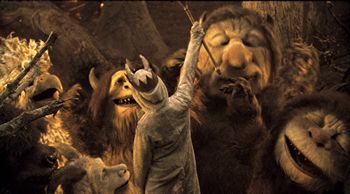
The film is an extraordinary merger of live action, state-of-the-art puppetry
and computer animation, putting Max directly into the company of nine-foot-tall
monsters in all their fanged, tufted, striped and wide-eyed glory,
simultaneously ferocious and endearing.
The beasts were given heart and soul by voice performances from a stellar
ensemble cast led by Lauren Ambrose, Chris Cooper, James Gandolfini, Catherine
O'Hara and Forest Whitaker, then put through their paces on location by costumed
actors who melded body language to the dialogue. Finally, their already
expressive faces were digitally enhanced for the range of movement and subtlety
their thoughts and actions required.
Says Jonze, "I knew it was going to be a complicated process. It seemed that
every choice we made turned out to be the hardest possible way to do it.
Building the creatures alone took eight months. But we decided what we wanted it
to feel like and worked backwards from there on how to achieve that, and stuck
to it."
Producer Landay, integral to the daily hands-on effort and the master plan,
admits, "I'm pretty tenacious. I feel if something's not happening it's because
we didn't try hard enough or we didn't look into enough ways to make it happen.
The only way to get through something this massive is to break it down and solve
each component, step by step. It's all a puzzle, and making movies is just a
gigantic crossword. Luckily, we've built a great team over the years, with a
strong vocabulary."
In addition to Landay, who worked with Jonze on both "Being John Malkovich" and
"Adaptation," Jonze's creative team on "Where the Wild Things Are" reunited many
of his longtime colleagues, including cinematographer Lance Acord, production
designer K.K. Barrett, editor Eric Zumbrunnen and costume designer Casey Storm.
He also re-enlisted the musical talents of former collaborators Karen O and
Carter Burwell.
Max is the Heart of the Movie
Casting for the lead role of Max was crucial. It involved a search of more than
a year and spanned continents, as the filmmakers employed not only standard
methods with casting agents but also reached out personally to friends and
colleagues who might know of a youngster who fit the criteria.
"I wanted a real kid--not necessarily an actor who was going to give a 'movie
kid' performance, but someone who was going to give a real, emotional
performance," says Jonze, who goes on to concede, "As we progressed, it became
clear that it was going to be hard to get the two sides of Max in one kid. He
would have to be a really deep, internal kid, who had a lot going on in his
head. A close-up of him should reveal his thinking and feeling. Simultaneously,
we needed him at times to be totally out-of-his-head gleeful and wild. We could
find one or the other, but finding both was hard."
Jonze found this duality in a boy coincidentally named Max--Max Records. Not
entirely inexperienced in front of a camera, Records had appeared in a couple of
music videos. He and the director immediately connected. Says Landay, "It was
fascinating to see Spike work with him and basically channel Spike's inner Max
to him. He never compromised and said, 'Well, he's just nine, it's all I can get
out of him.' He expected as much out of him as he did from James Gandolfini."
Records' work on the film split into two phases: Max's home life, and then his
journey across the sea to confront the untamed wilderness.
"It's somewhat chaotic at home for Max, where a lot of things are out of his
control," says Eggers. "His parents are divorced, his sister has reached
adolescence and is sort of abandoning him for other interests. He reaches a
point where all these people are too busy to see that he needs attention so he
puts on his wolf suit and goes charging around the house. The next thing you
know, he's running out the door."
These early scenes offer a sense of the myriad questions, as well as the
creative impulses, frustrations and powerful emotions that might collide in the
active mind of a young boy trying to get a handle on the world and his place in
it--and the reasons why, oftentimes, a child might yearn for a world where he's
in charge.
As part of his preparation, Jonze sought to get to the bottom of children's
genuine concerns from their own point of view, saying, "I interviewed a lot of
kids to get inspiration and ideas. I talked to them about things that made them
angry, fights they had with their parents, how it makes them feel. It's
dramatic, when you're that age."
"When we shot the movie, I just let Max read the script once and said, 'I don't
want you thinking about it. I want you to just show up on the day and see what
you're going to find,'" Jonze offers his strategy. "I wanted it to be fresh. The
complexity of the dialogue is very demanding. To get these things to not just be
dialogue but to be really thought and felt and coming from a specific place, is
hard. What I was asking Max to do would be hard for an adult actor."
"Where the Wild Things Are" stars Catherine Keener as Max's loving but
stretched-to-the-limit single mother.
After wrapping her early scenes with Records, Keener, also an associate producer
on the film, remained onboard through a portion of the subsequent location shoot
in Australia to serve as Jonze's acting collaborator and extra set of eyes for
working with Max and the Wild Things. "The whole experience of working with Max
resonated very deeply with me," she says. "His naturalness and purity of spirit
really come through in every scene. It was months of hard work and he brought
joy to it all the time."
"Catherine helped me a lot," says Records. "For instance, there's a scene where
I go into my sister's room and I have to be really mad. Beforehand, Catherine
was getting me to scream. She got me to yell all the swears I could muster."
Records also had a mentor in Jonze, who soon learned that directing a youngster
required a different approach than he was accustomed to and was much more
physically taxing. "There was very little time to sit down. I was always running
around because working with Max has to be interactive," he says. "It wasn't just
like I could watch his takes and give him notes. I was always moving with him,
whether it was jumping up and down, or yelling, or talking to him to get a
reaction. Whatever it was, it was very interactive directing."
The lengths to which the director went to elicit reactions or guide Records
through a specific emotion became a memorable series of performances in their
own right that the young actor now recounts with delight. "He was doing all
these crazy stunts. He had these big flamethrowers going off behind the camera
to make me scared. They hired a bunch of guys from a sideshow to do tricks, and
Spike learned fire-swallowing. The fire-swallowing thing really worked because
he wasn't very good at it. Spike's tricks really did make me feel scared at
times. The only drawback was that I wasn't scared I was going to get eaten by
the Wild Things; I was scared Spike was going to burn up his tongue."
Among the shoot's high points, Records cites Max's epic dirt clod battle with
the Wild Things as a personal favorite, especially as some of the action was
enhanced pyrotechnically. "One scene that was really fun was when I was running
through the forest. It's practically a minefield because all these dirt clods
are being thrown and just exploding on the ground. The special effects team had
hidden little explosives in the leaves and all around me was 'boom, boom,
boom.'"
Records' least-favorite scene was one in which Max must slide through the giant
mouth of one of the Wild Things and into its stomach to hide. The worst part
wasn't the tight fit or the heat, or even the cables strapped to his back; it
was being slathered in a gel he calls "the slime that smelled like rotten
lemons."
"I would always be inspired by Max. He worked really hard but he knew how to
have fun. No matter how hard the scene was, I'd come up to lunch and he'd have
his wolf suit off and be running around with the other kids. It helped me
remember that making movies is supposed to be fun," Jonze reveals. "I developed
a lot of different relationships on this movie but the one I had with Max was in
a class by itself. Max was my partner in making the heart of the movie come
through. He is the heart of the movie."
The Wild Things Find Their Voices and Reveal Their Personalities
Drawing greatly from the book's illustrations, Jonze and Eggers developed
Sendak's motley band of horned, clawed and hairy giants into a group of
individual personalities, each with his or her own impulses and motives. The
actors cast to voice the Wild Things were instrumental in forging their distinct
identities. They also focused on the ways in which the Wild Things interacted
with each other: at times bickering and conflicted, at other times playful and
comforting.
James Gandolfini portrays the powerful--and powerfully sensitive--de facto
leader of the pack, Carol. Lauren Ambrose is the free-spirited but somewhat
melancholy KW, who enjoys the group dynamic but also craves time alone. Chris
Cooper is the rooster-feathered Douglas, energetic and industrious. Catherine
O'Hara is the sarcastic, gloriously negative and domineering Judith; and Forest
Whitaker is Judith's modest and patient companion, Ira, who happens to be very
good at punching holes into things. Paul Dano is the diminutive goat-horned
Alexander, a mere eight feet tall, who often feels he's not taken seriously
enough.
"They're all meant to represent different things and be tangential relationships
with Max's world without being direct representations," Eggers explains. "We
didn't think of them as creatures, really. We thought of them as people the
entire time."
"Everything started with the voice actors," says Jonze, who eschewed the
traditional method of recording voice performances from lone actors in sound
booths, in favor of throwing them all together on stage to act out the entire
movie in a kind of physical pre-visualization. This way, their actions as well
as their voices were recorded. "We were going into a movie that incorporated
puppets and animation. Both those mediums are inherently not spontaneous. So we
decided to shoot the whole movie on a soundstage over two weeks. We needed the
spontaneity of what these incredible actors did in the moment."
At the same time, notes Chris Cooper, it was traditional in that "it was
actor-to-actor. I wore a microphone attached to a headband and was followed by a
boom mike. Everyone was outfitted in the same way. For each scene, Spike set up
the situation and we had the freedom of some improvisation. James and I, for
example, using the same space, were able to work off one another."
Having worked with Jonze before, Cooper cites their "built-in trust" and says,
"I came to the project ready to collaborate on bringing Douglas to life in a way
that was both true to the book and to Spike's vision of how film could expand
that character."
"There were more cameras than actors and we improvised all day around the
wonderful dialogue. Spike is an amazing and inventive director," says Catherine
O'Hara. "He doesn't take yes for an answer so he keeps working and playing and
working with you until...well, I'm still thinking about Judith!"
The set resembled a minimalist playground through which the actors padded around
shoeless to reduce extraneous sound as the action escalated. As Paul Dano points
out, "With the Wild Things, there's a juxtaposition between their size and
behavior. They seem like they'd be adults but they're very childlike. To capture
that, we did a lot of childish things to provoke each other. You get crazier and
funnier; you howl, you laugh. It's important not to break that energy once you
have it."
Foam cubes substituted for the trees, caves and boulders that would comprise the
landscape of the Wild Things' island home. The actors lobbed stale bread rolls
at each other to simulate the explosive dirt clod battle Jonze would later stage
on location with the fully-formed creatures. Forest Whitaker recalls, "It was an
all-encompassing experience, actively playing Ira and interacting with the other
actors--fighting with them, laughing and running with them, hitting them with
giant Styrofoam logs. It was a fun project and Spike was always so present, so
enthused."
Says James Gandolfini, "It was very physical. We were running around and beating
each other up and making ridiculous noises. In the end, it definitely got
everyone together as a group."
Revealing that it's Gandolfini's character, Carol, who forms the strongest and
most complex bond with Max, Jonze says, "He's kind of a leader but also very
sensitive. Understanding that the Wild Things symbolize the wildness of
emotions, I thought James would play that very well. There's something electric
about him. Sometimes I'd play the Max part with him and he'd pick me up. I put
him through the ringer in terms of the amount of takes we'd do or the amount of
times I'd come back in and try new dialogue."
"Spike really gets into it," Gandolfini responds. "He wants the performance to
be the best it can be so he's as adamant as I am about trying to make it better
and doing it as many times as it takes."
Reflecting on how the Wild Things represent feelings Max is just beginning to
comprehend, "the things we fear," Gandolfini says, "Carol can't find a place to
feel safe. He can't feel comfortable in a home because he always builds them and
then tears them down; he destroys things from the inside. That was one of the
aspects Spike and I discussed. It was all there in the writing, but it was just
a matter of making sure we got that side of Carol out."
Max also makes a special connection with the elusive KW, a character Lauren
Ambrose jokingly describes as looking "exactly like me, with the long red hair
parted down the middle. KW has sort of found her way to the outside of the pack
because she's protecting herself. She is often to the side, watching, and is
quite shy." As the story progresses, Max learns why. "But she opens her heart
because of Max's presence."
Another advantage to staging the vocal performance was how it later benefited
the Australian actors as they donned the gigantic costumes to physically animate
the Wild Things on location. Says Jonze, "The costumed actors would watch
footage from the voice recording and mirror what the voice actors did. They took
the essence of what they were doing and adapted it to what the costumes could
do."
"Knowing Spike was going to show this footage to the puppeteers, I wanted to
truly embody Ira as much as I could," says Forest Whitaker, who plays Ira. "One
of Ira's attributes is a big belly, and I wanted that to help me build the
character, to shape his attitude and performance." Toward that end, the actor
utilized a fat pad on stage to alter his gait appropriately. "I would move like
Ira and that would inform how I spoke as Ira. It not only put me into the right
frame of mind, it also affected how the others dealt with me. As the process
evolved, all the characters became more and more developed."
"It was interesting to see how the characters started from everything the voice
actors did," Jonze observes. "But it's a combination of what they did in
creating the roles, plus what the costumed actors did and what the animators did
with the facial performances. It was three totally disparate elements that make
one character."
"They roared their terrible roars and gnashed their terrible teeth
and rolled their terrible eyes and showed their terrible claws."
When it came to design, what mattered most about the Wild Things' big-screen
debut was that they had the depth of feeling, humor, ferocity and tenderness the
story required. They had to be alive.
Sendak was offered "the last word on what they looked like and how they moved.
Yet, at the same time, I didn't want to lock them into place so that they were
stuck rather than creatively excited by the prospect of what the monsters looked
like," the author said. "When I was doing the book, nobody bugged me. Nobody
said the monsters should look like this or that, because nobody knew what they
should look like."
Jonze and Landay first delved into the world of creature movies, the history of
suit performances and animatronics, to see what they liked or didn't like, and
why. It was hard to find a direct parallel. Research with designers and effects
companies turned up options that Jonze deemed "too troll-like or monster-like,"
or sometimes the opposite, "too cute." Repeatedly, they were advised toward full
CGI and cautioned that recreating the book's proportions in real space would be
a nearly insurmountable challenge. But they never gave up.
A friend referred them to artist Sonny Gerasimowicz, whose early sketches
conveyed the blend of humor, whimsy and pathos they were looking for. Together,
they experimented with color, textures and fur and from there moved into the
model stage.
The Jim Henson Company and its legendary Creature Shop in Los Angeles built and
refined the enormous costumes over a six-month period before shipping them to
Australia--at which point Sydney-based Dave Elsey and an Australian team of
costumers continued with on-site adjustments and reconfigurations to meet the
unique demands of location shooting, such as one Wild Thing hurling another into
the air--an effort involving wire work, pulleys and special rigs.
Peter Brooke, Creative Supervisor for the Creature Shop, begins, "We scanned the
maquette, then enlarged the head to actual size and modeled that in foam,
covered with clay. We re-sculpted the body of the maquette without fur, and were
left with the understructure. Then we enlarged the pattern off the maquette and
cut it out of foam. Within a week, we managed to get the basic shape and size of
the character."
Thinking from the inside out, he continues, "We tried to transfer most of the
weight of the costume to the hips of the performer. Basically, we approached the
project as if these were huge puppets that were going to be puppeteered from
inside, as opposed to thinking of them as huge costumes."
Elsey then adds, "Over the skeleton is the muscle suit, which gives the creature
shape. When the actors flex their arms the muscles actually flex; when they
lift, the rib cage will expand. That's what we call 'soft mechanics.'
Fabricating these things is a real art form. The actor inside has to be capable
of moving around and doing everything in the costume seemingly effortlessly.
'Soft mechanics' has been done before but this is on a whole different scale.
The costumes are an amazing combination of engineering and art."
The final touch was enabling the Wild Things' features to match their emotions.
Rather than using animatronic models, which would have caused lip-sync problems
due to the creatures' enormous mouths, Jonze opted to enhance their expressions
in post-production with computer animation, led by animation and visual effects
supervisor Daniel Jeannette.
Says Jeannette, "Even with the static images, you could already see a lot of the
impact they would have. We looked at the film and it was so beautiful we tried
to animate the faces without creating a completely CG version of them. Instead,
we did only the movement of the face in CGI."
Jonze clarifies, "Basically, they are creating 3D models of each creature's face
in the computer. They used wire frame models to animate; then, the animation of
those wire frames dictated the faces that were shot on camera. It's as if they
were able to slide that wire animation under the faces of the puppets. Then that
animation moved the fur on the faces that we shot on set."
"It looks real," Jeannette sums up, "because it's based on a real image."
One special costume that fell outside the purview of the Henson designers and
Dave Elsey was Max's second skin and alter ego: the wolf suit he wears while
making mischief at home and that later helps assert his animal nature over the
Wild Things. That suit--plus 56 individual versions of it--was provided by
costume designer Casey Storm, based on a drawing by Gerasimowicz that aged up
the footed pajamas of the book into something a boy of eight or nine might wear.
Storm's design included flocked whiskers, bendable ears, broken buttons, snaps
under the chin to keep Max's "head" on tight through the wildest of rumpuses,
and fingerless gloves.
Since Max is always in the wolf outfit, Records needed an entire wardrobe of
them in various stages of wear: some dirty and some pristine, some warmer and
others cooler in hue to match the tone of certain scenes and the camera's
different light filters.
"...and he came to the place where the Wild Things are."
"When you think of the setting for the characters in the book, they're in some
type of woods, on an island, a beach," says production designer K.K. Barrett,
marking his third collaboration with Jonze on "Where the Wild Things Are." "We
wanted the environment we put them in to be gritty and realistic, with natural
elements. We wanted it to feel like somewhere no one has visited before."
After considering places as diverse as Argentina, Hawaii, New Zealand,
California and the Southern U.S., the filmmakers found a home for the Wild
Things in the hills, quarries and shoreline areas of outer Melbourne, at the
southern tip of Australia. Here, says Jonze, "It felt like the edge of the
world, on this rocky cliff." The area's barren forest proved a perfect graphic
background for the action and suited the film's overall palette.
In keeping with the idea that they were discovering, along with Max, the
creatures' natural habitat, Jonze and director of photography Lance Acord gave
the island scenes a lived-in quality. Says Acord, "We needed a certain amount of
texture and lack of resolution, so we were under-exposing a fair amount and
letting the shadows go quite dark. The colors are less saturated than if you
have a sharp, high-contrast negative."
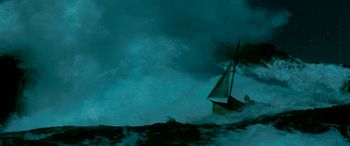
The downside of working in a place where your nearest neighbor is Antarctica is
that the production had to contend with bracing and often unpredictable winds
and a rough ocean, which Acord vividly recalls, describing a scene in which the
voyager Max pilots his boat alone toward the unknown shore. "I was shooting with
a hand-held in the back of the boat. Suddenly we heard people in the other
Zodiac yelling. A set of rogue waves was coming through, breaking at around 10
to 12 feet. They crashed over our boat and knocked the camera into the water. It
started dragging along the ocean floor and, unfortunately, it was tied around
the weight belt I had on, so was dragging me down with it. I struggled to get
the belt off before being drowned by my own camera."
Acord made maximum use of hand-held cameras throughout the shoot because, notes
Jonze, "We wanted it to feel as if this movie is being told through Max's eyes."
That point of view was a constant theme and extended to elements of production
design. Upon his arrival at the island, Max finds the Wild Things happily
demolishing their own homes, their immediate joy at wanton destruction
prevailing over their less-immediate need for a place to sleep. Later, as their
King, Max launches construction on the Ultimate Fort, in which they will all
live together. This meant Barrett had to design huts and a fort that that could
withstand some action but also look like something sprung from a child's
drawings and built by a crew of unskilled and impatient monsters.
After abandoning early attempts as too sophisticated, they finally hit upon the
perfect formula: a circle. "It took a long path to get to an idea that was
actually very simple," Jonze admits. "The round hut, the round door with the
round floor; there's no shape simpler than a circle." Adds Barrett, "The
circle-based bird's nest kept showing up in our sketches. We figured if a bird
could build it, they could build it. When you look at all the twigs and lines in
nests, and then look at Maurice's drawings, it just made sense."
At more than 40-feet high, the fort was a formidable undertaking. Twice. Says
Jonze, "We built two forts in Australia. The first one we built on the desert
location in order to shoot exterior shots and the second one was built on a
stage to shoot the interiors." Much of the physical fort was made of
gravity-defying molded foam, to offset the structure's outsized scale, and
painted to look like a weave of sticks, with actual sticks substituted in
close-up.
The production included upwards of 400 people working on three separate stages
and one location, with a shooting schedule divided between first unit, second
unit, reduced unit and puppet unit--all of which evolved on a daily basis.
New challenges arose regularly as might be expected while working in rough
terrain with actors navigating nine-foot costumes with giant heads. It took 45
minutes of prep time prior to each shot to clear a path the actor would then
tread on faith. "But," Jonze specifies, "you'd have to make a path that wouldn't
look like a path on camera, that looked just like the forest floor. We had to
fill in potholes, and all the roots and rocks would be taken out so there
wouldn't be anything to trip on."
On-set art director Tim Disney remembers some of the shoot's other inherent
challenges: "250 people's footprints in the sand dunes that had to be gone by
morning. Could we bring in choppers to 'buzz' them out? A hundred tons of kelp
was getting in the way of Max's island departure. Do we get boats to drag it
back into the ocean or pull it out? If Spike needed a forest down the side of a
mountain, he got it."
Music to Soothe the Savage Beast
Accompanying Max's discoveries on both a grand and an intimate scale is the
film's music, composed by Karen O and Carter Burwell. Jonze worked previously
with award-winning composer Burwell on "Being John Malkovich" and "Adaptation"
and with the Yeah Yeah Yeahs' Karen O on many music and film collaborations in
the past. He counts them both among the most intuitive and creative people he
has ever met.
Overall, suggests Jonze, "The music provides not so much a score as themes."
"I tried to follow Max on his emotional odyssey--never lead him," explains
Burwell. "This might mean, for instance, when he meets the Wild Things, moving
from curiosity to bluster to fear to wonder to triumph, all in a minute or two.
I certainly have seen that journey in the faces of my children."
"My job was to come up with simple, childlike melodies reminiscent of hooks of
great old pop songs that you can't shake, to shoot straight to the heart and be
the voice of Max on the inside," says Karen O, who assembled a group of
musicians she admires from various bands for the project. "We wrote the music
over a span of two years in five sessions. Writing to raw footage is freeing.
Without the constraints of an edited scene, we could really focus on the heart
of the feeling for the piece."
And heart, ultimately, is what "Where the Wild Things Are" is all about.
Says Jonze, "I love this book and have always loved this book, since I was a
kid. I didn't want to let Maurice down. His work is so important. He said, 'Make
a movie that's personal to you, make it your own.' Even so, he had lived with
the book as his creation for 40 years and that's a long time to live with
something. I wanted to really respect that and make a movie that felt true to
his values.
And that's what we did."

MAX RECORDS (Max) is twelve and has a wide range of interests: "Jesus
Christ Superstar," goat cheese, goofy bicycles, bass guitars, swordplay, "Star
Wars," text-messaging, ancient Egypt, waffles with fresh berries, and "The
Simpsons."
Through happenstance, at the age of eight, Records appeared in music videos for
Cake and Death Cab for Cutie. Records also recently appeared as a young Stephen
Bloom in "The Brothers Bloom."
He lives in Portland, Oregon.
CATHERINE KEENER (Mom) marks her third collaboration with Spike Jonze on
"Where the Wild Things Are." She earned an Academy Award® nomination for her
performance in the director's "Being John Malkovich," and went on to star in
"Synecdoche, New York" for director Charlie Kaufman, which Jonze produced.
Keener recently wrapped production on several feature films: Nicole Holofcener's
comedy "Please Give," opposite Oliver Platt and Rebecca Hall, about the
relationships between residents of a New York apartment building; the untitled
Duplas Brothers' Project, also starring Jonah Hill and Marisa Tomei; and Chris
Columbus' fantasy adventure "Percy Jackson & the Olympians: The Lightning
Thief."
Her additional film credits include Joe Wright's "The Soloist," opposite Robert
Downey Jr. and Jaime Foxx; Barry Levinson's "What Just Happened"; Andrew
Fleming's "Hamlet 2"; Tommy O'Haver's "An American Crime," opposite Ellen Page,
for which Keener received Golden Globe and Emmy nominations for Best Actress;
Sean Penn's "Into the Wild"; Nicole Holofcener's "Friends with Money," "Walking
and Talking" and "Lovely and Amazing," for which she received an Independent
Spirit Award nomination; and Bennett Miller's "Capote," starring opposite Philip
Seymour Hoffman, for which she received Academy Award® and Screen Actors Guild
Award® nominations for Best Supporting Actress and was named Best Supporting
Actress by the Toronto Film Critics Association. She has also appeared in Judd
Apatow's "The 40-Year-Old Virgin," opposite Steve Carell; Sydney Pollack's "The
Interpreter," with Sean Penn and Nicole Kidman; Rebecca Miller's "The Ballad of
Jack & Rose," opposite Daniel Day-Lewis; Spike Jonze's "Adaptation"; Andrew
Niccol's "S1m0ne"; Steven Soderbergh's "Full Frontal" and "Out of Sight"; Danny
DeVito's "Death to Smoochy"; Neil LaBute's "Your Friends & Neighbors"; and the
screen adaptation of Sam Shepard's "Simpatico." She has also appeared in four
films by Tom DiCillo: "Box of Moonlight," "Johnny Suede," "Living in Oblivion"
and "The Real Blonde."
Keener's television credits include HBO's critically acclaimed anthology "If
These Walls Could Talk," directed by Nancy Savoca, and a notable guest
appearance on "Seinfeld."
On stage, she starred opposite Edward Norton in the Signature Theatre Company's
critically acclaimed 2003 off-Broadway revival of Langford Wilson's "Burn This."
MARK RUFFALO (Boyfriend) will next be seen opposite Leonardo DiCaprio in
Martin Scorsese's thriller "Shutter Island." He also recently wrapped production
on his directorial debut, "Sympathy for Delicious," starring Orlando Bloom,
Laura Linney, Juliette Lewis and himself.
Ruffalo's recent projects include Rian Johnson's "The Brothers Bloom," with
Adrien Brody, Rachel Weisz and Rinko Kikuchi; Fernando Meirelles' "Blindness,"
which screened at the 2008 Cannes and the Toronto International Film Festivals;
"Reservation Road" which screened at the 2007 Toronto International Film
Festival; and "Zodiac," opposite Jake Gyllenhaal and Robert Downey Jr.
In 2006, he received a Tony Award nomination for his Broadway debut in the
Lincoln Center Theater's revival of Clifford Odets' "Awake and Sing!" with Ben
Gazzara, Zoe Wanamaker and Lauren Ambrose. The same year, Ruffalo appeared on
screen in "All the King's Men" with Sean Penn, Kate Winslet and Jude Law. The
film premiered at the 2006 Toronto International Film Festival. In 2005, he
starred opposite Reese Witherspoon in "Just Like Heaven," and the previous year
appeared in the Michael Mann directed "Collateral," opposite Tom Cruise. He
starred in and served as executive producer on the independent "We Don't Live
Here Anymore," which screened at the 2004 Sundance Film Festival and starred in
the romantic comedy "13 Going on 30." In 2004, he was seen in Charlie Kaufman's
"Eternal Sunshine of the Spotless Mind" and in 2003, starred in Jane Campion's
"In the Cut" and "My Life Without Me."
Ruffalo earned critical recognition in 2000 for his role in Kenneth Lonergan's
"You Can Count on Me," produced by Martin Scorsese, winning the Best Actor Award
at the 2000 Montreal Film Festival and the New Generation Award from the Los
Angeles Film Critics Association. His additional credits include "What Doesn't
Kill You," Brian Goodman's "The Last Castle," "Windtalkers," "XX/XY,"
"Committed," Ang Lee's "Ride With the Devil," "54" "Safe Men," "The Last Big
Thing," "Fish in the Bathtub," and Dan Bootzin's "Life/Drawing."
Ruffalo's acting roots lie in the theater, where he first gained attention
starring in the off-Broadway production of -"This is Our Youth," written and
directed by Kenneth Lonergan, for which he won a Lucille Award for Best Actor.
His theatrical recognition includes a Dramalogue Award and the Theater World
Award. In 2000, he was seen in the Off-Broadway production of James Lapine's
"The Moment When." Ruffalo trained with Joanne Linville at the distinguished
Stella Adler Conservatory. He made his stage debut in "Avenue A" at The Cast
Theater and went on to perform there in several of Justin Tanner's award-winning
plays, including "Still Life With Vacuum Salesman" and "Tent Show."
Also a writer, director and producer, Ruffalo co-wrote the screenplay for the
independent film "The Destiny of Marty Fine," which was first runner-up in the
1995 Slamdance Film Festival. In 2000, he directed Timothy McNeil's original
play "Margaret," at the Hudson Backstage Theatre in Los Angeles.
LAUREN AMBROSE (KW) most recently starred as Queen Marie in the Broadway
revival of Eugene Ionesco's tragicomedy "Exit the King," opposite Susan Sarandon
and Geoffrey Rush, directed by Neil Armfield. On screen, she starred with Paul
Giamatti, Emily Watson and David Strathairn in the metaphysical drama "Cold
Souls," which premiered at this year's Sundance Film Festival.
Ambrose recently completed production on "17 Photos of Isabel," opposite Natalie
Portman. Written and directed by Don Roos, the film follows an aspiring lawyer
through her difficult relationship with her stepson.
Her additional film credits include "A Dog Year," opposite Jeff Bridges;
"Starting Out in the Evening," opposite Frank Langella and Lili Taylor;
"Diggers," opposite Paul Rudd; and "Can't Hardly Wait." Ambrose won the Outfest
L.A. Grand Jury Award for Outstanding Actress for her lead performances in
"Swimming," a coming of age story, and the black comedy "Psycho Beach Party,"
adapted from Charles Busch's play.
Ambrose is most known for her critically acclaimed work as Claire Fisher on the
HBO series "Six Feet Under." During the show's five seasons, she received two
Emmy Award nominations for Outstanding Supporting Actress in a Drama Series,
2002 and 2003.
In April 2006, Ambrose made her Broadway debut in the Tony Award-winning
production of Clifford Odets' "Awake and Sing!" opposite Mark Ruffalo and Ben
Gazzara and directed by Bartlett Sher. In 2004, she made her stage debut at the
National Theatre in London in Sam Shepard's Pulitzer Prize-winning play "Buried
Child," directed by Matthew Warchus.
Ambrose currently resides in New York City.
CHRIS COOPER (Douglas) earned a 2003 Academy Award® and a Golden Globe
Award for Best Supporting Actor for his portrayal of John Laroche in
"Adaptation," written by Charlie Kaufman and directed by Spike Jonze. His
performance was also recognized by numerous critics' associations, including the
Broadcast Film Critics, the Los Angeles Film Critics Association and Toronto
Film Critics Association.
Cooper can currently be seen in "New York, I Love You," a collection of
vignettes from some of today's most imaginative filmmakers, including Shekhar
Kapur, Joshua Marston, Brett Ratner and Allen Hughes. He stars with Robin Wright
Penn, Ethan Hawke and Maggie Q in a storyline written and directed by Yvan Attal.
He recently completed production on Allen Coulter's romantic drama "Remember
Me," alongside Robert Pattinson and Pierce Brosnan, and earlier this year filmed
"The Company Men" with Ben Affleck, Kevin Costner and Tommy Lee Jones, for
writer/director John Wells--both scheduled for a 2010 release. Also in 2010, he
will star with Djimon Hounsou and Helen Mirren in Julie Taymor's version of "The
Tempest."
Cooper's recent film credits include a starring role in Peter Berg's "The
Kingdom"; "Married Life," which premiered at the International Toronto Film
Festival and also screened at the New York Film Festival; "Breach," directed by
Billy Ray; "Capote"; Sam Mendes' "Jarhead"; and "Syriana," for writer/director
Stephen Gaghan.
In 2005, Cooper re-teamed with director and friend John Sayles in "Silver City,"
a political drama and murder mystery that screened at the Toronto Film Festival.
He earned a Screen Actors Guild (SAG) Award® nomination for his role as the
trainer in Gary Ross' acclaimed 2003 drama "Seabiscuit" and, that same year,
earned an Emmy Award nomination for his performance in the HBO film "My House in
Umbria." He also appeared in "The Bourne Identity" and "The Bourne Supremacy,"
Roland Emmerich's epic "The Patriot," and the Farrelly brothers' comedy "Me,
Myself & Irene."
In 1999 Cooper received a SAG Award® for his supporting performance alongside
Kevin Spacey and Annette Bening in the Oscar®-winning film "American Beauty." He
also starred as the father of an amateur rocket enthusiast in the acclaimed
coming-of-age drama "October Sky," which earned great notices at the 1999 Venice
and Deauville Film Festivals. In 1997 he earned a Best Actor nomination from the
Independent Spirit Awards for his work in John Sayles' "Lone Star." Nearly a
decade earlier, Cooper made his feature film debut in Sayles' "Matewan." His
additional film credits include Robert Redford's "The Horse Whisperer," "Great
Expectations," "A Time to Kill," "Money Train," "This Boy's Life," "Guilty by
Suspicion" and "City of Hope."
On the small screen, Cooper has had roles in a number of notable longform
projects, including the miniseries "Lonesome Dove" and "Return to Lonesome
Dove." He most recently starred in HBO's "Breast Men," and includes among his
credits "Alone," "One More Mountain," "Ned Blessing," "Bed of Lies," "Darrow,"
"In Broad Daylight," "A Little Piece of Sunshine," "Law and Order" and "Journey
to Genius."
Born in Kansas City, Missouri, Cooper attended the University of Missouri School
of Drama and started his professional career on the New York stage. His theater
work includes "Of the Fields Lately," on Broadway, "The Ballad of Soapy Smith"
and "A Different Moon."
JAMES GANDOLFINI (Carol) has made his mark in a variety of motion picture
and television roles. He is currently on Broadway in the Tony Award-winning play
"God of Carnage," starring along side Marcia Gay Harden, Jeff Daniels and Hope
Davis.
Gandolfini's most recent films include director Tony Scott's "The Taking of
Pelham 123" and the independent feature "In the Loop."
On the small screen, he executive produced the Emmy-nominated HBO Documentary
Film "Alive Day Memories: Home from Iraq," a moving documentary that surveys the
physical and emotional cost of war through soldiers' memories of the day in
Iraq. Gandolfini conducted interviews in which the soldiers share their feelings
on their future, their severe disabilities and their devotion to the country. He
also starred in the HBO Emmy Award-winning drama "The Sopranos," as mob boss and
series lead Tony Soprano, earning three Emmy Awards and a Golden Globe Award for
Best Actor in a Drama Series. He also won four Screen Actors Guild Awards®,
including two for Outstanding Male Actor in a Drama Series and two shared with
"The Sopranos" cast for Outstanding Ensemble Cast.
Gandolfini's other films credits include "Romance & Cigarettes," in which he
starred opposite Susan Sarandon and Kate Winslet, directed by John Turturro with
Joel and Ethan Coen producing; "Lonely Hearts," with John Travolta and Salma
Hayek; director Steven Zaillian's "All the King's Men," starring opposite Sean
Penn and Jude Law; Mike Mitchell's "Surviving Christmas," opposite Ben Affleck;
the Coen brothers' "The Man Who Wasn't There"; "The Last Castle," directed by
Rod Lurie and starring Robert Redford; Gore Verbinski's "The Mexican," starring
Brad Pitt and Julia Roberts; Joel Schumacher's "8MM," with Nicolas Cage and
Joaquin Phoenix; Steven Zaillian's "A Civil Action," with John Travolta and
Robert Duvall; Peter Chelsom's "The Mighty," with Sharon Stone; Nick Cassavetes'
"She's So Lovely," starring Sean Penn and Robin Wright Penn; "Fallen," directed
by Gregory Hoblit, with Denzel Washington; Sidney Lumet's "Night Falls on
Manhattan," with Andy Garcia and Lena Olin; Brian Gibson's "The Juror," with
Alec Baldwin and Demi Moore; "Get Shorty," with Danny DeVito and John Travolta;
Tony Scott's "Crimson Tide," starring Gene Hackman and Denzel Washington;
"Angie," with Geena Davis; and his first Tony Scott picture, "True Romance,"
starring Christian Slater and Patricia Arquette.
Born in Westwood, New Jersey, Gandolfini graduated Rutgers University before
beginning his acting career in New York theatre. He made his Broadway debut in
the 1992 revival of "A Streetcar Named Desire," with Alec Baldwin and Jessica
Lange. He currently resides in New York.
CATHERINE O'HARA (Judith) most recently wrapped production on Mick
Jackson's biographical drama "Temple Grandin," with Claire Danes and Julia
Ormond, and the action comedy thriller "Killers," with Katherine Heigl, Ashton
Kutcher and Tom Selleck. Among her current and upcoming projects is a voice role
in the new animated Nick at Night series "Glenn Martin, DDS." Earlier this year,
she starred in the romantic comedy drama "Away We Go."
O'Hara won the 2007 National Board of Review Award for Supporting Actress for
her work in Christopher Guest's comedy "For Your Consideration." She previously
worked with Guest as a member of the ensemble casts of "A Mighty Wind," "Best in
Show" and "Waiting for Guffman."
Her earlier film work includes "After Hours," "Heartburn," "Beetlejuice" and the
first two "Home Alone" movies. O'Hara also worked on "Home Fries," "Orange
County," "Last of the High Kings," "The Life Before This" and "Penelope."
O'Hara first got into acting, writing, improvising, and directing with Toronto's
Second City Theatre and then, with fellow alumni, created the comedy show "SCTV,"
which is enjoying renewed success on DVD. O'Hara won an Emmy Award and earned
four additional Emmy nominations for her writing on the show.
She has also provided voices for characters in Tim Burton's "The Nightmare
Before Christmas" and for "Over the Hedge" and "Monster House."
FOREST WHITAKER (Ira) is one of Hollywood's most accomplished actors,
directors and producers. In 2007, after winning almost every critics' award,
Whitaker received Academy Award,® Golden Globe, SAG and BAFTA Awards for Best
Actor for his performance as Ugandan dictator Idi Amin in the historic drama
"The Last King of Scotland." Additionally, his independent film "American Gun,"
a movie in which he starred and produced, was nominated for an Independent
Spirit Award.
Among his upcoming projects is the highly anticipated "Repo Men," in which
Whitaker stars opposite Jude Law, set for 2010. He also served as an executive
producer of "Brick City," a six-part documentary about Newark, NJ, to air this
fall on the Sundance Channel. He recently wrapped filming Olivier Dahan's "My
Own Love Song," opposite Renee Zellweger; the Rick Famuyiwa comedy "Family
Wedding"; and "The Experiment," opposite Adrien Brody.
Whitaker made his film debut in 1982's "Fast Times at Ridgemont High," and in
1988 was named Best Actor at the Cannes Film Festival for his portrayal of jazz
legend Charlie Parker in Clint Eastwood's "Bird," a role for which he also
received a Golden Globe nomination. He played the title role of a spiritual
gangster in Jim Jarmusch's "Ghost Dog: The Way of the Samurai," nominated for an
Independent Spirit Award. The film's soundtrack was a co-venture with Whitaker's
own company, Spirit Dance. He then starred in, and executive produced "Green
Dragon," which won the Humanitas Award and the Audience Award at the South by
Southwest Film Festival.
His film credits include "Panic Room" and "Phone Booth," for which he was
nominated for an Image Award, and his roles in both films then earned him a
nomination for a Black Reel Award for Best Supporting Actor. His additional
credits include "The Great Debaters," "Vantage Point," "Street Kings," "The
Crying Game," "Fourth Angel," "A Little Trip to Heaven," "Mary," HBO's "Witness
Protection," "Light It Up," "Phenomenon," "Species," "Smoke," "Ready to Wear,
"Jason's Lyric," "Platoon," "Good Morning Vietnam," "Consenting Adults,"
"Stakeout," "The Color of Money," "Johnny Handsome," "Downtown," "Diary of a Hit
Man," "Body Snatchers," "Vision Quest," "Powder Blue" and, most recently,
"Hurricane Season" and "Fragments."
Whitaker made his feature directing debut with the box-office hit "Waiting to
Exhale." He first gained recognition as a director for the 1993 HBO original
"Strapped," for which he received the "Best New Director" honor at the Toronto
Film Festival. He also directed the romantic comedies "Hope Floats" and "First
Daughter."
Whitaker garnered two CableAce Award nominations for his performances in the
Showtime original film "Last Light," and HBO's "Criminal Justice," and received
SAG Award® nominations for "The Enemy Within" and Showtime's "Deacons for
Defense." He starred in and executive produced the miniseries "Feast of All
Saints," which won an Emmy Award and two additional nominations. He also
produced "Door to Door" for TNT under the Spirit Dance banner, which was
nominated for two Golden Globe Awards and an Emmy, and was honored by the
American Film Institute. Most recently, Whitaker earned critical attention for
his performance on "The Shield," as well as his Emmy-nominated guest appearances
on "ER."
In 2006, he received the Hollywood Actor of the Year Award at the 10th Annual
Hollywood Film Festival. In 2007, he received the American Riviera Award at the
Santa Barbara International Film Festival as well as the Cinema for Peace Award
and a star on the Hollywood Walk of Fame. An avid humanitarian, he is a
spokesperson for Hope North Orphanage in Northern Uganda and is involved with
Human Rights Watch. Last year, he participated in "Idol Gives Back," in
conjunction with Malaria No More. Also an animal rights activist, he has
provided assistance to PETA and Farm Sanctuary.
Whitaker resides in Los Angeles with his wife and children.
PAUL DANO (Alexander) next stars with Brian Cox in writer/director Dagur
Kari's 2009 Toronto Film Festival selection "The Good Heart," a character-driven
dramedy about an ailing misanthrope who takes a homeless kid (Dano) under his
wing to keep his New York bar in business. Earlier this year, Dano starred with
Zooey Deschanel in Matt Aselton's "Gigantic." He also served as an executive
producer on the film.
Most recently, Dano finished shooting "The Extra Man," Robert Pulcini and Shari
Springer Berman's eccentric comedy based on Jonathan Ames' popular novel. Kevin
Kline, Katie Holmes and John C. Reilly also star.
In 2007, Dano garnered a BAFTA nomination for Best Supporting Actor for his role
as the charismatic young preacher pitted against Daniel Day-Lewis's oil
prospector in "There Will Be Blood," Paul Thomas Anderson's adaptation of the
Upton Sinclair novel Oil! In 2006, he starred alongside Alan Arkin, Abigail
Breslin, Steve Carell, Toni Collette and Greg Kinnear in the Oscar®-nominated
box office hit "Little Miss Sunshine," directed by Jonathan Dayton and Valerie
Faris. His performance as an angst-ridden physical fitness/Nietzche devotee who
has taken a vow of silence earned him the Broadcast Film Critics Association
Award for Best Young Actor and an Independent Spirit Award nomination for Best
Supporting Actor. The ensemble earned a Screen Actors Guild Award® and a
Broadcast Film Critics Association Award.
Dano won an Independent Spirit Award for Best Debut Performance as a teenager
forced to navigate his adolescence virtually unsupervised in Michael Cuesta's
2001 coming-of-age drama "L.I.E." Additional film credits include a cameo in Ang
Lee's current "Taking Woodstock"; Rebecca Miller's "The Ballad of Jack and
Rose," with Daniel Day-Lewis and Catherine Keener; Richard Linklater's "Fast
Food Nation"; D.J. Caruso's "Taking Lives"; "The King," with Gael Garcia Bernal
and William Hurt; "Explicit Ills"; and "Weapons."
Dano began his career on the New York stage with supporting roles on Broadway in
"Inherit the Wind," opposite George C. Scott and Charles Durning, and "A
Christmas Carol," with Ben Vereen and Terrence Mann. He returned to the stage in
2007 with The New Group's off-Broadway production of "Things We Want," directed
by Ethan Hawke and co-starring Peter Dinklage, Josh Hamilton and Zoe Kazan.

SPIKE JONZE (Director/Screenwriter) is the versatile filmmaker behind
the acclaimed films "Being John Malkovich," for which he received an Academy
Award® nomination for Best Director, and "Adaptation," for which its three
stars--Nicolas Cage, Meryl Streep and Chris Cooper--received Academy Award®
nominations for their performances, with Cooper going on to win Best Supporting
Actor.
"Where the Wild Things Are" marks his third directorial feature. As a producer,
his credits include Michel Gondry's first film, "Human Nature," and frequent
collaborator Charlie Kaufman's directorial debut, "Synecdoche, New York." He is
also one of the creators and producers of the popular "Jackass" television show
and films.
Jonze has also directed music videos, commercials, short films, documentaries,
and is an accomplished photographer. He most recently co-directed "Tell Them
Anything You Want: A Portrait of Maurice Sendak," which will air in October on
HBO.
DAVE EGGERS (Screenwriter) is the author of six books, including his most
recent, Zeitoun, a non-fiction account of a Syrian-American immigrant and his
extraordinary experience during Hurricane Katrina, and What Is the What, a
finalist for the 2006 National Book Critics Circle Award. That book, about
Valentino Achak Deng, a survivor of the civil war in southern Sudan, gave birth
to the Valentino Achak Deng Foundation, run by Mr. Deng and dedicated to
building secondary schools in southern Sudan.
Eggers is the founder and editor of McSweeney's, an independent publishing house
based in San Francisco that produces a quarterly journal, the monthly magazine
The Believer, and Wholphin, a quarterly DVD of short films and documentaries.
In 2002, with Ninive Calegari, he co-founded 826 Valencia, a nonprofit writing
and tutoring center for youth in the Mission District of San Francisco. Local
communities have since opened sister 826 centers in Chicago, Los Angeles,
Brooklyn, Ann Arbor, Seattle, and Boston. In 2004, Eggers taught at the
University of California-Berkeley Graduate School of Journalism, and there, with
Dr. Lola Vollen, he co-founded Voice of Witness, a series of books using oral
history to illuminate human rights crises around the world.
A native of Chicago, Eggers graduated from the University of Illinois with a
degree in journalism. He lives in the San Francisco Bay Area with his wife and
two children.
TOM HANKS (Producer) is an award-winning actor as well as a writer,
producer and director. He holds the distinction of being the first actor in 50
years to be awarded back-to-back Best Actor Academy Awards: in 1993 as the
AIDS-stricken lawyer in "Philadelphia," and the following year in the title role
of "Forrest Gump." He also earned Golden Globe Awards for both performances,
along with his work in "Big" and "Cast Away."
In 1996, Hanks made his feature film writing and directing debut with "That
Thing You Do!." Hanks also served as an executive producer, writer, director and
actor for HBO's "From the Earth to the Moon," the Emmy Award-winning miniseries
that explored the entire Apollo space program. In 2000, he served as executive
producer, writer, and director for another epic HBO miniseries, "Band of
Brothers," based on Stephen Ambrose's book. The miniseries aired in fall 2001 to
wide-scale critical acclaim, leading to an Emmy and Golden Globe Award for Best
Miniseries in 2002.
In 2008, Hanks executive produced the critically acclaimed HBO miniseries "John
Adams," starring Paul Giamatti, Laura Linney and Tom Wilkinson. It won an Emmy
for Outstanding Miniseries and a Golden Globe for Best Miniseries. Other
producing credits include "The Polar Express," "My Big Fat Greek Wedding," "The
Ant Bully," "Charlie Wilson's War," "Mamma Mia!," "The Great Buck Howard,"
"Starter for 10," the HBO series "Big Love" and the upcoming HBO miniseries "The
Pacific."
Hanks most recently reprised his onscreen role Robert Langdon in Ron Howard's
thriller "Angels & Demons" and will next lend his voice to the character Woody
in "Toy Story 3," set for a 2010 release.
GARY GOETZMAN (Producer) counts among his producing credits "Mamma Mia!,"
"Charlie Wilson's War," "The Polar Express," "My Big Fat Greek Wedding," "The
Ant Bully," "That Thing You Do!," "The Silence of the Lambs" (winner of five
Academy Awards®, including Best Picture), "Philadelphia," "Devil in a Blue
Dress," "Beloved," "Miami Blues," "The Great Buck Howard," "Starter for 10,"
"Modern Girls," "Amos & Andrew," the Talking Heads' concert film "Stop Making
Sense," the 3-D IMAX film "Magnificent Desolation," the Emmy and Golden Globe-
nominated HBO series "Big Love," the Emmy and Golden Globe-winning miniseries
"John Adams," the Emmy and Golden Globe-winning miniseries "Band of Brothers,"
and the HBO miniseries event "The Pacific."
In 1998, Goetzman and Tom Hanks teamed to form PLAYTONE, a film and television
production company.
JOHN B. CARLS (Producer) is a producer with a rich history in family and
children's entertainment. In 1992, Carls formed Wild Things Productions (WTP)
with world-renowned author and illustrator Maurice Sendak. As partner and
president, Carls established WTP as a family entertainment content provider for
film and television.
In association with Nelvana Communications and Nickelodeon, WTP produced five
seasons and a direct-to-video movie of the Daytime Emmy-nominated children's
preschool animated television series "Maurice Sendak's Little Bear." WTP also
produced two seasons of the Daytime Emmy-nominated "George and Martha" for HBO,
which stars the voices of Nathan Lane and Andrea Martin. WTP and Nelvana
produced three seasons of the animated television series "Seven Little Monsters"
for PBS. Additionally, WTP and Carls are developing and producing several
television and feature film projects.
In 2002, Carls launched The Carls Company, developing both animated and
live-action projects for film and television. Working with comic strip creator
Steve Moore, Carls sold their animated feature film treatment "City Sewer" to
DreamWorks Animation, which became the basis for Aardman Animation's next film,
re-titled "Flushed Away." Carls and Moore followed up with a deal to develop and
produce the animated film "Open Season," based on their original treatment,
which was released in September 2006 with Martin Lawrence and Ashton Kutcher
voicing the leads. They are currently working with Overbrook Entertainment on an
animated movie, "Gatoraid," in development at Sony Pictures. For television,
Carls and Moore produced a series of animated shorts for ESPN based on Moore's
comic strip "In the Bleachers," and are currently creating and producing an
animated series, "Flat Stanley" for Starz Entertainment and Working Title Films.
Carls is actively developing and producing a slate of new animated feature
films. Currently in production is "Rango," ILM's first full-length animated
movie with director Gore Verbinski. Additional projects are in development with
Laika, Sony Animation, and Playtone Productions.
Prior to forming WTP and The Carls Company, John Carls held executive positions
at Orion Pictures and Columbia Pictures.
MAURICE SENDAK (Author/Producer) has, for more than forty years, written
and illustrated books which have nurtured children and adults alike and have
challenged established ideas about what children's literature is and should be.
Winner of the 1964 Caldecott Medal for Where the Wild Things Are, in 1970 Sendak
became the first American illustrator to receive the international Hans
Christian Andersen Award, recognition of his entire body of work. In 1983, he
received the Laura Ingalls Wilder Award from the American Library Association,
also for his body of work.
Beginning in 1952, with A Hole Is to Dig, by Ruth Krauss, Sendak's illustrations
have enhanced many texts by other writers, including the Little Bear books by
Else Holmelund Minarik, children's books by Isaac Bashevis Singer and Randall
Jarrell, and The Juniper Tree and Other Tales from Grimm. Dear Mili, Sendak's
interpretation of a newly discovered tale by Wilhelm Grimm, was published to
extraordinary acclaim in 1988.
In addition to Where the Wild Things Are (1963), Sendak has both written and
illustrated The Nutshell Library (1962), Higglety Pigglety Pop! (1967), In the
Night Kitchen (1970), Outside Over There (1981), and We Are All in the Dumps
with Jack and Guy (1993). He illustrated Swine Lake (1999), authored by James
Marshall.
Since 1980, Sendak has designed the sets and costumes for highly regarded
productions of Mozart's "The Magic Flute" and "Idomeneo," Janacek's "The Cunning
Little Vixen," Prokofiev's "The Love for Three Oranges" and Tchaikovsky's "The
Nutcracker."
In 1990, Sendak founded The Night Kitchen, a national theater company devoted to
the development of quality productions for children. In 1997, he received the
National Medal of Arts from President Clinton and, in 2003, the first Astrid
Lindgren Memorial Award, an international prize for children's literature
established by the Swedish government.
Sendak was born in Brooklyn in 1928. He now lives in Connecticut.
VINCENT LANDAY (Producer) has spent the last 16 years producing with
director Spike Jonze, a collaboration that has been fruitful ever since its
start. Music videos for bands such as Bjoerk, Weezer, Fatboy Slim & the Yeah
Yeah Yeah's and commercials for Nike, Ikea & Levis have lead to numerous awards
including those from MTV, the Grammys, the Emmys, the Museum of Modern Art and
the Cannes Film Festival. Landay produced the acclaimed Directors Label DVD
Series that featured collected short form work of Jonze, Chris Cunningham and
Michel Gondry.
In 1999, Landay produced Jonze's debut feature film, "Being John Malkovich,"
which received Academy Award and Golden Globe nominations and won awards
including the Producers Guild, BAFTA, Independent Spirit and MTV Movie Awards.
In 2003 Landay produced "Adaptation," Jonze's second feature film, which also
marked his second time working with screenwriter Charlie Kaufman. The film's
three stars--Nicolas Cage, Meryl Streep and Chris Cooper--received Academy
Award® nominations for their performances, with Cooper going on to win Best
Supporting Actor. "Where the Wild Things Are" is Landay's third feature film
with Spike Jonze.
Jonze and Landay recently completed the documentary "Tell Them Anything You
Want: A Portrait of Maurice Sendak," that Jonze co-directed with Lance Bangs,
which will premiere at the Museum of Modern Art and air on HBO. They are
currently finishing a new short film directed by Jonze, entitled "I'm Here," and
together are producing a short film adaptation of Maurice Sendak's Higglety
Pigglety Pop, by directing team Clyde Henry.
THOMAS TULL (Executive Producer) is the Chairman and CEO of Legendary
Pictures, a private equity-backed film production company with more than $1.5
billion in total financing. Legendary Pictures' current deal, through which it
co-produces and co-finances films with Warner Bros. Pictures, runs through 2012.
Since its inception in 2005, Legendary has joined with Warner Bros. to make such
successful films as "Superman Returns," "Batman Begins," the blockbuster "300,"
"Watchmen," the record-breaking, award-winning film phenomenon "The Dark
Knight," which has earned in excess of $1 billion worldwide, and the recent
runaway hit comedy "The Hangover." Upcoming releases in the partnership include
"Ninja Assassin," opening in November 2009, as well as "Clash of the Titans" and
"Jonah Hex," all scheduled for a 2010 release.
Legendary Pictures is also developing a number of film projects in-house,
including "Paradise Lost"; "Warcraft," to be directed by Sam Raimi; "Kung Fu";
"The Mountain"; and "The Lost Patrol."
Tull is a member of the Board of Trustees of the American Film Institute (AFI)
and the Board of Directors of Hamilton College, his alma mater. He serves on the
Board of the Fulfillment Fund and is a board member of the San Diego Zoo.
JON JASHNI (Executive Producer) is the Chief Creative Officer of
Legendary Pictures and is currently overseeing the development and production of
such films as "Clash of the Titans," "Warcraft" and "Gears of War." He most
recently served as executive producer on Todd Phillips' blockbuster hit "The
Hangover," as well as the action thriller "Ninja Assassin," set for a November
2009 release.
Prior to joining Legendary, Jashni was President of Hyde Park Entertainment, a
production and financing company with overall deals at 20th Century Fox, Disney
and MGM. While there, he oversaw the development and production of "Shopgirl,"
"Dreamer: Inspired by a True Story," "Walking Tall" and "Premonition."
Before joining Hyde Park in 2002, Jashni was a producer of director Andy
Tennant's smash hit romantic comedy "Sweet Home Alabama." The film set the
record for the highest-grossing September opening ever and went on to earn $140
million domestically.
Jashni's collaboration with Andy Tennant began with the $100 million-grossing
fairytale "Ever After," on which Jashni oversaw the development and production
as a 20th Century Fox senior production executive.
Jashni has co-produced two films that have received a total of three Academy
Award® nominations. The critically acclaimed "The Hurricane" garnered a Best
Actor nomination for its star, Denzel Washington, and "Anna and the King,"
directed by Andy Tennant, earned two nominations and grossed over $125 million
worldwide.
Earlier in his career, Jashni partnered with Irving Azoff in the Warner Bros.
Pictures-based production company Giant Pictures. Their association resulted in
the production of the aforementioned "The Hurricane," "Jack Frost" and "The
Inkwell."
Jashni joined with Azoff after a stint as a Columbia Pictures production
executive, where he was involved in the development and production of such films
as "Groundhog Day," "Bram Stoker's Dracula," "Mo' Money," "Stephen King's
Sleepwalkers" and "Fools Rush In."
Jashni began his career at Daniel Melnick's The IndieProd Company, where he was
involved in the production of "Air America," "Mountains of the Moon," "Roxanne"
and "Punchline."
BRUCE BERMAN (Executive Producer) is Chairman and CEO of Village Roadshow
Pictures. The company has a successful joint partnership with Warner Bros.
Pictures to co-produce a wide range of motion pictures, with all films
distributed worldwide by Warner Bros. and in select territories by Village
Roadshow Pictures.
The initial slate of films produced under the pact included such hits as
"Practical Magic," starring Sandra Bullock and Nicole Kidman; "Analyze This,"
teaming Robert De Niro and Billy Crystal; "The Matrix," starring Keanu Reeves
and Laurence Fishburne; "Three Kings," starring George Clooney; "Space Cowboys,"
directed by and starring Clint Eastwood; and "Miss Congeniality," starring
Sandra Bullock and Benjamin Bratt.
Under the Village Roadshow Pictures banner, Berman has subsequently executive
produced such wide-ranging successes as "Training Day," for which Denzel
Washington won an Oscar®; "Ocean's Eleven" and its sequels, "Ocean's Twelve" and
"Ocean's Thirteen"; "Two Weeks' Notice," pairing Sandra Bullock and Hugh Grant;
Eastwood's "Mystic River," starring Sean Penn and Tim Robbins in Oscar®-winning
performances; "The Matrix Reloaded" and "The Matrix Revolutions"; Tim Burton's
"Charlie and the Chocolate Factory," starring Johnny Depp; the Oscar®-winning
animated adventure "Happy Feet"; the blockbuster "I Am Legend," starring Will
Smith; the hit comedy "Get Smart," teaming Steve Carell and Anne Hathaway; the
romantic drama "Nights in Rodanthe," starring Richard Gere and Diane Lane; the
comedy "Yes Man," starring Jim Carrey; and, most recently, Clint Eastwood's
acclaimed drama "Gran Torino."
Village Roadshow's upcoming film projects include director Guy Ritchie's action
adventure mystery "Sherlock Holmes," starring Robert Downey Jr. as the legendary
detective, with Jude Law and Rachel McAdams.
Berman got his start in the motion picture business working with Jack Valenti at
the MPAA while attending Georgetown Law School in Washington, DC. After earning
his law degree, he landed a job at Casablanca Films in 1978. Moving to
Universal, he worked his way up to production Vice President in 1982.
In 1984, Berman joined Warner Bros. as a production Vice President, and was
promoted to Senior Vice President of Production four years later. He was
appointed President of Theatrical Production in September 1989 and, in 1991, was
named President of Worldwide Theatrical Production, where he served through May
1996. Under his aegis, Warner Bros. Pictures produced and distributed such films
as "Presumed Innocent," "GoodFellas," "Robin Hood: Prince of Thieves," the
Oscar®-winning Best Picture "Driving Miss Daisy," "Batman Forever," "Under
Siege," "Malcolm X," "The Bodyguard," "JFK," "The Fugitive," "Dave,"
"Disclosure," "The Pelican Brief," "Outbreak," "The Client," "A Time to Kill"
and "Twister."
In May of 1996, Berman started Plan B Entertainment, an independent motion
picture company at Warner Bros. Pictures. He was named Chairman and CEO of
Village Roadshow Pictures in February 1998.
LANCE ACORD (Director of Photography) was raised in Northern California,
and studied photography and filmmaking at the San Francisco Art Institute.
Following graduation, he began his professional career working with acclaimed
photographer and filmmaker Bruce Weber on documentaries, commercials and music
videos.
Over the next ten years, Acord's talent led him to the top of the commercial and
music video industries, where he teamed with such innovative directors as Michel
Gondry, Stephane Sednaoui, Jonathan Dayton and Valerie Faris, Mark Romanek,
Peter Care and Spike Jonze.
Combining the expressive cinematographic technique of his commercials and music
videos with narrative filmmaking, Acord crossed over to feature films. He served
as director of photography on the strikingly visual "Buffalo 66," and soon
followed with the offbeat hit "Being John Malkovich," directed by his longtime
collaborator Spike Jonze.
Acord's other notable feature credits include "The Dangerous Life of Altar
Boys," for director Peter Care; "Adaptation," directed by Jonze and written by "Malkovich"
scribe Charlie Kaufman; the Academy Award®-winning "Lost in Translation,"
directed by Sofia Coppola, for which Acord earned a 2004 BAFTA Award nomination;
and "Marie Antoinette," also directed by Coppola.
K.K. BARRETT (Production Designer) earned a BAFTA Award nomination for
his work on Sofia Coppola's biographical drama "Marie Antoinette." He also
collaborated with Coppola on the Oscar®-winning "Lost in Translation"; with
director David O. Russell on the comedy "I ♥ Huckabees"; and with Michel Gondry
on his film "Human Nature".
"Where the Wild Things Are" continues Barrett's collaboration with Spike Jonze.
Previously, the two worked together on the award-winning feature "Being John
Malkovich" and "Adaptation," as well as two Silver Clio Award-winning
commercials for Nissan ("Lazy Boy Chair") and Sprite ("Sun Fizz"), a memorable
Levi's commercial ("Hospital"/ "Tainted Love"), and Jonze's music videos.
Barrett co-directed, with Lance Bangs, a concert film for the musical group Yeah
Yeah Yeahs, "IsIs," and also designed stage sets for their 2009 tour.
Barrett has twice been honored with the MTV Video Music Award for Best Art
Direction: for Beck's "New Pollution" in 1996 and for Smashing Pumpkins'
"Tonight, Tonight" in 1997. His extensive commercial credits include spots for
Lexus, Disney, Budweiser, Revlon, Zune, Puma and Mountain Dew, and he has worked
with such notable directors as Jonathan Dayton & Valerie Faris, Rupert Sanders,
Roman Coppola, Mike Mills, Patrick Daughters, Stephane Sednaoui, Simon West,
Mark Romanek, Lance Acord, Jeff Preiss and Herb Ritts.
ERIC ZUMBRUNNEN (Editor) got his start editing music videos for such
artists as Jane's Addiction, Beastie Boys, Smashing Pumpkins, Bjoerk, Weezer,
Fat Boy Slim and Beck. During that period he earned two MTV Music Video Awards
for Best Editing and developed a working partnership with such directors as
Jonathan Dayton and Valerie Faris, who directed "Little Miss Sunshine," and
Spike Jonze.
Zumbrunnen successfully transitioned to feature films with Jonze's "Being John
Malkovich," which received three Academy Award® nominations and earned
Zumbrunnen a BAFTA nomination and an ACE Award for Best Edited Feature Film.
Jonze and Zumbrunnen subsequently collaborated on the feature "Adaptation,"
which received four Academy Award® nominations and netted another ACE nomination
for editing.
JAMES HAYGOOD (Editor) began working with David Fincher in San Francisco
in 1985 when Fincher left ILM to direct music videos. After relocating to Los
Angeles in 1989, Haygood continued working on music videos with Fincher and
other directors, for such artists as Madonna, Aerosmith, Paula Abdul and The
Rolling Stones, receiving two MTV Awards, a Clio Award and numerous other
industry accolades.
In 1992, Haygood launched Superior Assembly, a commercial editing company, which
created TV spots for clients including Nike, Coca-Cola, AT&T and Nissan. He left
the company in 2001, and now is a partner at Union Editorial in Los Angeles.
In 1997, he edited his first feature film for Fincher, the action thriller "The
Game," and continued his collaboration with the acclaimed director on the hit
films "Fight Club" and "Panic Room." Haygood then worked as an additional editor
on "Eternal Sunshine of the Spotless Mind"; edited six episodes of the HBO
series "Unscripted," for director George Clooney; and cut the independent
feature "Lies & Alibis," for directors Kurt Matilla and Matt Chekowski. His most
recent feature credit was the Polish Brothers' 2007 adventure comedy "The
Astronaut Farmer," starring Billy Bob Thornton.
Among Haygood's upcoming projects is the sci-fi thriller "Tron Legacy," set for
a 2010 release.
KAREN O (Music), known for groundbreaking fashion and a captivating stage
presence and voice, has fronted the Yeah Yeah Yeahs since 2000. The New York
Times called the band's 2003 Grammy Award-nominated album "Fever to Tell" (Interscope/Fiction)
the best album of the year and SPIN magazine named their latest full-length
album, "It's Blitz!," (DGC/Interscope) the alternative pop album of the decade.
CARTER BURWELL (Music) graduated from Harvard College in 1977. While at
Harvard he studied animation with Mary Beams and George Griffin, electronic
music with Ivan Tcherepnin, and pursued a course of independent study at the MIT
Media Lab (then known as the Architecture Machine Group). After graduation he
became a teaching assistant in the Harvard Electronic Music Studio.
In 1979, Burwell's animated film "Help, I'm Being Crushed to Death by a Black
Rectangle" won first place at the Jacksonville Film Festival and second place at
the Ottawa International Animation Festival. He subsequently worked as Chief
Computer Scientist at Cold Spring Harbor Laboratory in Long Island, where he
wrote software for image processing, lab automation and protein analysis.
From 1982 to 1987 he worked at the New York Institute of Technology, beginning
as a computer modeler and animator and rising to the position of Director of
Digital Sound Research. During this time he worked on many computer-animated
television spots and films, ultimately contributing models and animation to the
Japanese anime "Lensman."
During the 1980s, Burwell pursued a parallel career in music, playing with a
number of bands in New York City, particularly The Same, Thick Pigeon and
Radiante. He also wrote music for dance, notably RAB, which premiered at the
Avignon Festival in 1984; theatre, "The Myth Project," at Naked Angels in 1989;
and film, including "Blood Simple, "Psycho III" and "Raising Arizona."
He went on to score numerous feature films, including "Miller's Crossing,"
"Barton Fink," "The Hudsucker Proxy," "Rob Roy," "Fargo," "Conspiracy Theory,"
"The Spanish Prisoner," "Gods and Monsters," "Three Kings," "Being John
Malkovich," "Before Night Falls," "The Man Who Wasn't There," "Adaptation,"
"Intolerable Cruelty," "Kinsey," "Before the Devil Knows You're Dead," "Burn
After Reading" and "Twilight." Simultaneously, he taught and continued to
compose dance and theatrical projects, most notably "The Return of Lot's Wife,"
"Cara Lucia" and "Theater of the New Ear."
CASEY STORM (Costume Designer) marks his third feature collaboration with
Spike Jonze on "Where the Wild Things Are." Previously, he designed the costumes
for Jonze's acclaimed films "Being John Malkovich" and "Adaptation," as well as
the 1999 comedy short mockumentary "Torrance Rises," for directors Jonze and
Lance Bangs.
Most recently, Storm worked on David Fincher's crime drama "Zodiac," as well as
the award-winning comedy short "Pol Pot's Birthday" and the 2009 short "See You
in My Nightmare," featuring Kanye West. His designs also appeared in the
television pilot for "Cavemen."
For the 1997 comedy short "How They Get There," directed by Spike Jonze and
written by Jonze and Mark Gonzales, Storm served as both costume designer and
production designer.
His career includes work on a wide range of music videos for artists including
Michael Jackson, Metallica, Beck, The Cure, Beastie Boys, Bjoerk, The Chemical
Brothers, Elastica, Fatboy Slim, Weezer, the Yeah Yeah Yeahs, Def Leppard, Faith
No More, Puff Daddy and Notorious B.I.G., to list only a few. He has also
designed the wardrobe for more than 100 commercials, for clients such as Nike,
Levi's, BMW, Cadillac, Ford, Adidas, Van's, Sony PlayStation, SEGA, 7-UP, Bud
Light, Dominos, Johnnie Walker, AT&T, Coca-Cola and MasterCard.
Storm won the 2009 Costume Designers Guild Award for the "White Gold" series of
Milk commercials. He was previously nominated for a CDA for his work on Geico's
"Cavemen."


(C) MBN 2009