
WALL-E
WALL•E

ABOUT THE PRODUCTION
What if mankind had to leave Earth
and somebody forgot to turn off the last robot?
That’s the intriguing and whimsical premise posed by Disney•Pixar’s extraordinary new computer-animated comedy set in space, “WALL•E.” Filled with humor, heart, fantasy, and emotion, “WALL•E” takes moviegoers on a remarkable journey across the galaxy and once again demonstrates Pixar’s ability to create entire worlds and set new standards for storytelling, character development, out-of-this-world music composition, and state-of-the-art CG animation.


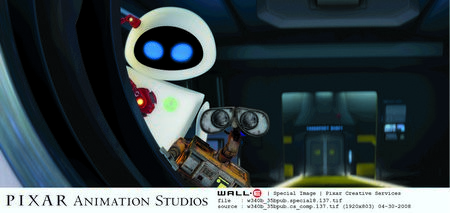
Set in a galaxy not so very far away, “WALL•E” is an original and exciting comedy about a determined robot. After hundreds of lonely years doing what he was built for, WALL•E (Waste Allocation Load Lifter Earth-Class) discovers a new purpose in life (besides collecting knickknacks) when he meets a sleek search robot named EVE (Extra-terrestrial Vegetation Evaluator). EVE comes to realize that WALL•E has inadvertently stumbled upon the key to the planet’s future and races back to space to report her findings to the humans who have been eagerly waiting aboard the luxury spaceship Axiom for news that it is safe to return home. Meanwhile, WALL•E chases EVE across the galaxy and sets into motion one of the most incredible comedy adventures ever brought to the big screen.

Joining WALL•E on his fantastic journey across the universe 800 years into the future is a hilarious cast of characters, including a pet cockroach and a heroic team of malfunctioning misfit robots.

The ninth feature from Disney and Pixar Animation Studios, “WALL•E” follows the studio’s most recent triumph, “Ratatouille,” which won an OscarÆ for Best Animated Feature, garnered the best reviews for any 2007 release, and was a box-office hit all over the globe. The combined worldwide box-office gross for Pixar’s first eight releases is an astounding $4.3 billion.
“WALL•E” is the latest film from Academy AwardÆ-winning director/writer Andrew Stanton, who joined Pixar in 1990 as its second animator and the fledgling studio’s ninth employee. He was one of the four screenwriters to receive an Oscar nomination in 1996 for his contribution to “Toy Story” and was credited as a screenwriter on subsequent Pixar films, including “A Bug’s Life,” “Toy Story 2,” “Monsters, Inc.,” and “Finding Nemo,” for which he earned an Oscar nomination as co-writer. Additionally, he co-directed “A Bug’s Life,” executive-produced “Monsters, Inc.” and the 2007 Academy AwardÆ-winning “Ratatouille,” and won an Oscar for Best Animated Feature for “Finding Nemo.”

Disney•Pixar’s “WALL•E,” directed by Andrew Stanton from an original story by Stanton and Pete Docter and a screenplay by Stanton and Jim Reardon, is executive-produced by John Lasseter and produced by Jim Morris (“Star Wars: Episode I” and “Episode II,” “Pearl Harbor,” “The Abyss,” and three of the “Harry Potter” films), who helped create some of the industry’s groundbreaking visual effects during his 18-year association with ILM as president of Lucas Digital. Lindsey Collins, an 11-year Pixar veteran, serves as co-producer; Thomas Porter is associate producer. OscarÆ-winning cinematographer Roger Deakins serves as visual consultant.
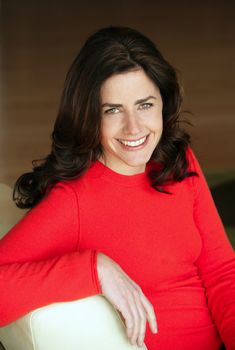
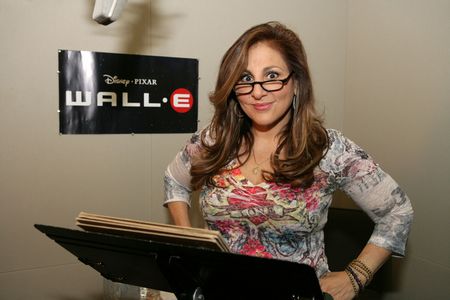
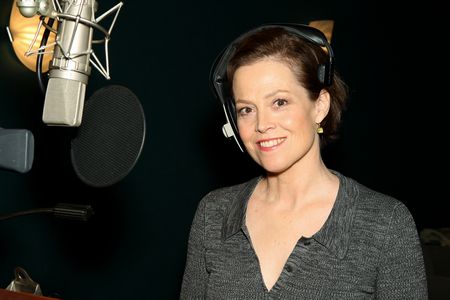
The voice cast includes funnyman Jeff Garlin (“Curb Your Enthusiasm”), Pixar veteran John Ratzenberger (“Cheers,” “Ratatouille,” “Toy Story”), actress Kathy Najimy (“Sister Act,” “King of the Hill”), stage and film star Sigourney Weaver (“Alien,” “Gorillas in the Mist,” “Baby Mama”), and acclaimed four-time OscarÆ-winning sound designer Ben Burtt (“E.T.: The Extra-Terrestrial,” “Indiana Jones and the Last Crusade”). Comedian Fred Willard (“Best in Show,” “Back to You”) also appears in the film.
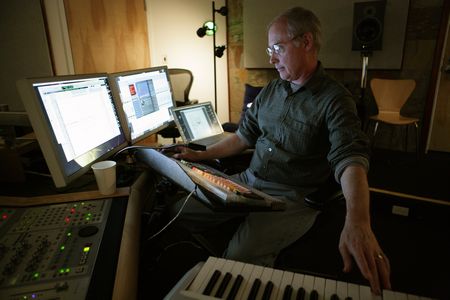
WALL•E’s expressive range of robotic voices was created by Burtt, whose memorable work includes creating the “voices” of other legendary robots, such as R2-D2 (from the “Star Wars” films). Drawing on 30 years of experience as one of the industry’s top sound experts, Burtt was involved from the film’s earliest stages in creating an entire world of sound for all of the robotic characters and the spacecraft, as well as all environments.
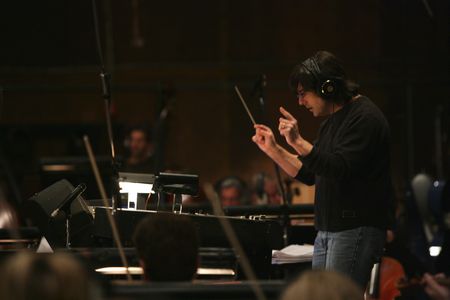
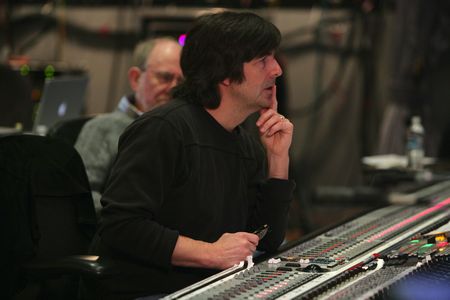
The original score for “WALL•E” is composed by eight-time OscarÆ nominee Thomas Newman, who had previously worked with Stanton on “Finding Nemo.” Rock-and-roll legend Peter Gabriel collaborated with Newman on an original song called “Down to Earth.” Gabriel wrote the lyrics for this captivating and clever musical epilogue and performed the song as well.
OUT TO LUNCH:
PIXAR PIONEERS CHEW ON NEW FILM CONCEPTS—
A ROMANTIC ROBOT BEGINS TO TAKE SHAPE
The idea for “WALL•E” came about in 1994 at a now-famous lunch that included Pixar pioneers Stanton, John Lasseter, Pete Docter, and the late storytelling genius Joe Ranft. With their first feature, “Toy Story,” in production, the group suddenly realized that they might actually get a chance to make another movie. At that fateful gathering, the ideas for “A Bug’s Life,” “Monsters, Inc.,” and “Finding Nemo” were first discussed. “One of the things I remember coming out of it was the idea of a little robot left on Earth,” says Stanton. “We had no story. It was sort of this Robinson Crusoe kind of little character—like, what if mankind had to leave Earth and somebody forgot to turn the last robot off, and he didn’t know he could stop doing what he’s doing?”
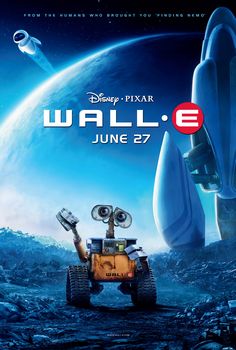
Years later, the idea took shape—literally. “I started to just think of him doing his job every day and compacting trash that was left on Earth,” Stanton recalls. “And it just really got me thinking about what if the most human thing left in the universe was a machine? That really was the spark. It has had a long journey.”
Stanton says he was heavily influenced by the sci-fi films of the 1970s. “Films like ‘2001,’ ‘Star Wars,’ ‘Alien,’ ‘Blade Runner,’ and ‘Close Encounters’—they all had a look and feel to them that really transported me to another place, and I really believed that those worlds were out there,” he explains. “I haven’t seen a movie since then that made me feel that same way when we went out to space, so I wanted to recapture that feeling.”
In preparation for their assignment on “WALL•E,” Pixar’s animation team made field trips to recycling stations to observe giant trash crushers and other machinery at work, studied real robots up close and in person at the studio, and watched a wide range of classic films (from silents to sci-fi) for insights into cinematic expression. Sticking to Pixar’s motto of “truth in materials,” the animators approached each robot as being created to perform a particular function and tried to stay within the physical limitations of each design while creating performances with personality. Alan Barillaro and Steven Clay Hunter served as the film’s supervising animators, with Angus MacLane assuming directing animator duties.
Production designer Ralph Eggleston (“The Incredibles,” “Finding Nemo,” “Toy Story”) drew inspiration for the look of “WALL•E” from NASA paintings from the ’50s and ’60s and original concept paintings for Disneyland’s Tomorrowland by Disney Imagineers. He recalls, “Our approach to the look of this film wasn’t about what the future is going to be like. It was about what the future could be—which is a lot more interesting. That’s what we wanted to impart with the design of this film. In designing the look of the characters and the world, we want audiences to really believe the world they’re seeing. We want the characters and the world to be real—not realistic-looking, but real in terms of believability.”
Adding to the believability of the film is the way the film is photographed. Jeremy Lasky, director of photography for camera, explains, “The whole look of ‘WALL•E’ is different from anything that’s been done in animation before. We really keyed in to some of the quintessential sci-fi films from the ’60s and ’70s as touchstones for how the film should feel and look.”
Stanton adds, “We did a lot of camera-work adjustment and improvements on our software so our cameras were more like the Panavision 70mm cameras that were used on a lot of those movies in the ’70s.”
A WORLD OF ROBOTS AND OTHER BOTS:
THE WHO’S WHO IN “WALL•E”
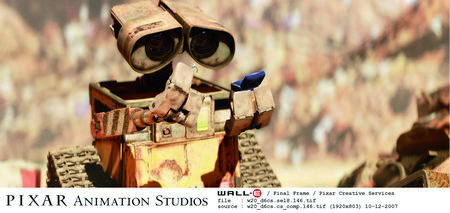
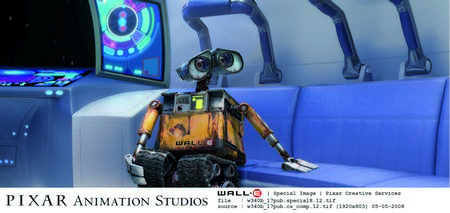
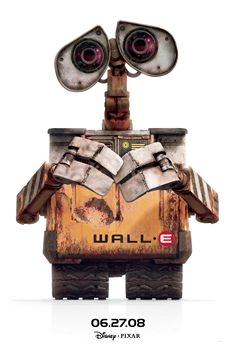
• WALL•E (Waste Allocation Load Lifter Earth-Class) is the last robot left
on Earth, programmed to clean up the planet, one trash cube at a time.
However, after 700 years, he’s developed one little glitch—a personality.
He’s extremely curious, highly inquisitive, and a little lonely. WALL•E
was one of thousands of robots sent by the Buy n Large corporation to
clean up the planet while humans went on a luxury space cruise. He is
alone, except for the companionship of his pet cockroach, affectionately
known within Pixar’s walls as Hal (named after a famous 1920s
producer, Hal Roach, and in homage to HAL from “2001: A Space
Odyssey”). WALL•E faithfully compacts cubes of trash every day,
uncovering and collecting artifacts along the way. In fact, WALL•E has
amassed a treasure trove of knickknacks—a Rubik’s CubeÆ, a lightbulb, a
spork—which he keeps in a transport truck he calls home. A bit of a
romantic, WALL•E dreams of making a connection one day, certain that
there must be more to life than this monotonous job he does every day.
His dream takes him across the galaxy and on an adventure beyond his
greatest expectations.
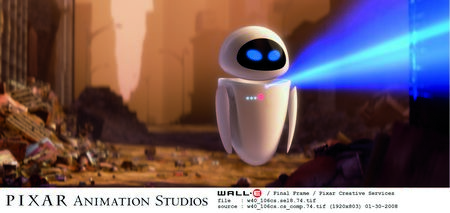
• EVE (Extra-terrestrial Vegetation Evaluator) is a sleek, state-of-the-art
probe-droid. She’s fast, she flies, and she’s equipped with a laser gun.
EVE, also called Probe One by the captain of the Axiom (the enormous
luxury mother ship which houses thousands of displaced humans), is one
of a fleet of similar robots sent to Earth on an undisclosed scanning
mission. EVE has a classified directive, and she is determined to
complete her mission successfully. She hardly even notices her new
admirer, WALL•E. One day, frustrated with not finding what she is
looking for, she takes a break and develops an unexpected bond with this
quirky robot. Together, they embark on an amazing journey through
space.
• M-O (Microbe-Obliterator) is a cleaner-bot programmed to clean
anything that comes aboard the Axiom that is deemed a “foreign
contaminant.” M-O travels speedily around the Axiom on his roller ball,
cleaning the dirty objects he encounters. His biggest challenge comes on
the day WALL•E shows up on the ship. M-O becomes fixated on the
filthiest robot he has ever seen. A game of cat and mouse ensues as M-O
attempts to wash years of garbage residue off WALL•E. However, as
WALL•E tries to escape this pest, the two eventually become friends, and
M-O is soon WALL•E’s devoted sidekick.
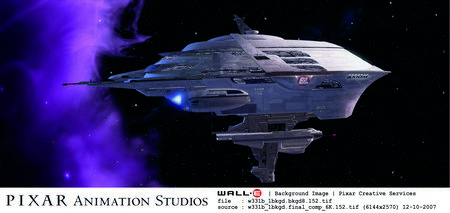
• AXIOM is the space-docked ship housing humans. Serving as the voice
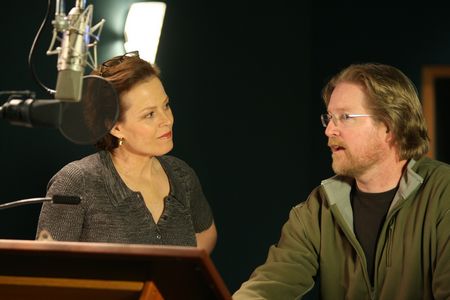
of the ship’s computer is Sigourney Weaver, who coincidentally made
her motion-picture debut in “Alien,” one of Stanton’s inspirations for the
film. And since her character in “Alien” battled Mother, the ship’s
computer, casting Weaver in the role was ultimately a nod to sci-fi for the
filmmakers.
• CAPTAIN is the current commander of the Axiom. Trapped in a routine,
like WALL•E, the captain longs for a break in the tiresome cycle of his
so-called life. His uneventful duties are simply checking and rechecking
the ship’s status with Auto, the autopilot. When he is informed of a long-
awaited discovery by one of the probe-droids, he discovers his inner
calling to become the courageous leader he never could have imagined
and plots a new course for humanity. Jeff Garlin, part of the hilarious
ensemble cast on the popular HBO series “Curb Your Enthusiasm,” lends
his voice to this likeable character.
• AUTO is the Axiom’s autopilot, who has piloted the ship through all of
its 700 years in space. A carefully programmed robot in the form of the
ship’s steering wheel, Auto’s manner is cold, mechanical, and seemingly
dutiful to the captain. Unknown to all the Axiom crew, a hidden mandate
exists in Auto’s programming. Auto is determined to execute these secret
orders at any cost, regardless of the consequences for the inhabitants of
the Axiom.
• REJECT BOTS are the Axiom’s cornucopia of robots that perform every
function imaginable to serve the ship’s passengers and keep them in the
lap of luxury. However, even hundreds of years in the future, machines
are still fallible. Robots that have malfunctioned are sent to the repair
ward and branded with a red boot. WALL•E befriends this renegade
group of reject bots, among them a beautician-bot that fails to beautify
her clients, a vacu-bot that erroneously spits out dirt, and an umbrella-
bot that opens and closes at inopportune moments. The misfit robots band
together with WALL•E to change the fate of the Axiom.
• GO-4 is the Axiom’s first mate, who harbors a secret with the autopilot.
A roving pneumatic capsule with a siren light for a head, he is dutiful to a
fault.
• JOHN and MARY are two of the humans living on the Axiom, where
they have settled into a life of pampered luxury. The arrival of WALL•E
jolts them from their daily routines and causes them to realize the
existence of one another and that there may be more to life than floating
around on their high-tech deck chairs. Pixar veteran/good-luck charm
John Ratzenberger lends his voice to the character of John, while actress/
comedienne Kathy Najimy (“Sister Act,” “King of the Hill”) speaks for
Mary.
• SHELBY FORTHRIGHT is the personable and charming CEO of the
Buy n Large corporation, the massive global entity that gained control of
the universe with its product line of robots (including the WALL•E line)
and luxury space cruisers (like the Axiom). The corporation’s promises
of a great, big, beautiful tomorrow echo on through Forthright’s digital
messages even though things haven’t turned out according to plan. Fred
Willard (“Best in Show,” “Fernwood 2 Night”) appears in the film as the
face of the company.
THE IDEA BECOMES REALITY:
DIRECTOR/CO-WRITER ANDREW STANTON’S FUTURISTIC TALE OF ROBOTS, ROMANCE AND GALACTIC ADVENTURE
“We wanted the audience to believe they were witnessing a machine that has come to life. The more they believe it’s a machine, the more appealing the story becomes.”
—Andrew Stanton, Director/Co-Writer
The image of a lonely little robot—the last one on the planet—
methodically going about his job picking up trash intrigued director/co-writer Andrew Stanton from the first time it came up over lunch with his colleagues back in 1994. It would be many years before he would find a unique story that could use this character to its full potential.
Stanton explains, “I became fascinated with the loneliness that this situation evoked and the immediate empathy that you had for this character. We spend most of our time on films trying to make our main characters likeable so that you want to follow them and root for them. I started thinking, ‘Well, where do I go with a character like this?’ And it didn’t take long to realize that the opposite of loneliness is love or being with somebody. I was immediately hooked and seduced by the idea of a machine falling in love with another machine. And especially with the backdrop of a universe that has lost the understanding of the point of living. To me, that seemed so poetic. I loved the idea of humanity getting a second chance because of this one little guy who falls in love. I’m a hopeless romantic in cynic’s clothing. This movie gave me a chance to indulge in that romantic side a little more than I normally would in public.”
Jim Reardon—a veteran director and story supervisor on “The Simpsons,” who directed 35 episodes of the show and supervised story on nearly 150 episodes—came on board to be head of story for “WALL•E.” He ended up co-writing the screenplay for the film along with Stanton.
According to Reardon, “We started with the idea of making ‘WALL•E’ a comedy, but about a third of the way through, we realized that the film is a love story, too. WALL•E is an innocent and child-like little character who unintentionally ends up having a huge impact on the world. The story arc of the film is really about EVE. Her character undergoes the biggest change, and the film is as much about her as it is about him. She’s very sleek, techno-sexy, and very futuristic-looking. He’s totally designed just to do his job and is rusty, dirty, and ugly. But we always thought that would make a great romantic adventure.”
Producer Jim Morris sums it up. “This film is a mix of genres. It’s a love story, it’s a science-fiction film, it’s a comedy, it’s a romantic comedy.”
One of the great turning points for Stanton in creating the story for “WALL•E” was stumbling upon the idea of using the musical imagery and songs from the 1969 movie version of “Hello, Dolly!” to help him define WALL•E’s personality. In fact, it is WALL•E’s repeated viewings of an old videotape of that film (the only one in his collection) that have led to the glitch of his romantic feelings.
Stanton explains, “I had been searching for the right musical elements to go with the film, and stumbling upon ‘Hello, Dolly!’ was the best thing that could have ever happened. The song ‘Put on Your Sunday Clothes,’ with its ‘Out There’ prologue, seemed to play so well with the themes of the film and yet would normally not be the kind of music you’d expect to find in a film like ours. It’s a very naÔve song, really, and it’s sung in ‘Hello, Dolly!’ by two guys who don’t know anything about life. They want to go to the big city, and they ‘won’t come home until we’ve kissed a girl.’ There’s such simple joy to it, and it really worked for us. When I found ‘It Only Takes a Moment,’ it was like a godsend. That song became a huge tool for me to show WALL•E’s interest in what love is.”
It only takes a moment
For your eyes to meet and then
Your heart knows in a moment
You will never be alone again
I held her for an instant
But my arms felt sure and strong
It only takes a moment
To be loved a whole life long...
—Excerpt: “It Only Takes a Moment” from “Hello, Dolly!”
Says producer Morris, “Holding hands is the thing that WALL•E’s wanted to do the entire movie, ’cause it’s what he’s learned from watching ‘Hello, Dolly!’...it’s the way you show affection in that movie.”
Adds Stanton, “And I realized, ‘That’s right.’ That musical moment in the film showed these two people holding hands, and I knew it was meant to be,” he says. “I’ve always felt, almost with a zealous passion, that animation can tell as many stories in different ways as any other medium, and it’s rarely been pushed outside of its comfort zone,” concludes Stanton. “I was so proud to have had something to do with the origin and creation of ‘Toy Story,’ because I felt that the tone of the movie and the manner of its storytelling broke a lot of conventions that were in people’s minds. And I still feel like you can keep pushing those boundaries. Even before I knew this film was going to be called ‘WALL•E,’ I knew it was yet another step in pushing those boundaries out farther. I’m so proud that I got a chance to make it and that it matched my expectations.”
“This little robot actually teaches humanity how to be human again.”
—Lindsey Collins, Co-Producer
Co-producer Lindsey Collins observes, “Andrew’s films have an incredible emotional core to them that lays the foundation upon which the action-adventure plays out. He writes stories that are so simple and identifiable. Even though the movie is out there in terms of its concept and scale, it feels very personal from him as a writer. He likes to write about small characters whose journey or struggle has an enormous impact. In ‘Finding Nemo,’ Marlon went on a journey, and Dory unintentionally had this enormous impact on him, and he was changed as a result. In a similar way, WALL•E is this unintentional hero. He has the ability to impact humanity, and the ironic thing is that he is the most human thing left on Earth. This little robot actually teaches humanity how to be human again. It’s that twist and irony combined with real emotion that I think is going to resonate with audiences.”
STRETCHING THE LIMITS OF ANIMATION:
PIXAR’S ANIMATORS ADD ROBOTS TO THEIR REPERTOIRE
Pixar’s talented team of animators has tackled some seemingly impossible tasks for the films they’ve created, raising the bar for quality animation on every occasion. From toys to ants, fish to monsters, and superheroes to culinary rats, they’ve created memorable characters that have become icons the world over. For their latest assignment on “WALL•E,” new challenges were posed by a colorful cast of robot and human characters. With supervising animators Alan Barillaro and Steve Hunter in charge of the group (50 animators at the peak of production), and directing animator Angus MacLane adding his experience and talent, this film represents another triumph in the art of animation.
Jim Reardon, head of story for “WALL•E,” observes, “What we didn’t want to do on this film was draw human-looking robots with arms, legs, heads and eyes, and have them talk. We wanted to take objects that you normally wouldn’t associate with having humanlike characteristics and see what we could get out of them through design and animation.”
Stanton explains, “We wanted the audience to believe they were witnessing a machine that has come to life. The more they believe it’s a machine, the more appealing the story becomes.”
“In ‘WALL•E,’ the animators are really operating at the
height of their craft to be able to convey emotions and
complex thoughts with so few words. It’s more about being able
to touch people through the animation.”
—Ed Catmull, President of Disney and Pixar Animation Studios
One of the biggest challenges facing the animators was the need to communicate emotions and actions clearly without being able to rely on traditional dialogue.
“We felt we could do it with nontraditional dialogue, maintaining the integrity of the character,” says Stanton. “In real life, when characters can’t speak—a baby, a pet—people tend to infer their own emotional beliefs onto them: ‘I think it’s sad,’ ‘She likes me.’ It’s very engaging for an audience.”
According to Ed Catmull, president of Disney and Pixar Animation Studios, “In ‘WALL•E,’ the animators are really operating at the height of their craft to be able to convey emotions and complex thoughts with so few words. It’s more about being able to touch people through the animation.”
Stanton notes, “In the world of animation, pantomime is the thing that animators love best. It’s their bread and butter, and they’re raised on it instinctually. John Lasseter realized this when he animated and directed his first short for Pixar, ‘Luxo Jr.,’ featuring two lamp characters who express themselves entirely without dialogue. The desire to give life to an inanimate object is innate in animators. For the animators on ‘WALL•E,’ it was like taking the handcuffs off and letting them run free. They were able to let the visuals tell most of the story. They also discovered that it’s a lot more difficult to achieve all the things they needed to.
“I kept trying to make the animators put limitations on themselves, because I wanted the construction of the machines and how they were engineered to be evident,” Stanton adds. “The characters seem robotic because they don’t squash and stretch. It was a real brain tease for the animators to figure out how to get the same kind of ideas communicated and timed the way it would sell from a storytelling standpoint and yet still feel like the machine was acting within the limitations of its design and construction. It was very challenging—and completely satisfying when somebody found the right approach and solution.”
To help prepare them for their assignment, the filmmakers and animation team met with people who designed real-life robots, visited NASA scientists at Jet Propulsion Laboratory, attended robotic conferences, and even brought in some real robots, including a bomb-sniffing robot from the local police department. To understand what the human characters might look like after hundreds of years of pampered life in space, NASA expert Jim Hicks came in to discuss disuse atrophy and the effects of zero gravity on the body.
Jason Deamer, the film’s character art director, recalls that one of the starting points in designing WALL•E was his eyes. “Andrew came in one day with the inspiration for WALL•E’s eyes. He had been to a baseball game and was using a pair of binoculars. He suddenly became aware that if he tilted them slightly, you got a very different look and feeling out of them. That became one of the key design elements for the main character.”
The rest of WALL•E’s design stemmed from functionality. “How does he get trash into himself and how does he compact it?” Deamer asks. Field trips were made to recycling plants to see trash-compacting machines in action. “We knew he needed treads to go up and over heaps of trash,” he says. “He also needed to be able to compact cubes of trash and have some kind of hands to gesticulate.”
DO ROBOTS HAVE ELBOWS?
One of the big points of discussion in creating the character of WALL•E was whether or not he should have elbows.
“Early in the film, we had designed WALL•E with elbows,” explains supervising animator Steve Hunter. “This gave him the ability to bend his arms. As animators, we were fighting for it, thinking he’s got to be able to touch his face, hang off a spaceship, and have a wide range of motion. But when you really looked at it, it didn’t feel right. He’s designed to do a task, which is to pull trash into his belly. Why would he have elbows? It didn’t make any sense. So with Andrew’s help and an inspired idea by directing animator Angus MacLane, we gave him a track around his side which allowed him to position his arms differently and give him a range of motion. It helped us flesh out the character a lot more. Something like elbows may seem kind of trivial, but the way we solved the problem makes you believe in WALL•E more, because we didn’t take the easy way out.”
Despite the relative simplicity of his movements, animating WALL•E proved to be one of the toughest assignments yet for the animation team. According to supervising animator Barillaro, “WALL•E has a lot of different controls, including about 50 for the head alone. He’s not organic like a human. We had to boil his movements down to their bare essence to make them effective. The first thing the animators wanted to do when they got a scene with him was to do all their tricks, like bouncing his head around. They were trying to get too broad and too human. We had to keep reminding them to pare things down and go as simply as possible with the animation. Simpler is definitely better in this case.”
With WALL•E’s voice being such an important part of his personality, the animators worked in close concert with sound designer Ben Burtt to inspire one another. Typically, the animators would work with the rough designs to prepare test animation. Burtt would then add WALL•E’s voice and send it back to the animators for another pass. Voice and animation would get edited together, and out of that would come the final performance.
“She has this gracefulness and elegance in the way
she moves, which you’d expect in a technically advanced robot.”
—Angus MacLane, Directing Animator
Animating EVE also posed its share of challenges for the group. With only two blinking eyes and four moving parts, she required a lot of advanced thought and just the right subtle movement. Designed to look like a futuristic robot, EVE is the epitome of elegance and simplicity.
“We wanted her to be graceful,” says Stanton. “There are different ways to convey what is masculine and what is feminine in this world, and we felt that she should be fluid, seamless, she should have attractive feminine qualities.”
MacLane explains, “While WALL•E’s movements are more traditional, with motors, gears, and cogs, EVE is this sleek, egg-shaped robot who moves through the use of magnets. Every frame and composition has to be cheated ever so slightly so that it’s pleasing to the eye. She has this gracefulness and elegance in the way she moves, which you’d expect in a technically advanced robot.”
Hunter adds, “Every plane change, every angle, and even the way her head curved around to the back when rotated had to be posed in a certain way to make it feel right. Everything with her had to be really, really subtle. Basically, she consists of only four parts and two eyes that blink. We had a lot of discussions about how she would move using her arms. We treated her almost like a drawing in some ways and came up with just the right poses to express emotion. It’s pretty amazing how much you really read into her.”
In addition to some of the other main robot characters—Auto, M-O and the reject bots, among others—the character design team created a catalogue of robots and crowds of up to 10,000 humans to populate the Axiom. A modular robot system was devised using a series of different robot heads that could be combined with a variety of arms and bodies. Painted various colors and otherwise differentiated, countless robots were created.
Co-producer Collins notes, “We created a library of characters with interchangeable parts so that we could do a build-a-bot program. We could choose from different kinds of treads and arms. You could swap them to create different silhouettes and characters. We had close to a hundred variations and about 25 different basic silhouettes that we could mix and match to make the world seem fuller.”
MacLane credits Stanton with inspiring the animators to do their best work. “What makes Andrew such a successful director,” says MacLane, “is his ability to see the film in its entirety at all times. He’s able to zero in on what you’re working on and suggest how to make it better for the sequence. His sense of story is so strong, and he knows how to communicate that to the animators. He likened good storytelling to telling a joke. He’s ultimately trying to tell a really good joke over a period of nearly 90 minutes. We have all these building blocks that evoke emotions, and he’s trying to figure out the best way to tell it. Our job in animation is to make sure we’re communicating clearly to the audience and that it supports his ideas for the story.”
Stanton sums up his appreciation for the animators on the film. “They were just such champions of this movie, and they really loved the concept and particularly the challenges and the limitations that we had put upon ourselves for designing all the characters the way we did. They got it from the very beginning.”
WHAT THE BEEP?
LEGENDARY SOUND DESIGNER BEN BURTT CREATES UNIQUE ROBOT VOICES ALONG WITH A UNIVERSE OF SOUNDS FOR “WALL•E”
The cast of characters in “WALL•E” includes a wide assortment of robots, including several that speak or communicate in their own unique language. For the film’s producer, Jim Morris, and director/co-writer Andrew Stanton, there was only one clear choice to create the specialty voices for these robot characters and design the sounds for this film. And that choice was multiple OscarÆ-winning sound designer Ben Burtt, the legendary talent who created the voice of R2-D2, the crack of Indiana Jones’ whip, the hiss for “Alien,” and many other iconic sounds known to moviegoers everywhere.
“Ben is one of a kind,” says Stanton. “He is such a master of sound design, and he’s the name that’s been made famous by every kid who ever liked ‘Star Wars’ and all the films that followed.
“When I realized I was actually going to get the chance to make ‘WALL•E,’ I knew that in many ways, the film had to rely on sound to tell the story,” Stanton continues. “I wanted our robots to communicate more on the level of R2-D2 than C-3PO—with their own machine-like language. I felt it would be more clever, more interesting that way. When Jim told me that he had worked with Ben at ILM for many years and suggested that we invite him over, I was thrilled. I pitched the movie to Ben and told him that I would need him to be a good deal of my cast. Thank goodness he said yes, because it soon became obvious that we couldn’t have done it without him. He’s the absolute best.”
Jim Morris adds, “Ben’s ability to create otherworldly voices and special voices that have emotion and sentiment made him a perfect casting choice for ‘WALL•E,’ and we’re so delighted that he worked on the film. Some of the character voices he created are completely synthetic, some are made up of a conglomeration of various types of sounds that Ben has found or created, and some of them are based on a little bit of human performance that is then manipulated. Ben was also extremely important with all the sounds in the movie.”
“It was a weird balance between sounding like it was generated by a machine but still having the warmth and intelligence—I call it soul—that a human being has.”
—Ben Burtt, Sound Designer
Burtt explains, “My background on ‘Star Wars’ gave me lots of experience in working with robot and alien voices, but ‘WALL•E’ required more sounds for the robot characters than any previous movie I’d worked on. The challenge of this film was to create character voices that the audience would believe are not human. Yet they could relate to the characters with all the intimacy, affection and identity that they’d attribute to a living human character. The voices couldn’t just sound like a machine with no personality or like an actor behind a curtain imitating a robot. It was a weird balance between sounding like it was generated by a machine but still having the warmth and intelligence—I call it soul—that a human being has.”
Burtt got the call to work on “WALL•E” just months after completing work on the last “Star Wars” film. He had told his wife “No more robots,” but the temptation to work at Pixar on an entirely different kind of robot film proved to be too strong.
“Fortunately, it was such a fresh and exciting idea, and the challenge of the sound in the film really appealed to me,” says Burtt. “Sound and the robot voices were going to play such an unusual role that I couldn’t help but be inspired. So, of course, I signed on to work with Jim and Andrew and do the sound design for the film.”
Regarding the voice for the character of WALL•E, Burtt explains, “It starts with me in my little recording chamber in our sound department. I take those original recordings and run it through my computer in which the sound is analyzed and broken down into all its component parts. Much like you’d take light and run it through a prism to break it into a spectrum of colors, you can do the same thing with an audio file. Once you’ve broken the sound into all its component parts, you can start re-fabricating it back together again. But now you can control the amounts of one thing or another. I can inject a machine-like quality into the sound and do things to it that the human vocal chords could never really do. You can hold a certain vowel longer and stretch it. You can change the pitch of something up and down. You can put two sounds close together. In re-fabricating the sound with a particular program I developed, I was able to keep as much of the original performance as I wanted but add a bit of synthetic form to it.
“If sound were Silly Putty,” adds Burtt, “you could stretch it and make it longer. And I found a way of working on WALL•E’s voice where I could do that. It gave a quality that Andrew really liked, and it allowed us to keep the personality going.”
In addition to the character WALL•E, Burtt was also responsible for the voices of M-O, Auto and EVE, whose tone he created by manipulating the voice of Pixar employee Elissa Knight.
For the other sounds in the film, Burtt created a library of 2,400 files—the most he’s ever accumulated for any film. “WALL•E” was Burtt’s first animated feature. “Animation is very dense, and the sounds are all really fast,” he observes. “When I was initially making sounds for WALL•E, I found I was always doing it too slow, so I had to speed up everything in my life to get the sounds fast.”
Burtt had to be resourceful in creating sounds for the film. To make the sound of the cockroach skittering, he found a pair of police handcuffs and recorded the clicking as he took them apart and reassembled them. To get the sound of EVE flying, he found someone who had built a 10-foot-long, radio-controlled jet plane and recorded it flying immediately overhead. Running up and down a carpeted hallway with a big, heavy canvas bag created a howling wind effect that was perfect for an Earth windstorm. And a hand-cranked inertia starter from a 1930s biplane did the trick in creating the sound of WALL•E moving into high gear.
“The best part of working on any film when you’re the sound designer is when you’re alone in your editing room and you’ve got some finished footage in front of you,” says Burtt. “And you put the sound in for the first time, and something really clicks. You’re the first one to see it, and that’s a sweet moment. Wandering the halls at Pixar was really inspiring, because there are so many talented people there doing incredible things. I would go back to my studio and think, ‘Can my sound be as good as what I’m seeing?’”
OUT THERE:
PRODUCTION DESIGNER RALPH EGGLESTON’S
FANTASTIC VISIONS OF EARTH AND SPACE
The production design for “WALL•E” required a unique cinematic vision of the future that ran the gamut—from an abandoned, trash-covered Earth to an enormous floating cruise ship in space perched on the edge of a nebula that is home to thousands of humans. Overseeing the production design on the film was Ralph Eggleston (“Finding Nemo”), a Pixar veteran with art-director credits on “Toy Story” and “The Incredibles,” also the director of the OscarÆ-winning short “For the Birds.” Working closely with him to achieve his artistic goals were three top art directors: Anthony Christov (sets art director), Bert Berry (shader art director), and Jason Deamer (character art director).
“We find our own sense of world and create it from scratch.”
—Ralph Eggleston, Production Designer
According to producer Morris, “The biggest overall challenge on this film from my point of view was the production design and locking down the look of our sets and environments. We knew going into it that we needed to have a future incarnation of Earth in its abandoned state, but it was enormously complicated to get all the detailed nooks and crannies figured out. The design of the Axiom and the space environments was also tricky, but we had a larger body of material for those elements to research and learn from. Ralph and his team did an amazing job creating entertaining and intriguing worlds that became characters in their own right and helped Andrew tell the story he wanted to tell.”
“One of the great things about what Pixar does,” explains Eggleston, “is that we create animated films that also have elements of special-effects films and live-action films. We find our own sense of world and create it from scratch. With ‘WALL•E,’ it was essential that the audience believe in this world or they would have a hard time believing that our main character is really the last robot on Earth. So we set out to make our Earth setting very realistic, with a great level of detail. We created nearly six miles of cityscape so that everywhere WALL•E goes, we know exactly where it is and that world really exists. We ended up stylizing it quite a bit for animation, but these are the most realistic settings we’ve ever created here at Pixar. This was also our toughest assignment from an artistic standpoint.
“Another one of our goals on this film was to use color and lighting to highlight WALL•E’s emotions and help the audience connect with them,” Eggleston adds. “Act one is all about romantic and emotional lighting, and act two is very much about sterility, order, and cleanliness. The second act is the direct antithesis of the first. As the film progresses, we slowly but surely introduce a little bit more romantic lighting. A big part of my job is wrangling all of these disparate ideas from the art department all the way through the production pipeline.”
For inspiration in creating the look of outer space for “WALL•E,” Eggleston and his team turned to idealized views of the future from NASA scientists of the ’50s and ’60s and the concept art for Disneyland’s Tomorrowland.
“One of the biggest influences for me and everyone on the film in terms of creating our vision of the future was the art created for Tomorrowland,” explains Eggleston. “It wasn’t about the specifics but rather the notion of ‘Where’s my jet pack?’ You look at a lot of the space-program paintings of the ’40s, ’50s, and ’60s, and you see fantastic imagery of buildings on Mars. Somewhere around 1978, they stopped doing that, because they wouldn’t fund anything that they knew they couldn’t do. We were interested in showing what the future could be like and won’t it be great when we get there. That’s what we wanted to impart with a lot of the design of this film.”
Inspiration for the Axiom design came from researching luxury cruise ships, including those operated by Disney. Field trips to Vegas also helped to suggest practical lighting for an artificial luxury setting.
“The original concept for the Axiom came from a cruise line,” says Eggleston. “We designed a massive spaceship that is as big as a city, several miles long, and capable of holding hundreds of thousands of residents. We knew that the audience would need some kind of visual grounding, so we put it next to a nebula. When we first see the nebula, it reminds you of a mountain with something on top, and then it reveals the Axiom.”
ADVANCING THE ART OF COMPUTER ANIMATION:
ACCLAIMED CINEMATOGRAPHER ROGER DEAKINS
AND VISUAL-EFFECTS PIONEER DENNIS MUREN
CONSULT ON “WALL•E”
“One of the things that Andrew wanted to do with ‘WALL•E’ was to create a different look than we’re used to seeing in animated films,” recalls producer Morris. “Very often, animated films feel like they’re recorded in some kind of computer space. We wanted this film to feel like cinematographers with real cameras had gone to these places and filmed what we were seeing. We wanted it to have artifacts of photography and to seem real and much more gritty than animated films tend to be. During my many years working at ILM, I had met several people that I thought could be helpful with that.”
Morris invited two of the top filmmakers in their respective fields to visit Pixar and to serve as consultants on the film. Cinematographer Roger Deakins (“No Country for Old Men,” “The Assassination of Jesse James by the Coward Robert Ford,” “Fargo,” “O Brother, Where Art Thou?”), a seven-time OscarÆ nominee best known for his frequent work with the acclaimed Coen Brothers, lent his expertise on lighting and camera issues. Renowned visual-effects wizard and six-time OscarÆ winner Dennis Muren (“Star Wars,” “Indiana Jones,” “Terminator 2,” “Jurassic Park,” “The Abyss,” “Twister”) offered his expertise on visual effects and creating the right atmospheric imagery.
“There’s a bit of imperfection in the look of the final film that adds to its believability.”
—Jim Morris, Producer
“Both Roger and Dennis spent periods of time on the film bringing their perspectives to it and giving us a lot of ideas about how things would look and feel,” says Morris. “We actually brought in some vintage 1970s Panavision cameras, similar to the ones used to shoot the original ‘Star Wars,’ and shot some imagery to get a sense of the kind of artifacts those lenses created. We observed technical things like chromatic aberration, barrel distortion and other imperfections and took what we learned and applied it to our computer-graphics photography. Dennis and Roger were pivotal in helping us get those looks. For example, their advice on cinematography, lighting, and composition helped us create the austere, glaring, and harsh Earth landscape in the first act.”
Morris’ background in live-action and visual-effects filmmaking also helped the filmmakers achieve their desire to have the movie feel like it was filmed and not recorded. “I explained to the technical team that, in the real world, when you’re shooting, the lens is usually about three feet in front of the film plane, and you’re getting perspective shift when you pan and tilt. They took this information and came back with imagery that looked 50 percent more like a photographed image. The result feels like there was a cameraman present, as opposed to being in some sort of virtual space where everything is pristine. There’s a bit of imperfection in the look of the final film that adds to its believability.”
As director of photography for camera, Jeremy Lasky helped take the film to an even higher level. “We advanced our camera and lighting technology to give the film a feel like there was a camera and lens shooting the action. We used a widescreen aspect ratio and a very shallow depth of field to give a real richness to the cinematography. You’ll notice backgrounds out of focus and more textured layers of focus in some shots to create almost watercolor compositions. We also used a lot of handheld and steady-cam shots, especially in space, to make the audience feel that could really happen and that this is a real robot moving through a real world. You feel like you’re witnessing this scene really unfold. One of the great innovations for us on this film, and a first for Pixar, was that we were able to previsualize the key lights prior to shooting so that we would have a much better idea of what the final film frame would look like. In the past, we had no lighting information at all at this stage of the production.” Lasky worked closely with Danielle Feinberg, who was the director of photography for lighting.
“When I saw the finished film, I had one of those moments where I thought, ‘I’ve never seen a movie quite like this before!’” concludes Morris. “I felt like I was seeing it through fresh eyes.”
DOWN-TO-EARTH MUSIC:
THOMAS NEWMAN AND PETER GABRIEL CREATE
COSMIC COMPOSITIONS
Andrew Stanton and composer Thomas Newman got along swimmingly on their first collaboration, “Finding Nemo,” so it seemed a natural that the two would come together for an encore on “WALL•E.” With its emphasis on visual storytelling and less dialogue, music plays an even greater role than usual in helping the filmmakers create moods and communicate their story. Newman collaborated with rock-and-roll legend Peter Gabriel on a song called “Down to Earth,” providing an entertaining musical epilogue to the film.
Stanton observes, “Working with Tom has always been a dream for me. I’ve been a fan of his music for a long time, because he is such an original. I remember first telling him about this new project on the night of the Academy AwardsÆ in 2004 when we were there for ‘Nemo.’ I said that I have this idea for a film, and it involves ‘Hello, Dolly!’ and science fiction. I was wondering if he would still speak to me after that. It turns out that the score for ‘Hello, Dolly!’ was composed by Tom’s legendary uncle, Lionel Newman, so in a sense, we were keeping it all in the family.”
“The one thing that’s guaranteed when you work with Tom is that you’re going to get something that isn’t conventional,” adds Stanton. “When you request something that comes from a conventional place, like a sci-fi genre, you know you’re going to get something with a slight left turn to it. His score always gives the film its own special stamp of identity, and it doesn’t feel like anything you’ve ever heard before. For ‘WALL•E,’ he really found a whole new level of beauty and majesty and scale that was beyond anything I could have imagined.”
“In animation, mood happens in smaller increments of time,
seconds sometimes.”
—Thomas Newman, Composer
One of the things that Stanton most admired about Newman’s work on “WALL•E” was its ability to capture the big, sweeping outer-space themes as well as all of the intimacies of the relationship between the two lead robots.
“Tom was able to communicate a sense of the world we were creating with his score,” notes Stanton. “There’s a scene in the first act where we see WALL•E going about his daily routine, and there’s a mechanical clockwork aspect to it. The score has a factory-like rhythm to it, with almost a faint whistle, almost like whistling while you work. Tom is always able to find the truth of these moments. And with his unique style of overdubs and mixing after he’s recorded with the orchestra, he comes up with a fresh palette of sounds. He has a real natural ability to find the intimate emotion in a scene. I think that’s why we fit together so well, because my natural inclination is to emphasize the emotional aspect of storytelling.”
Newman adds, “Writing music for an animated film is very different than working in live action. In animation, mood happens in smaller increments of time, seconds sometimes. Here’s a mood, and then boom, an action takes place. I learned with ‘Nemo’ that you couldn’t just create a prevailing mood and let it sit very long. Working in animation requires making transitions, and it’s about how the music moves from one feeling to another.
“My music tends to be patterned or repeating, so I like to get together with a percussionist or a guitarist who can take these patterns and add to them to make them sonically interesting,” says Newman. “If you have repeating phrases, oftentimes it allows the ear to hear colors that widen your perception of sound and music. What interests me about music is the depth of it.”
“Tom went to London to jam with Peter, and it was like this
whirlwind romance.”
—Andrew Stanton, Director/Co-Writer
For the song “Down to Earth,” which is heard at the end of the film, Stanton had the opportunity to collaborate with another of his musical heroes—Peter Gabriel. A huge fan of the rock-and-roll legend since he was 12 years old, Stanton contacted Gabriel about writing a song that would be integral to the conclusion of the story.
Stanton recalls, “Working with Peter has been one of the biggest highlights of my professional career. When it came to the ending for our film, I knew that we needed to add some additional story points and create something with a global feel to it. And it suddenly dawned on me that Peter is the father of world music to much of the Western world. I got completely seduced with the idea of putting him and Tom in a room together and seeing what they could come up with. Tom went to London to jam with Peter, and it was like this whirlwind romance. Suddenly, there was this amazing Thomas Newman/Peter Gabriel song called ‘Down to Earth’ that is just beyond my wildest dreams. Peter’s lyrics are so deceivingly simple, but they’re spot on. I was so moved when I heard the lyrics, because they were so clever and fit so well. They felt completely indicative of Peter Gabriel, and knowing that it was based on the story I had written and that I had any association whatsoever with, it really blew my mind.
“It feels very much like a Peter Gabriel song, but it has a connectivity and sensitivity that is Tom’s,” adds Stanton. “Tom was so inspired by the song that he went back into the movie and rescored some key moments to include some of the same themes. It really feels completely organic and integral to the film.”
ABOUT THE CAST
JEFF GARLIN’s (Captain) talent encompasses writing, producing, directing, acting, and performing stand-up comedy.
Garlin both co-stars and executive-produces the HBO series “Curb Your Enthusiasm.” The unique comedy stars “Seinfeld” creator Larry David, with Garlin portraying his loyal manager. The critically acclaimed series has won numerous awards, including the Golden GlobeÆ Award for Best Comedy, The Danny Thomas Producer of the Year Award from the Producers Guild of America, and the AFI Comedy Series of the Year award.
Born and raised in Chicago and then South Florida, Garlin studied filmmaking and began performing stand-up comedy while at the University of Miami. He has toured the country as a stand-up comedian, is an alumnus of Chicago’s Second City Theatre, and has written and starred in three critically acclaimed solo shows (“I Want Someone to Eat Cheese With,” “Uncomplicated,” and “Concentrated”). Garlin recently had his first film, “I Want Someone to Eat Cheese With,” released to critical acclaim. Garlin has also directed “Curb Your Enthusiasm” and both Jon Stewart (“Unleavened”) and Denis Leary (“Lock-n-Load”) in their HBO specials.
Garlin has extensive feature acting credits, including a starring role opposite Eddie Murphy in the comedy “Daddy Day Care.” He recently completed the Fox Atomic Comedy “The Rocker” opposite Rainn Wilson and Christina Applegate.
FRED WILLARD (Shelby Forthright) kicked off his career as part of Chicago’s renowned The Second City. His improvisational performance in the film “Best in Show” earned him the Boston Society of Film Critics Award for Best Supporting Actor, the American Comedy Award for Funniest Performance by a Supporting Actor, nominations for Best Supporting Actor from the New York Film Critics and The National Film Critics Society, and the Official Selection Award from AFI.
Willard’s credits on the small screen include his most recent role alongside Kelsey Grammer and Patricia Heaton in the FOX comedy “Back to You.” He received three EmmyÆ Award nominations for his recurring role on “Everybody Loves Raymond” and received a Daytime Emmy Award nomination for Best Day Time Talk Show Host for “What’s Hot What’s Not.” He co-starred in Norman Lear’s innovative cult-classic talk-show satire “Fernwood 2 Night” and has had recurring roles on “Ally McBeal,” “The Simpsons,” and “Mad About You.” Additionally, Willard counts more than 90 appearances on “The Tonight Show with Jay Leno.”
On the big screen, Willard earned an American Comedy Award nomination and a Screen Actors Guild AwardÆ nomination for Funniest Supporting Actor for his role in “Waiting for Guffman.” His film credits also include “This Is Spinal Tap,” “Roxanne,” “The Wedding Planner,” “How High,” “American Wedding,” “A Mighty Wind,” and “Anchorman: The Legend of Ron Burgundy.”
Willard has several stage roles to his credit, including off-Broadway performances in “Little Murders,” directed by Alan Arkin, and “Arf,” directed by Richard Benjamin. His regional roles include “Call Me Madam” in Chicago and the musicals “Promises, Promises” with Jason Alexander and “Anything Goes” with Rachel York, both in Los Angeles. He starred in Wendy Wasserstein’s “Isn’t It Romantic” and off-Broadway in “Elvis and Juliet,” which was written by his wife, Mary Willard. “Fred Willard: Alone at Last!”—a one-man show with a cast of 12—received two Los Angeles Artistic Director Awards for Best Comedy and Best Production.
JOHN RATZENBERGER (John) is an accomplished director, producer, and multiple EmmyÆ Award-nominated actor with notable credentials as an entrepreneur and humanitarian. While he is best known to international audiences as postman Cliff Clavin on “Cheers,” for which he garnered two Emmy nominations, Ratzenberger is the only actor to voice a role in all of the Disney•Pixar films. Indeed, his characters have been memorable: the charming and witty Hamm the piggy bank in “Toy Story” (reprised in “Toy Story 2” and the upcoming “Toy Story 3”), P.T. Flea in “A Bug’s Life,” Yeti the snow monster in “Monsters, Inc.,” a school of Moonfish in “Finding Nemo,” a philosophical character named Underminer in “The Incredibles,” a Mac truck in “Cars,” and Mustafa, the head waiter in “Ratatouille.”
A former carpenter, archery instructor, carnival performer, and oyster-boat crewman, Ratzenberger was raised in Bridgeport, Conn. An English-literature major at Sacred Heart University, he starred in one-man shows and directed others after graduation. Ratzenberger spent a decade in England as co-founder of the improvisational duo Sal’s Meat Market, earning acclaim across Europe and a grant from the British Arts Council. Early in his career, he appeared in more than 22 motion pictures, including “A Bridge Too Far,” “Superman,” “Gandhi,” and “Star Wars: The Empire Strikes Back.” Ratzenberger also starred in the Granada TV series “Small World” and cut his teeth as a producer and writer for the BBC, Granada TV, and several prestigious theater companies.
In 1982, Ratzenberger auditioned for a role on “Cheers,” suggesting to creators that they consider adding a know-it-all bar regular. The character of Cliff Clavin was brought to life, and the “Cheers” team rewrote the pilot to include him. During 11 seasons on “Cheers,” Ratzenberger improvised many of his lines, helping bring freshness and enduring popularity to a show that earned 28 EmmyÆ Awards. With “Cheers” still airing in worldwide syndication, Cliff Clavin remains one of television’s most beloved characters.
Ratzenberger has reprised his role of Cliff Clavin in “Frasier,” “The Simpsons,” “Blossom,” “Wings,” “St. Elsewhere,” and eight NBC specials. The accomplished character actor has also appeared on “8 Simple Rules,” “That ’70s Show,” “Sabrina the Teenage Witch,” “Murphy Brown,” “The Love Boat,” “Magnum P.I.,” and “Hill Street Blues.” Among his numerous TV movies are starring roles in “The Pennsylvania Miners Story” for ABC, “A Fare to Remember,” “Remember Wenn,” PBS Masterpiece Theater’s “The Good Soldier,” and the BBC’s “Song of a Sourdough” and “Detectives.” Ratzenberger’s big-screen animation success extends to the small screen in the long-running TBS series “Captain Planet and the Planeteers” and “The New Adventures of Captain Planet.” Recently, he was a fan favorite on the hit ABC show “Dancing with the Stars.”
Ratzenberger is currently making the film-festival rounds, promoting “The Village Barbershop,” winner of the Audience Choice Award at the Cinequest Festival. He recently kicked off season five of his popular Travel Channel series, “John Ratzenberger’s Made in America.” Ratzenberger created the show in 2004 to showcase American-made products, a cause for which he has been very active. Ratzenberger’s nonprofit organization, Nuts, Bolts, and Thingamajigs Foundation, is positioned to restore esteem and dignity to the manual and industrial arts and to inspire the next generation of American artisans, inventors, engineers, repairmen and skilled workers.
Voted Ms. Magazine’s “Woman of the Year 2005,” KATHY NAJIMY (Mary) is an accomplished film, television, and stage star, with credits ranging from her internationally known portrayal of Sister Mary Patrick in “Sister Act” and “Sister Act 2: Back in the Habit” to her 12 seasons as the voice of Peggy Hill on the EmmyÆ Award-winning FOX series “King of the Hill.”
Najimy was most recently seen on the CBS drama “Numb3rs.” Her television credits include three seasons opposite Kirstie Alley as Olive on NBC’s “Veronica’s Closet” as well as appearances on Disney’s “The Scream Team” and FOX’s TV special “CinderElmo.” Najimy received critical acclaim for her three-part arc on “Chicago Hope” and performed the opening musical number of the 1995 Academy AwardsÆ. She starred in “In Search of Dr. Seuss” and appeared in several TV series, including “She TV,” “Fool for Love,” “Early Edition,” and several episodes of “Ellen.”
Winner of the American Comedy Award as Funniest Supporting Actress for her role in “Sister Act,” Najimy has had numerous roles in films, including “Hocus Pocus,” “RatRace,” “Hope Floats,” “Nevada,” “Cats Don’t Dance,” “Zack and Reba,” “This Is My Life,” “The Fisher King,” “Say Uncle,” “Soapdish,” and “The Hard Way.” She also appeared in “The Wedding Planner,” “It’s Pat,” “Jeffrey,” “The Big K,” and Margaret Cho’s “Bam Bam and Celeste” and “2 Sisters.”
On stage, Najimy was critically acclaimed for her Broadway portrayal of Mae West in “Dirty Blonde” and also appeared on Broadway in “The Vagina Monologues.” Her original off-Broadway hit plays “The Kathy and Mo Show: Parallel Lives” and “The Dark Side,” which became HBO specials, garnered Obie Awards and CableACE Awards.
Najimy has directed several projects, including an off-Broadway musical, “Back to Bacharach,” and several one-woman shows.
With more than 20 years of AIDS activism, she has been honored with the L.A. Shanti’s Founder award as well as the L.A. Gay & Lesbian Center’s Distinguished Achievement Award. Najimy has posed twice for PETA’s popular campaign, “I’d Rather Go Naked than Wear Fur,” and in 2000, she received PETA’s Humanitarian of the Year Award from Paul McCartney. She’s served as keynote speaker for more than 50 women’s organizations across the country.
Najimy contributed to the Random House book “The Choices We Made.” She also voiced Wally Lamb’s novel “She’s Come Undone.”
Up next for the award-winning actress is the Walt Disney Studios Home Entertainment full-length animated release “Tinker Bell,” for which she voices the Minister of Summer.
With films like “Alien” and “Gorillas in the Mist” in her repertoire, actor SIGOURNEY WEAVER (Ship’s Computer) has created a host of memorable characters, both dramatic and comic, on stage and in film.
Born and educated in New York City, Weaver graduated from Stanford University and received a master’s degree from the Yale School of Drama. Her first professional job was as an understudy in Sir John Gielgud’s production of “The Constant Wife,” starring Ingrid Bergman.
Weaver made her motion-picture debut in the blockbuster “Alien,” later reprising the role of Warrant Officer Ripley in “Aliens,” which earned her Academy AwardÆ and Golden GlobeÆ nominations for Best Actress. She returned to the role for “Aliens 3” and “Alien Resurrection,” which she also co-produced. Weaver next portrayed primatologist Dian Fossey in “Gorillas in the Mist,” receiving an Academy Award nomination and a Golden Globe. Her role in “Working Girl” earned another Academy Award nomination and a second Golden Globe. Other films include “Ghostbusters,” Peter Weir’s “Year of Living Dangerously,” Roman Polanski’s “Death and the Maiden,” “Galaxy Quest,” “Heartbreakers,” “Holes,” Jim Simpson’s “The Guys,” “Imaginary Heroes,” and Showtime’s live-action film “Snow White,” which earned her an Emmy Award nomination and a Screen Actors Guild AwardÆ nomination. Her performance in Ang Lee’s “The Ice Storm” garnered a BAFTA Award. Weaver was nominated for a Golden Globe for Best Actress for “A Map of the World.” Recent films include “Baby Mama,” “Infamous,” “The TV Set,” “The Girl in the Park,” “Vantage Point,” and “Snow Cake,” in which Weaver portrays an autistic woman and for which she received a Proclamation from the City of New York.
On stage, Weaver received a Tony AwardÆ nomination for her starring role in Broadway’s “Hurlyburly,” directed by Mike Nichols. Other plays include “The Mercy Seat” by Neil Labute, “The Merchant of Venice,” and Christopher Durang’s “Sex and Longing,” as well as several at The Flea Theater, including “Mrs. Farnsworth” by A.R. Gurney and “The Guys.” Weaver started her stage career off-off-Broadway in Durang’s “The Nature and Purpose of the Universe” and “Titanic.” “Das Lusitania Songspiel,” which she co-wrote with Durang, earned them both Drama Desk nominations.
Weaver recently completed production on the 3-D movie “Avatar,” her first collaboration with James Cameron since “Aliens,” “Crazy on the Outside,” directed by Tim Allen, and Lifetime’s “Prayers for Bobby.”
She is on the boards of The Flea Theater in downtown Manhattan, “dedicated to raising a joyful hell in a small space,” and Human Rights First, where she has worked on the issue of asylum. Weaver is also an Honorary Chairperson of the Dian Fossey Gorilla Fund International. She works for other organizations whenever she can, including Conservation International, amFAR, Trickle Up, the Natural Resources Defense Council, and GRASP.
Multiple Academy AwardÆ winner BEN BURTT (WALL•E/
M-O/Sound & Character Voice Designer) joined Pixar Animation Studios in May 2005. A 30-year veteran and an accomplished filmmaker, Burtt has written, directed, and served as film editor on a vast array of projects.
Burtt began his work with director George Lucas in 1977 as sound designer of the original “Star Wars,” earning his first Academy AwardÆ—a Special Achievement Award. He rejoined Lucas 20 years later to supervise the sound work on “Star Wars Trilogy” (Special Edition).
In addition to his work on the “Star Wars” films, Burtt has worked on many film and television projects. He has won Academy AwardsÆ for Best Sound Editing in “Raiders of the Lost Ark” and for Best Sound Effects Editing in “E.T.: The Extra-Terrestrial” and “Indiana Jones and the Last Crusade.” Burtt has also been recognized for his work with a number of Academy AwardÆ nominations, including Best Sound in “Star Wars: Episode VI—Return of the Jedi,” Best Sound and Sound Effects Editing in “Willow,” Best Sound Effects Editing in “Stars Wars: Episode I—The Phantom Menace,” and, as director of “Special Effects, Anything Can Happen,” Best Short Subject Documentary.
In addition to his Academy AwardÆ wins and nominations, Burtt has also been awarded a British Academy Award for Best Sound in “Star Wars: Episode V—The Empire Strikes Back,” a Golden Reel Award for Best Sound Effects Editing in “Raiders of the Lost Ark,” and a British Academy Award nomination for Best Sound in “Star Wars: Episode I—The Phantom Menace.”
ABOUT THE FILMMAKERS
ANDREW STANTON (Director/Screenwriter/Vice President, Creative, Pixar Animation Studios) has been a major creative force at Pixar Animation Studios since 1990, when he became the second animator and ninth employee to join the company’s elite group of computer-animation pioneers. As Vice President, Creative, he currently leads the initiatives and oversees all features and shorts development for the studio.
Stanton made his directorial debut with the record-shattering “Finding Nemo,” an original story of his that he also co-wrote. The film garnered Stanton two Academy AwardÆ nominations (Best Original Screenplay and Best Animated Film), and “Finding Nemo” was awarded an OscarÆ for Best Animated Feature Film of 2003, the first such honor Pixar Animation Studios has received for a full-length feature.
Stanton was one of the four screenwriters to receive an OscarÆ nomination in 1996 for his contribution to “Toy Story” and went on to receive credit as a screenwriter on every subsequent Pixar film—“A Bug’s Life,” “Toy Story 2,” “Monsters, Inc.,” and “Finding Nemo.” Additionally, he served as co-director on “A Bug’s Life” and was the executive producer of “Monsters, Inc.” and the 2006 Academy AwardÆ-winning “Ratatouille.”
A native of Rockport, Mass., Stanton earned a Bachelor of Fine Arts degree in Character Animation from California Institute of the Arts (CalArts), where he completed two student films. In the 1980s, he launched his professional career in Los Angeles, animating for Bill Kroyer’s Kroyer Films studio and writing for Ralph Bakshi’s production of “Mighty Mouse, the New Adventures.”
JIM MORRIS (Producer/Executive Vice President, Production, Pixar Animation Studios) joined Pixar Animation Studios in 2005. Morris is responsible for managing the production of the studio’s features, shorts, DVD content, and theme-park activities. He also oversees various production departments at Pixar, including Story, Art, Editorial, Animation, Shading, Lighting, and Technical Direction.
Prior to joining Pixar, Morris held a range of key positions in various divisions of Lucasfilm Ltd. He served as President of Lucas Digital Ltd. and managed its two divisions, Industrial Light & Magic (ILM) and Skywalker Sound. As ILM’s General Manager for more than ten years, he supervised a staff of over 1,400 artists and technicians and guided the largest visual-effects facility in the entertainment industry.
During Morris’ tenure, ILM created the groundbreaking, Academy AwardÆ-winning visual effects in “Jurassic Park,” “Death Becomes Her,” and “Forrest Gump.” Other notable projects completed under his management include “Mission: Impossible,” “Twister,” “Saving Private Ryan,” “Star Wars: Episode I” and “II,” “The Perfect Storm,” “Pearl Harbor,” “Minority Report,” “Pirates of the Caribbean,” “Master and Commander,” and the first three “Harry Potter” films.
Morris joined ILM in 1987 as a producer of visual effects for films and commercials. He was subsequently promoted to ILM’s executive in charge of production, where he supervised all of the company’s production. “The Abyss,” which earned an OscarÆ for Best Achievement in Visual Effects, and “Always” are among his producing credits.
Before joining ILM, Morris was executive producer at Arnold & Associates, where he oversaw the company’s three offices and produced national commercials for clients such as Atari and Chevron. Prior to that, Morris was executive producer at One Pass, where he headed the commercial production department. He served in the production departments at J. Walter Thompson and also Foote, Cone & Belding in San Francisco. Morris worked as a producer and director for PBS affiliate WCNY-TV and began his career as a cameraman and editor at NBC affiliate WSYR-TV.
Morris is the recipient of both the Producers Guild of America Digital 50 Award and the Visual Effects Society Board of Directors Award. He currently serves as president of the San Francisco Film Commission. Morris earned a Bachelor of Science degree in film and a Master of Science degree in television and radio from the Newhouse School at Syracuse University.
LINDSEY COLLINS (Co-Producer) joined Pixar Animation Studios in 1997 and has worked in a variety of production capacities on such films as “A Bug’s Life,” “Toy Story 2,” “Finding Nemo,” and “Ratatouille.” She also provided the voice of the character Mia in the 2006 Pixar release “Cars.”
Prior to joining Pixar, Collins worked at Disney Feature Animation for three years, managing creative teams on the films “Pocahontas,” “The Hunchback of Notre Dame,” and “Hercules.”
Collins earned a Bachelor of Arts degree in Diplomacy and World Affairs at Occidental College in Los Angeles. She currently resides in Oakland, California, with her husband and two children.
Moving effortlessly from drama to sharp satire to period classics to animation, THOMAS NEWMAN (Composer) is building on an amazing family tradition in Hollywood, with a varied body of work that has earned the praise of filmmakers ranging from Robert Altman to Gillian Armstrong. To date, Newman has received eight Academy AwardÆ nominations for his film work: He was the only double nominee in 1994’s Oscar race, receiving nominations for both “Little Women” and “The Shawshank Redemption,” and he has since received nominations for his scores from “Unstrung Heroes,” “American Beauty,” “Road to Perdition,” “Finding Nemo,” “Lemony Snicket’s A Series of Unfortunate Events,” and, most recently, “The Good German.” Newman also won an EmmyÆ Award for Outstanding Main Title Theme Music for HBO’s award-winning drama “Six Feet Under.”
Since the beginning of sound film, the Newman name has been an integral part of the evolution of film scoring. Newman is the youngest son of the legendary Alfred Newman, a nine-time Academy AwardÆ winner and 45-time nominee, who, as musical director of Twentieth Century Fox from the mid-’30s to the early ’60s, was responsible for overseeing or composing all of the music created for more than 200 films. Uncle Lionel was a composer and studio music director with more than 50 scores to his credit, and uncle Emil was also a conductor, with more than four dozen film-score credits. Sister Maria is an acclaimed concert violinist, brother David has scored more than 60 films, and cousin Randy is a much-beloved pop songwriter and film composer who scored Pixar’s first four features.
Newman studied composition and orchestration at USC, completing his academic work at Yale. His greatest mentor, Broadway’s Stephen Sondheim, was deeply impressed with Newman’s originality and championed one of his earliest works, the musical-theater piece “Three Mean Fairy Tales,” which received a workshop production courtesy of the Stuart Ostrow Foundation.
Newman also won the support of a young New York casting agent, Scott Rudin, who brought Newman aboard director James Foley’s 1984 film, “Reckless,” as a musical assistant. Newman’s initiative on the project soon elevated him to the position of composer, and at age 29, he had successfully scored his first film.
Newman’s reputation for originality and for intensifying mood and character grew rapidly with such films as “Desperately Seeking Susan,” “The Lost Boys,” “Scent of a Woman,” “Citizen Cohn,” and more than 40 other major titles, including “Meet Joe Black,” “The Horse Whisperer,” “Up Close and Personal,” “Phenomenon,” “The People vs. Larry Flynt,” “In the Bedroom,” “Pay It Forward,” “Erin Brockovich,” “Red Corner,” “How to Make an American Quilt,” “The Green Mile,” “Jarhead,” “Cinderella Man,” “Fried Green Tomatoes,” and, more recently, “Little Children” and “Towelhead.” Newman also composed the music for HBO’s acclaimed six-hour miniseries “Angels in America,” directed by Mike Nichols. He was commissioned to create a unique seven-minute symphonic piece, “Reach Forth Our Hands,” for the city of Cleveland, commemorating its bicentennial in 1996.
Multiple GrammyÆ Award-winning musician PETER GABRIEL co-founded the group Genesis in 1966. Together, they made seven albums before Gabriel left the group in 1975. He returned to music a year later and has since made 11 solo albums, including hit singles like “Shock the Monkey,” “Sledgehammer,” “Big Time,” and “In Your Eyes.” Gabriel has also completed film-soundtrack works, including “Birdy,” “The Last Temptation of Christ,” and “Rabbit Proof Fence.” His “Sledgehammer” video has been voted best video of all time, and his interactive work “Eve” won the Milia D’Or for Multimedia.
The musician, entrepreneur, and activist is a recipient of the Man of Peace award, presented by the Nobel Peace Laureates, and the Chevalier dans Ordre des Arts et des Lettres. He has received various lifetime achievement awards and BT’s Digital Music Pioneer Award.
Gabriel founded WOMAD (World of Music Arts and Dance) in 1980, presenting more than 150 festivals in more than 40 countries. Additionally, the WOMAD Foundation has provided education and workshops to many schools.
Gabriel’s human-rights work includes coordinating and participating in the 1988 Human Rights Now Tour with Amnesty International. He co-founded Witness.org in 1989 to give cameras and computers to human-rights activists. Witness.org pioneered the adoption of video and online technologies in human-rights campaigning. The Hub has just been launched, providing a platform for human-rights videos from all over the world (a YouTube for human rights). In 2000, Gabriel co-founded TheElders.org with Richard Branson, which Nelson Mandela launched in 2007.
His business interests have been in the field of music, media, and technology. In 1987, he founded the Real World group of companies: Real World Studios, Real World Records, and, later, Real World Multi Media and Real World Films. Gabriel co-founded OD2 (On Demand Distribution) in 1999, which became the leading European platform provider for the distribution of online music. In 2005, Gabriel acquired Solid State Logic with David Engelke, the world’s leading manufacturer of mixing consoles for music recording, broadcast and post-production. He also co-founded TheFilter.com and We7.com.
Information contained within as of June 12, 2008.
© Disney/Pixar. All Rights Reserved. disney.com/WALL-E
WALT DISNEY PICTURES
Presents
A
PIXAR ANIMATION STUDIOS
Film
WALL•E
Directed by. . . . . . . . . . . ANDREW STANTON
Produced by . . . . . . . . . . . . . . . . . JIM MORRIS
Co-Produced by . . . . . . . . LINDSEY COLLINS
Executive Producer. . . . . . . . JOHN LASSETER
Associate Producer. . . . . . . THOMAS PORTER
Original Score Composed &
Conducted by . . . . . . . . . THOMAS NEWMAN
Original Story by . . . . . . ANDREW STANTON
PETE DOCTER
Screenplay by . . . . . . . . . ANDREW STANTON
JIM REARDON
Production Designer . . . RALPH EGGLESTON
Film Editor . . . . . . . . . . STEPHEN SCHAFFER
Supervising Technical
Director . . . . . . . . . . . . . NIGEL HARDWIDGE
Supervising Animators . . . ALAN BARILLARO
STEVEN CLAY HUNTER
Director of Photography:
Camera. . . . . . . . . . . . . . . . . . JEREMY LASKY
Director of Photography:
Lighting. . . . . . . . . . . . DANIELLE FEINBERG
Sound & Character
Voice Designer . . . . . . . . . . . . . . . BEN BURTT
Production Manager . . . . . ANDREA WARREN
Character Art Director . . . . . JASON DEAMER
Sets Art Director . . . . . ANTHONY CHRISTOV
Shader Art Director. . . . . . . . . . . BERT BERRY
Graphics
Art Director . . . . MARK CORDELL HOLMES
Character Supervisor. . . . . . . . . . . . BILL WISE
Sets Supervisor. . . . . . . . . . . . DAVID MUNIER
Effects Supervisor. . . . . DAVID MACCARTHY
Technical
Pipeline Supervisor . . . . . . . . . JOHN WARREN
Character
Modeling Lead. . . . . . . JASON BICKERSTAFF
Character
Shading Lead . . . . . . . . . . ATHENA XENAKIS
Set Modeling Lead . . . . . . . KRISTIFIR KLEIN
Set Shading
Lead . . . . . . . . CHRISTOPHER M. BURROWS
Set Dressing Lead . . . . . . . DEREK WILLIAMS
Crowds Supervisor . . . . . . . . MARK T. HENNE
Rendering Supervisor . . . . . . . SUSAN FISHER
“Down To Earth”
Music by Peter Gabriel and Thomas Newman
Lyrics by Peter Gabriel
Performed by Peter Gabriel,
Featuring The Soweto Gospel Choir
Casting by. . . . . . . . . . . . . . . . . KEVIN REHER
NATALIE LYON
CAST
WALL•E . . . . . . . . . . . . . . . . . . . . BEN BURTT
Eve. . . . . . . . . . . . . . . . . . . . . ELISSA KNIGHT
Captain . . . . . . . . . . . . . . . . . . . . JEFF GARLIN
Shelby Forthright,
BnL CEO. . . . . . . . . . . . . . . . FRED WILLARD
Auto . . . . . . . . . . . . . . . . . . . . . . . MACINTALK
M-O. . . . . . . . . . . . . . . . . . . . . . . . BEN BURTT
John. . . . . . . . . . . . . . JOHN RATZENBERGER
Mary. . . . . . . . . . . . . . . . . . . . KATHY NAJIMY
Ship’s Computer . . . . . SIGOURNEY WEAVER
Visual
Consultants . . . . ROGER DEAKINS, A.S.C., B.S.C.
DENNIS MUREN, A.S.C.
STORY
Story Supervisor. . . . . . . . . . . . JIM REARDON
Story Manager . . . . . . . . . . . . . SABINE KOCH
Story Artists
KEVIN O’BRIEN MAX BRACE
DEREK THOMPSON BRIAN FEE
NATHAN STANTON ROB GIBBS
SCOTT MORSE RONNIE DEL CARMEN
JEFF PIDGEON JUSTIN WRIGHT
ANGUS MACLANE ALEXANDER WOO
TED MATHOT PETER SOHN
JAMES S. BAKER KYLE SHOCKLEY
CREDITS
1
CREDITS
Digital Boarding
& Effects. . . . . . . . . . . . DOUGLASS CARNEY
CHRIS O’DOWD
Additional
Digital Boarding . . . . . . . . . PATRICK SIEMER
Script
Supervisor. . . . . . . . STACEY HENDRICKSON
Story
Coordinator. . . . . . . . KATE RANSON-WALSH
Story Production
Assistant. . . . . . . . . . . . . . MAGGIE WEIDNER
ART
Art Manager. . . . . . . . . . . . GILLIAN LIBBERT
Production Artists
DANIEL ARRIAGA NELSON “REY” BOHOL
CHIA HAN JENNIFER CHANG ROBIN COOPER
TONY FUCILE DANIEL HOLLAND
LORI KLOCEK NOAH KLOCEK
ROBERT KONDO ALBERT LOZANO
ANGUS MACLANE TEDDY NEWTON
KRISTIAN NORELIUS JAY SHUSTER
Production Illustrator . . . . . . . . . . . . JOHN LEE
Motion Graphics
Designer. . . . . . . . . . . . . . PHILIP METSCHAN
Motion Graphics
Technical Lead. . . . . . . . SANDRA KARPMAN
Matte Painter. . . . . . . . . . . . . . PAUL TOPOLOS
Matte Paint Technical Lead . . PATRICK JAMES
Sculptor . . . . . . . . . . . . . . . . . JEROME RANFT
Graphic Artists . . . . . . . . . . . . CRAIG FOSTER
CATHERINE M. KELLY
ELLEN MOON LEE
BECKY NEIMAN
Digital Painters
GLENN KIM MARIA LEE
ERNESTO NEMESIO LAURA PHILLIPS
JAPETH PIEPER BILL ZAHN
Graphics & Paint
Technical Artists. . . . . . . . . . . . CHUCK WAITE
JAY CARINA
Development Artists . . . . . . . . . . . SHAUN TAN
BRUCE ZICK
RICARDO DELGADO
GEEFWEE BOEDOE
GEORGE HULL
Additional
Art Management . . . . . . . . . . TRISH CARNEY
Art Coordinators. . . . . . . . . . . . . . ZOE BOXER
BECKY NEIMAN
LEE RASÉ
Art Production Assistant. . . . BRIAN LONDON
EDITORIAL
Editorial Managers . . . . . . . . . . NOELLE PAGE
COLIN BOHRER
Second Film Editors . . . . . . . . AXEL GEDDES
JASON HUDAK
NICHOLAS C. SMITH, A.C.E.
First Assistant
Editor. . . . . . . . . . ANTHONY J. GREENBERG
Second Assistant
Editors. . . . . . . . . . . KEVIN ROSE-WILLIAMS
RENÉE STEEN
TESSA SWIGART
Additional Editing . . . . . . . . KEVIN NOLTING
Editorial Production Assistant . . JESS FULTON
Additional Sound Design . . . E.J. HOLOWICKI
Additional
Editorial Support . . STACEY HENDRICKSON
CAMERA & STAGING
Layout Manager. . . . . . . RICHMOND HORINE
Layout Artists
ROBERT ANDERSON MATT ASPBURY
SHAWN BRENNAN ANDREW CADELAGO
SIMON DUNSDON ROBERT KINKEAD
SUKWON PARK MARK SHIRRA
MATTHEW SILAS BOB WHITEHILL
DEREK WILLIAMS SYLVIA GRAY WONG
Post-Animation
Camera Artist. . . . . . . . . . . . . . . CRAIG GOOD
Layout Coordinators. . . . . . . . TRISH CARNEY
KEARSLEY HIGGINS
ANIMATION
Animation Manager . . . . . . . . . JAKE MARTIN
Directing Animator . . . . . . ANGUS MACLANE
Animation Character
Development . . . . . . . . . . . . VICTOR NAVONE
DAVID DEVAN
2
Animators
CARLOS BAENA RODRIGO BLAAS
ADAM BURKE SHAUN CHACKO
LOUIS CLICHY BRETT CODERRE
JONATHEN COLLINS DON CRUM
PATRICK DELAGE DAVID DEVAN
EVERETT DOWNING, JR. DOUG FRANKEL
TIMOTHY HITTLE GUILHERME SAUERBRONN JACINTO
NANCY KATO PATTY KIHM
KEN KIM JAIME LANDES
JOHN CC LEE WENDELL LEE
HOLGER LEIHE AUSTIN MADISON
MICHAL MAKAREWICZ AMBER MARTORELLI
DAN MASON PAUL MENDOZA
SARAH MERCEY-BOOSE CAMERON MIYASAKI
VICTOR NAVONE DANIEL NGUYEN
KEVIN O’HARA BRET PARKER
BRETT PULLIAM NICKOLAS ROSARIO
ROGER ROSE BRETT SCHULZ
BOB SCOTT DOUG SHEPPECK
RAPHAEL SUTER JEAN-CLAUDE TRAN QUANG THIEU
ROB DUQUETTE THOMPSON KRISTOPHE VERGNE
IAN WHITE KUREHA YOKOO
RON ZORMAN
Fix Animation Lead . . . . . . . ANDREW BEALL
Fix & Additional
Animation . . . . . . . SEQUOIA BLANKENSHIP
CHRISTOPHER CHUA
CURRAN W. GIDDENS
BRUCE KUEI
TOM ZACH
Crowds Animation Lead. . . . . . . . . ARIK EHLE
Crowds &
Additional Animation . . . . . . . . SIMON ALLEN
DOVI ANDERSON
STEPHEN WONG
Additional Animators
JASON BOOSE TIM CRAWFURD
IKE FELDMAN ANDREW GORDON
KAREN KISER MATT MAJERS
STEVE MASON GINI CRUZ SANTOS
ANDREW L. SCHMIDT MICHAEL WU
Animation Shot Support
Technicians. . . . . . . . . . . DANIEL CAMPBELL
TODD R. KRISH
Animation Coordinators . . . . . . . DAVID PARK
DANIEL A. GOODMAN
CATHLEEN CARMEAN
CHARACTERS
Character Managers . . . . . . . ADRIAN OCHOA
JAKE MARTIN
Character Modeling & Articulation Artists
LOU HAMOU-LHADJ RICHARD HURREY
KEN LAO AUSTIN LEE
MARK PIRETTI BILL SHEFFLER
SAJAN SKARIA JACOB SPEIRS
IAN STEPLOWSKI MARK THERRELL
BRIAN TINDALL MICHAEL TODD
AUDREY WONG
Character Shading Artists
DAVID BATTE STEPHAN VLADIMIR BUGAJ
TRENT CROW SARAH FOWLER DELUNA
PATRICK GUENETTE BRANDON ONSTOTT
MAXWELL PLANCK KEITH STICHWEH
Character Interns. . . . . . . . . . . . . . . . . DON BUI
SETH FREEMAN
CROWDS & SIMULATION
Crowds & Simulation
Manager . . . . . . . . . . . . . KATHLEEN RELYEA
Crowds & Simulation Artists
LENA PETROVI C´CHRIS LAWRENCE
JIAYI CHONG JOSH ANON
PAUL KANYUK GEORGE NGUYEN
FRANK AALBERS MICHAEL LORENZEN
MATTHEW SILAS
Tailor. . . . . . . . . . . . . . . . . . . . CARMEN NGAI
Crowds
Sequence Lead . . . . . . . ZIAH SARAH FOGEL
Crowds Rendering Optimization . . DAVID RYU
Additional Simulation . . CHRISTINA GARCIA
Characters & Crowds
Coordinator. . . . . . . . . . . ALICE CLENDENEN
Additional Crowds
Production . . . . . . . . . . . RICHMOND HORINE
LAUREN TOPAL
INVENTORY
Sweatbox Managers . . . . . . . . . SABINE KOCH
KEARSLEY HIGGINS
Sweatbox Coordinator. . . . . KESTEN MIGDAL
CREDITS
3
CREDITS
SETS
Sets Previs/Modeling
Manager. . . . . . . . . . . . MARY VAN ESCOBAR
Sets Shading/Dressing
Manager . . . . . . . . . . . . MARC SONDHEIMER
Previsualization Artists . . . . . MATT ASPBURY
BRIAN CHRISTIAN
SIMON DUNSDON
ROBERT KINKEAD
Sets Technical Developer . . . . . . . . ARUN RAO
Sets Model Optimization. . . . DALE RUFFOLO
Modeling Artists
MARK ADAMS NEIL BLEVINS
BRIAN CHRISTIAN RICHARD HURREY
JAE H. KIM IVO KOS
MIKE KRUMMHOEFENER MARK PIRETTI
EVAN PONTORIERO CHRIS SANCHEZ
GARY SCHULTZ KEVIN SINGLETON
SUZANNE SLATCHER RICHARD SUN
GASTÓN UGARTE CHUCK WAITE
RAYMOND V. WONG
Senior Shading Artist . . . . . CHRIS BERNARDI
Shading Artists
ALEXANDER ADELL ALEC BARTSCH
NEIL BLEVINS MARC COOPER
NOAH HORNBERGER THOMAS JORDAN
MICHAEL KILGORE STEPHEN KING
EMMA WEYERMAN MERRELL J. D. NORTHRUP
ANDREW PIENAAR JOSH QUALTIERI
KEITH STICHWEH RENEE TAM
ANDREW WHITTOCK
Set Dressing Artists . . . . CHRISTINA GARCIA
ALISON LEAF
SOPHIE VINCELETTE
Sets Coordinators. . . . . . . . . . . SUSAN FRANK
ERIC ROSALES
Sets Production Assistant. . . . LAUREN TOPAL
Sets Interns . . . . . . . . . JONATHAN FARRELL
MICHAEL JUTAN
SHELDON SERRAO
LIGHTING
Lighting Manager. . . . . . . . . . . . . . JENNI TSOI
Technical Lighting Lead . . . . . . . . ERIK SMITT
Lead Lighting Artists . . . . JONATHAN PYTKO
MICHAEL SPARBER
Master Lighting Artists
LLOYD BERNBERG TIM BEST
BRIAN BOYD STEFAN GRONSKY
JAE H. KIM LUKE MARTORELLI
ANDREW PIENAAR SUDEEP RANGASWAMY
SONJA MARWOOD MARIA YERSHOVA
Shot Lighting Artists
JEREMY BIRN LIZ KUPINSKI CARTER
YE WON CHO CHARU CLARK
KEITH CORMIER ANGELIQUE REISCH
CHRIS FOWLER JULIE GARCIA
IAN HOUSE SUNGYEON JOH
JOSÉE LAJOIE JESSICA GIAMPIETRO MCMACKIN
IAN MEGIBBEN EILEEN O’NEILL
KIMBERLY ROSS DALE RUFFOLO
AFONSO SALCEDO JULIEN SCHREYER
DAVID SHAVERS KENNETH SULLIVAN
KYOUNG LEE SWEARINGEN ESDRAS VARAGNOLO
JEREMY VICKERY
Lighting Consultant . . . . SHARON CALAHAN
Lighting Optimization
Engineers. . . . . . . . . . CARL NAI FREDERICK
BRYAN CLINE
Illumination Engineer . . . . . JACOB KUENZEL
Lighting
Coordinators . . . . . . . KATE RANSON-WALSH
ERIC ROSALES
EFFECTS
Effects Manager. . . . . . . . . . . . . . BRAD KANE
Effects Sequence Leads . . . CHRIS CHAPMAN
JASON JOHNSTON
KEITH DANIEL KLOHN
FERDI SCHEEPERS
Effects Artists
FRANK AALBERS DAVID BATTE
JUAN J. BUHLER TOLGA GÖKTEKIN
SETH HOLLADAY CHRIS KING
MACH TONY KOBAYASHI TOM NIXON
ENRIQUE VILA BILL WATRAL
BRAD WINEMILLER
Effects Interns . . DIEGO GARZÓN SANCHEZ
KURT PHILLIPS
Lighting & Effects Production
Assistant. . . . . . . . . . . SARAH CHIAPPINELLI
4
RENDERING & OPTIMIZATION
Rendering Manager . . . . . . . . . PAUL MCAFEE
Rendering & Optimization
Artists. . . . . . . . . . . . . . . . . . . JOSHUA JENNY
ALEXANDER KOLLIOPOULOS
NICK LUCAS
ALEXANDER TIMCHENKO
Starfields
Development . . . MARK VANDEWETTERING
Rendering Coordinator . . ALICE CLENDENEN
Rendering Intern . . . . . . . . . . . . . ERIC PEDEN
TECHNICAL DEVELOPMENT
Technical
Development Lead . . . . . . . LUCAS R. A. IVES
Technical Development
Coordinator . . . . . . . . . MARY VAN ESCOBAR
Development Engineers
BRIAN SMITS FRANK AALBERS
FAREED BEHMARAM-MOSAVAT FERDI SCHEEPERS
MAXWELL PLANCK KURT FLEISCHER
CHRIS CHAPMAN JIAYI CHONG
KEITH DANIEL KLOHN MICHAEL K. O’BRIEN
MARTIN NGUYEN CHRIS SCHOENEMAN
DAVID WALLACE
Technical Interns. . . . . . . NATHAN MATSUDA
MANISH SHARMA
PRODUCTION
Production
Finance Lead . . . . . . . . MARC SONDHEIMER
Assistant to the
Director . . . . . . . MARGUERITE K. ENRIGHT
Assistant to the Producers . . . DANIEL COMBS
Assistant Production
Accountants. . . . . . KIRSTEN AMES STAUBLI
CHRISTOPHER ‘STU’ STEWART
Production Office Manager . TRICIA ANDRES
Production
Office Assistants . . . . . . . . MEAGAN MILLER
STEPHEN KRUG
MAX SACHAR
PAUL BAKER
Additional Production
Management. . . . . . . . . . . . JULIET POKORNY
Additional Production
Support. . . . . . . . . . . . . . VICTORIA JASCHOB
DOUG NICHOLS
ESTHER PEARL
DAVID WILLNERD
THOMAS QUINTAS
In Loving Memory of
Justin Wright
1981 – 2008
IMAGE MASTERING
Manager . . . . . . . . . . . JOSHUA HOLLANDER
Lead Engineer . . . . . . . . . . . . . . ROD BOGART
Administration Manager . . . BETH SULLIVAN
Image Mastering Coordinator . ROBIN YOUNG
Media Control Manager ROBERT TACHOIRES
Color Grading Operators . . DAVID LORTSHER
SUSAN BRUNIG
Media Control
Transfer Operators. . . . . . . . . . ANDRA SMITH
GLENN KASPRZYCKI
JEFF WHITTLE
RICHARD PINKHAM
Camera Operators. . . . . . . . . . . . . . . JEFF WAN
MARK DINICOLA
Projection . . . . . . . . . . . . . . JOHN HAZELTON
TIMOTHY KENNELLY
Software Engineering . . . . . DOMINIC GLYNN
DREW TTV ROGGE
HEE SOO LEE
RICK SAYRE
POST PRODUCTION
Post Production
Supervisor. . . . . . . . . . . . . . . PAUL CICHOCKI
Director of Editorial &
Post Production. . . . . . . . . . . . . . BILL KINDER
International Managers . . . . . CYNTHIA LUSK
MARY VAN ESCOBAR
International
Technical Lead . . . . . . . . . . DOMENIC ALLEN
International Editorial. . . . DAVID H. TANAKA
International
Art Direction . . . . . . . . . . . SUSAN BRADLEY
Post Production
Supervisor, Video . . . . . . CYNTHIA SLAVENS
Post Production Manager . . . . ERIC PEARSON
CREDITS
5
CREDITS
Post Production
Coordinator. . . . . . . . . . . . . . NOAH NEWMAN
Management
Assistant . . . . . . . . . KATELIN C. HOLLOWAY
Post Production
Assistant. . . . . . . . . . . . . . FREESIA PEARSON
Original Dialogue Mixers . . . . . . VINCE CARO
DOC KANE
Additional
Dialogue Recording. . . . . BOBBY JOHANSON
Supervising Sound Editor
& Mixer. . . . . . . . . . . . . . . . . . . . . BEN BURTT
END TITLES
Direction . . . . . . . . . . . . . . JIM CAPOBIANCO
Production Management . . . . . . SARA MAHER
GALYN SUSMAN
Design Lead. . . . . . . . . . . . . . . SCOTT MORSE
Title Design . . . . . . . . . . . . SUSAN BRADLEY
Animation. . . . . . . . . . . . . ALEXANDER WOO
BOB SCOTT
KRISTOPHE VERGNE
Background Paint. . . . . . . . . . . . . . . JOHN LEE
After Effects. . . . . . . . . . . . . . CHRIS O’DOWD
CATHERINE M. KELLY
RENDER PIPELINE GROUP
Manager . . . . . . . . . . . . . . . . . . . . . . ANNE PIA
Technical Lead. . CHRISTOPHER C. WALKER
Team
KATE CRONIN JOSH GRANT
DON SCHREITER ERICK TRYZELAAR
MIKE WALLACE ADAM WOOD-GAINES
PRODUCTION ENGINEERING
Team Leads . . . . . . . F. SEBASTIAN GRASSIA
ALLAN POORE
BILL POLSON
GUIDO QUARONI
SAM WIJEGUNAWARDENA
Software Development
JIM ATKINSON DAVID BARAFF
MALCOLM BLANCHARD STAS BONDARENKO
JUEI CHANG BENA CURRIN
GORDON CAMERON ADAM GABBERT
THOMAS HAHN JAMIE HECKER
GEOFFREY IRVING BEN JORDAN
RYAN KAUTZMAN MANUEL KRAEMER
DANIEL MCCOY GARY MONHEIT
SHAWN NEELY MICHAEL K. O’BRIEN
BRIAN M. ROSEN MICHAEL SHANTZIS
KIRIL VIDIMCE CHRISTINE WAGGONER
Infrastructure
BEAU CASEY JUNE FOSTER
RITA GARCIA SUSAN BOYLAN GRIFFIN
BJÖRN LEFFLER MARÍA MILAGROS SOTO
DAN WEEKS
PREPRODUCTION ENGINEERING
Lead. . . . . . . . . . . . . . MICHAEL B. JOHNSON
Team
BRENDAN DONOHOE RALPH HILL
PHRED LENDER JOSH MINOR
RUDRAJIT SAMANTA
Post Production Sound Services by
SKYWALKER SOUND
A LUCASFILM LTD. COMPANY,
MARIN COUNTY, CALIFORNIA
Supervising
Sound Editor . . . . . . . . . . . MATTHEW WOOD
Re-Recording Mixers. . . . . . . . . . TOM MYERS
MICHAEL SEMANICK
Sound Effects Editors . . . . . TERESA ECKTON
DUSTIN CAWOOD
AL NELSON
ADR Editor . . . . . . . . . . . . . . STEVE SLANEC
Foley Editors. . . . . . . . . . . . . KEVIN SELLERS
JUAN PERALTA
Assistant Supervising
Sound Editor . . . . . . . . . . . . . . COYAELLIOTT
Foley Artists . . . . . . . . . . . . . . . . JANAVANCE
DENNIE THORPE
Foley Mixer . . . . . . . . . . . . . FRANK RINELLA
Foley Recordist. . . . . . . . . . . SEAN ENGLAND
Mix Technician . . . . . . . . . . . . TONY SERENO
6
Digital Transfer . . . . . . . JONATHAN GREBER
CHRISTOPHER BARRON
JOHN COUNTRYMAN
Additional Voices
LORI ALAN BOB BERGEN
JOHN CYGAN PETE DOCTER
PAUL EIDING DON FULLILOVE
JESS HARNELL SHERRY LYNN
MICKIE MCGOWAN LARAINE NEWMAN
TEDDY NEWTON JEFF PIDGEON
JAN RABSON LORI RICHARDSON
ANDREW STANTON JIM WARD
COLETTE WHITAKER
MUSIC
Recorded & Mixed by . . . . . . TOMMY VICARI
Orchestra Recorded by . . . . . ARMIN STEINER
Orchestrations by . . . . . THOMAS PASATIERI,
J.A.C. REDFORD
Music Editor . . . . . . . . . . . . BILL BERNSTEIN
Music Contractor . . . . . . . . . . LESLIE MORRIS
Music Preparation . . JULIAN BRATOLYUBOV
Assistant Music Editor . . . MICHAEL ZAINER
Digital Audio . . . . . . . . . . . . . . . . LARRY MAH
Executive Music Producer. . . CHRIS MONTAN
Music Supervisor . . . . . TOM MACDOUGALL
Music Production Manager. . . ANDREW PAGE
Music
Business Affairs . . . . . DONNA COLE-BRULÉ
Music Production
Coordinator . . . . . . . . . . . . . ASHLEY CHAFIN
Music Production Assistants . . . JILL IVERSON
SIOBHAN SULLIVAN
Music Recorded & Mixed at
Sony Pictures Scoring Stage,
Newman Scoring Stage-Twentieth Century Fox
Studios, The Village, and Paramount Pictures
Scoring Stage M
“Down To Earth”
Produced by Peter Gabriel
L.A. Sessions Produced by Thomas Newman
Recorded by Richard Chappell
Mixed by Tchad Blake
“Put On Your Sunday Clothes”
“It Only Takes A Moment”
Written by Jerry Herman
Courtesy of Twentieth Century Fox
Film Corporation
“La Vie En Rose”
Written by Louiguy, Edith Piaf and Mack David
Performed by Louis Armstrong
Courtesy of The Verve Music Group
Under License from Universal Music
Enterprises
“Don’t Worry, Be Happy”
Written and Performed by Bobby McFerrin
Produced by Linda Goldstein
Courtesy of Original Artists
“Also Sprach Zarathustra”
Written by Richard Strauss
“BnL Jingle”
Music by Thomas Newman
Lyrics by Bill Bernstein
LIVE ACTION
Director of
Photography . . . . . . . . . MARTY ROSENBERG
Pixar Visual Effects
Supervisor . . . . . . . . RICHARD HOLLANDER
Line Producer . . . . . . . . . . GILLIAN LIBBERT
Pixar Digital Production
Supervisor . . . . . . . . . . . . . . . . JOHN WARREN
CREDITS
7
CREDITS
Live Action Production by Pixar Senior Creative Team
KERNER OPTICAL
CHRISTOPHER HALL ZOE BOXER
JANET NIELSEN FRED MYERS
ALICE TOMPKIN JOHN GAZDIK
RANDY JONSSON NELSON STOLL
SCOTT KINSEY BRIAN COPENHAGEN
MICHAEL MEIER FRANK STRZALKOWSKI
ORLANDO ORONA STEVE CARDELLINI
TODD KUHN TOM CLOUTIER
DON HENDERSON CHRIS SHELLENBERGER
BERNIE DEMOLSKI CHRISTINE BLOOMINGDALE
STEVE COLLINS DAVE MURPHY
BUCK O’HARE JOHN DUNCAN
BARBARA KASSEL JUDY FEIL
NANCY SERVIN GRETCHEN DAVIS
YVETTE RIVAS JENNIFER TREMONT
DIANE HARRELL DANA BONILLA
JAY BEVERLY BLAKE BENHAM
MOLLY WELIN
NANCY HAYES CASTING
MARLA DELL CASTING
BELLA CUCINA CATERING
Live Action Visual Effects by
INDUSTRIAL LIGHT & MAGIC
A LUCASFILM LTD. COMPANY
Visual Effects Supervisor . . . . . . . . . ED HIRSH
Visual Effects Producer . . . . . . . JEANIE KING
Digital Production
Supervisor . . . . . . . . . . . . . PATRICK TUBACH
Layout Supervisor . . . . . . BRIAN CANTWELL
Visual Effects Editor . . . . . . . . GREG HYMAN
Digital Paint & Roto
Supervisor . . . . . . . . . . . . MICHAEL VAN EPS
Digital Artists. . . . . . . . . JASON BILLINGTON
KAI CHANG
LANNY CERMAK
CARLOS MONZON
Production Coordinator . . . . . STACY BISSELL
Media Operations. . . . . . . . . . . . . . . . C.J. NEFF
Color Timers. . . . . . . . . . . . TERRY CLABORN
JIM PASSON
Negative Cutting by. . WALT DISNEY STUDIOS
MICHAEL ARNDT PETE DOCTER
GARY RYDSTROM BRAD BIRD
JOHN LASSETER LEE UNKRICH
BRENDA CHAPMAN BOB PETERSON
PIXAR STUDIO TEAM
A/V Engineering
DANIEL ANNEREAU CHRIS COLLINS
CHRISTOPHER FEHRING BOB FREY
GRANT GATZKE WARREN LATIMER
EDGAR QUIÑONES M.T. SILVIA
ALEX STAHL KELLI TOWNLEY
JASON WATKINS
Administration & Application Support
ALEJANDRO AGUILAR TLALOC ALVAREZ
RICKY DER CASSANDRA FALBY
MARTY LEW BRITTANY MOORE
HEIDI PARMELEE PETER PLACKOWSKI
MAY PON
Data Management Group
MARY ANN GALLAGHER MARK HARRISON
PETER NYE HEIDI STETTNER
MIKE SUNDY
Desktop & Infrastructure
NEFTALI “EL MAGNIFICO” ALVAREZ BRYAN BIRD
JOHNOEL CUEVAS LARS R. DAMEROW
JAMES G. DASHE ROSS DICKINSON
MILES EGAN EDWARD ESCUETA
TYLER FAZAKERLEY ERIK FORMAN
REMY GALANG ALISA GILDEN
JONATHAN HADDEN JAMES HANDELIN
BETHANY JANE HANSON WARREN HAYS
JASON HENDRIX DAN HOFFMAN
LING HSU KENNETH HUEY
JASON “JAYFISH” HULL JOSE RICHARD IGNACIO
THOMAS INDERMAUR PETER KALDIS
JOHN KIRKMAN ELISE KNOWLES
CORY ANDER KNOX CHRIS LASELL
MATTHEW MUHILI LINDAHL JEREMIAH MACIAS
BOB MORGAN TERRY LEE MOSELEY
MICHAEL A. O’BRIEN MARK PANANGANAN
WIL PHAN A.U.B.I.E.
NELSON SETTE SIU DAVID SOTNICK
ANDY THOMAS RUDY JASON VUCELICH
PETER WARD JAY WEILAND
IAN WESTCOTT ROBERT YUMOL
8
Consumer Products
KELLY BONBRIGHT BEN BUTCHER
AIDAN CLEELAND KAT CHANOVER
T.Q. JEFFERSON EMERY LOW
JONATHAN RODRIGUEZ CHRISTOPHER SCHNABEL
Marketing
DONALD EVANS LEEANN ALAMEDA
STEVEN ARGULA ED CHEN
DEBORAH COLEMAN ANDY DREYFUS
ADAM GATES HILARY GOSS
CHERIE HAMMOND ERIN HARRISON
HOLLY LLOYD SEAN MCGINN
DESIREE MOURAD SHANNON NICOSIA
BURT PENG LAURIE SCHREY
AMANDA SORENA HASIA SROAT
CLAYBORN WELCH TIMOTHY ZOHR
DVD Production
STEVE BLOOM TIM FOX
TONY KAPLAN MORGAN KARADI
SUREENA MANN ERICA MILSOM
BRICE PARKER
Theme Parks
ANTHONY A. APODACA NICK BERRY
LOREN CARPENTER EDWIN CHANG
DAVID DIFRANCESCO TOM DUFF
LIZ GAZZANO ROGER GOULD
MATTHEW MARTIN DONNA QUATTROPANI
KRISTA SHEFFLER JACLYN SIMON
J. WARREN TREZEVANT CAROL WANG
Production Resources
SHELLEY KATAYAMA TERRY MCQUEEN
JAMES FORD MURPHY EBEN F. OSTBY
KATHERINE SARAFIAN SUSAN T. TATSUNO
JOHN WALKER
Human Resources
YVONNE BRAZIL KIMBERLY CLARK
ELEUTERIO CRUZAT, JR. LISA ELLIS
TIFFANY RENO FUNG TRICIA GREEN
DAWN HAAGSTAD PAMELA HARBIDGE
ROBIN MCDONALD JENNIFER MARTELYI
JENNYLYN MERCADO MARCOS NAVARRETE
ELIZABETH PALMORE ERICA PERKINS-YOUMAN
STEPHANIE SHEEHY AMIE SHINOHARA
Administration & Finance
MEGAN ALBERT CASSANDRA ANDERSON
NANCY GARRETSON CASE RACHEL ERGAS
HEATHER FENG-YANU TIMOTHY GLASS
MARC S. GREENBERG KAITLIN HENDRICK
KENTARO HINOKI HEATHER D.C. JACKSON
MARK JOSEPH JENNIFER MADJAROV
KAREN PERRY KRISTINA RUUD
MICHELLE SIMONS JOAN SMALLEY
WENDY DALE TANZILLO SHARI VILLARDE
DEANA WALKER ANNETTE WANG
SUE WILLIAMS
Legal
LEAH MARSHALL ROB RIEDERS
BOB RODEN JODY SILVERMAN
CARRIE WINCHELL
Development
MARY COLEMAN KAREN PAIK
KIEL MURRAY JAMES RODERICK
RYAN DONNELLY
RenderMan Development
DANA BATALI JAMES BURGESS
PER CHRISTENSEN RAY DAVIS
JULIAN FONG IAN HSIEH
DAVID LAUR MARK LEONE
KATRIN BRATLAND BRIAN K. SAUNDERS
BRIAN SAVERY BRENDEN SCHUBERT
JONATHAN SHADE BRIAN SMITS
WAYNE WOOTEN
RenderMan Sales & Marketing
CHRISTOPHER FORD RENEE LAMRI
PETER MOXOM DYLAN SISSON
WENDY WIRTHLIN
CREDITS
9
CREDITS
Software Development
HOWARD LOOK RENEE ADAMS
BRADLY ANDALMAN JOHN R. ANDERSON
PETER ANTON LORRAINE AOCHI
JONATHAN BIANCHI IAN BUONO
ANDREW BUTTS MICHAEL CHANN
ALDEN CHEW ROB COOK
SEAN COTTER TONY DEROSE
THOMAS DRAKE GEORGE ELKOURA
SEAN FEELEY GREGORY FINCH
LISA FORSSELL MICHAEL FU
ERIC GREGORY TARA HERNANDEZ
WILSON TAYLOR HOLLIDAY HAYLEY IBEN
PAUL ISAACS OREN JACOB
ROB JENSEN MASA JOW
MICHAEL KASS JASON KIM
MURAT N. KONAR TASHANA LANDRAY
BRETT LEVIN YUN LIEN
AARON LUK MICHELLE LAI
MARK MEYER TIM MILLIRON
ALEX MOHR DANIEL LEAF NUNES
GREGG OLSSON CORY OMAND
SILVIA PALARA MARTIN REDDY
JUSTIN RITTER SUSAN SALITURO
FLORIAN SAUER PATRICK SCHORK
STEFAN SCHULZE KAY SEIRUP
JOHN SHANNON SARAH SHEN
BURTON SIU ELIOT SMYRL
C. BART SULLIVAN ALLISON STYER
ERIN TOMSON J. WARREN TREZEVANT
DIRK VAN GELDER SIGMUND VIK
BRAD WEST ANDY WITKIN
ADAM WOODBURY RICHARD YOSHIOKA
LISA S. YOUNG DAVID G. YU
Pixar University & Archives
DEANN COBB SAMUEL DAFFNER
KIM DONOVAN CHRISTINE FREEMAN
JULIET ROTH DAVID R. HAUMANN
ELYSE KLAIDMAN MICHELLE N. LINDSEY
RANDY NELSON MEG OCAMPO
ADRIENNE RANFT PEGGY TRAN-LE
Facilities
TOM CARLISLE CRAIG PAYNE
CHERISE MILLER BRIAN TORRES
JOHN BENNETT KEITH JOHNSON
KENT BARNES MICHAEL HITSON
PAUL GILLIS PETER SCHREIBER
Purchasing & Relocation
KRISTIN GAMBLE DENNIS “DJ” JENNINGS
JEANIE GRAY
Shipping & Receiving
KENNY CONDIT EDGAR A. OCHOA
KEVAN PARMELEE MARCO CASTELLANOS
Safety & Security
KEITH KOPS MARLON CASTRO
PAUL CHIDEYA AL CIMINO
RICHARD COGGER GERALD E. HACKETT, III
RAMON HANNON MICHAEL HITSON
KRISTINE JAVIER RAYMOND LIST
NOAH SKINNER BRIAN SMITH
JONI SUPERTICIOSO
Craft Services by LUXO CAFÉ
LUIGI PASSALACQUA CANDELARIA LOZANO
FRANCISCO A. FIGUEROA FRANCISCO MARTINEZ
GUILLERMO SEGOVIA LARRY HENDERSON
LAUREN GRBICH LUIS ALARCON-CISNEROS
MARIE NILSSON OLGA VELAZQUEZ
PIER GIORGIO PERUCCON SAMANTHA WILSON
Pixar Senior Staff
ED CATMULL ALI ROWGHANI
LORI MCADAMS GREG BRANDEAU
Special Thanks
STEVE JOBS MARY BEECH
SIMON BAX LOIS SCALI
MARK ANDERSON LLOYD ELLIS
DAVID FINCHER MICHAEL GORFAINE
JAMES HICKS JONATHAN IVE
LESLIE IWERKS KEITH LONDON
DAN MAAS DAVID MAISEL
KIM MARKS SARAH MCARTHUR
GEOFFREY NUNBERG MIKE RIZK
HEATHER ROGERS HARRIS SAVIDES
KIM SILVERMAN BRAD & LIZ SODEN
MICHAEL THOMAS
AÑO NUEVO STATE RESERVE,
CALIFORNIA STATE PARKS
CALIFORNIA WASTE SOLUTIONS
DISNEY CRUISE LINE
SAN MATEO COUNTY
SHERIFF’S OFFICE BOMB SQUAD
NUMMI PLANT
10
MOBILITY & ROBOTIC SYSTEMS,
JET PROPULSION LABORATORY
Production Babies
ALEXANDER & WILLIAM AMELIE
ASHER ATLEE
AVA AVERY
BERGE COHEN
CORA DILLAN
DYLAN ELLEN
EMMA-BRIE EMMA JANE
EMMA JUNE ESHA
EVIJA FLORA
FRIEDERICH GIORGIA
HAILEY HARPER & GRIFFIN
JACK JACKSON & PARKER
JENNA JONATHAN
KATIE KAYLA
KEILANI LEILA
LIAM LOGAN
LUCA LUCIE
MAEVE MAYA
NASREEN NOAH
PARISA PETER
PHOENIX REINA
SADIE SEQUOIA
TAIS TESSA
TOBIAN & ELLARUDY TOMAS
VICTORIA VIOLET
VIOLET GRACE VIVIEN
VOUK ZUMI
CPUs for Final Rendering
INTEL
Animated on Marionette™
Rendered with Pixar’s RenderMan
Footage and Still from “HELLO, DOLLY!”
Courtesy of Twentieth Century Fox.
All Rights Reserved.
Available from Twentieth Century Fox
Home Entertainment.
PONG® Classic Video Game and Atari 2600™
Console courtesy of Atari Interactive, Inc.
© 2008 Atari Interactive, Inc.
All Rights Reserved. Used by Permission.
Computer-Generated Voices
Courtesy of Apple Inc.
Images © Corbis
Images © Getty
MPAA #44354
Prints by Deluxe & Technicolor®
To Learn More About
the Creators of Wall•E,
Visit www.pixar.com
© 2008 Disney Enterprises, Inc./Pixar
All Rights Reserved
This Motion Picture Was Created by
Pixar Talking Pictures for Purposes of
Copyright Law in the United Kingdom.
Original Soundtrack Available on
CREDITS
11
CREDITS
WALL•E the Video Game from
In Stores Now on Your
Favorite Gaming Systems
Distributed by
WALT DISNEY STUDIOS
MOTION PICTURES
Created and Produced at
PIXAR ANIMATION STUDIOS
Emeryville, CA
WALL•E
ABOUT THE PRODUCTION
What if mankind had to leave Earth
and somebody forgot to turn off the last robot?
That’s the intriguing and whimsical premise
posed by Disney•Pixar’s extraordinary new
computer-animated comedy set in space,
“WALL•E.” Filled with humor, heart, fantasy,
and emotion, “WALL•E” takes moviegoers on a
remarkable journey across the galaxy and once
again demonstrates Pixar’s ability to create
entire worlds and set new standards for
storytelling, character development, out-of-thisworld
music composition, and state-of-the-art
CG animation.
Set in a galaxy not so very far away,
“WALL•E” is an original and exciting comedy
about a determined robot. After hundreds of
lonely years doing what he was built for, WALL•E (Waste Allocation Load Lifter Earth-Class)
discovers a new purpose in life (besides collecting knickknacks) when he meets a sleek search
robot named EVE (Extra-terrestrial Vegetation Evaluator). EVE comes to realize that
WALL•E has inadvertently stumbled upon the key to the planet’s future and races back to
space to report her findings to the humans who have been eagerly waiting aboard the luxury
spaceship Axiom for news that it is safe to return home. Meanwhile, WALL•E chases EVE
across the galaxy and sets into motion one of the most incredible comedy adventures ever
brought to the big screen.
Joining WALL•E on his fantastic journey across the universe 800 years into the future is a
hilarious cast of characters, including a pet cockroach and a heroic team of malfunctioning
misfit robots.
The ninth feature from Disney and Pixar Animation Studios, “WALL•E” follows the studio’s
most recent triumph, “Ratatouille,” which won an Oscar® for Best Animated Feature, garnered
the best reviews for any 2007 release, and was a box-office hit all over the globe. The combined
worldwide box-office gross for Pixar’s first eight releases is an astounding $4.3 billion.
“WALL•E” is the latest film from Academy Award®-winning director/writer Andrew
Stanton, who joined Pixar in 1990 as its second animator and the fledgling studio’s ninth
employee. He was one of the four screenwriters to receive an Oscar nomination in 1996 for
his contribution to “Toy Story” and was credited as a screenwriter on subsequent Pixar films,
ABOUT THE PRODUCTION
13
OUT TO LUNCH
including “A Bug’s Life,” “Toy Story 2,” “Monsters, Inc.,” and “Finding Nemo,” for which he
earned an Oscar nomination as co-writer. Additionally, he co-directed “A Bug’s Life,”
executive-produced “Monsters, Inc.” and the 2007 Academy Award®-winning “Ratatouille,”
and won an Oscar for Best Animated Feature for “Finding Nemo.”
Disney•Pixar’s “WALL•E,” directed by Andrew Stanton from an original story by Stanton
and Pete Docter and a screenplay by Stanton and Jim Reardon, is executive-produced by John
Lasseter and produced by Jim Morris (“Star Wars: Episode I” and “Episode II,” “Pearl
Harbor,” “The Abyss,” and three of the “Harry
Potter” films), who helped create some of the
industry’s groundbreaking visual effects during
his 18-year association with ILM as president of
Lucas Digital. Lindsey Collins, an 11-year
Pixar veteran, serves as co-producer; Thomas
Porter is associate producer. Oscar®-winning
cinematographer Roger Deakins serves as
visual consultant.
The voice cast includes funnyman Jeff Garlin
(“Curb Your Enthusiasm”), Pixar veteran John
Ratzenberger (“Cheers,” “Ratatouille,” “Toy
Story”), actress Kathy Najimy (“Sister Act,”
“King of the Hill”), stage and film star Sigourney
Weaver (“Alien,” “Gorillas in the Mist,” “Baby Mama”), and acclaimed four-time Oscar®winning
sound designer Ben Burtt (“E.T.: The Extra-Terrestrial,” “Indiana Jones and the Last
Crusade”). Comedian Fred Willard (“Best in Show,” “Back to You”) also appears in the film.
WALL•E’s expressive range of robotic voices was created by Burtt, whose memorable work
includes creating the “voices” of other legendary robots, such as R2-D2 (from the “Star Wars”
films). Drawing on 30 years of experience as one of the industry’s top sound experts, Burtt
was involved from the film’s earliest stages in creating an entire world of sound for all of the
robotic characters and the spacecraft, as well as all environments.
The original score for “WALL•E” is composed by eight-time Oscar® nominee Thomas
Newman, who had previously worked with Stanton on “Finding Nemo.” Rock-and-roll legend
Peter Gabriel collaborated with Newman on an original song called “Down to Earth.” Gabriel
wrote the lyrics for this captivating and clever musical epilogue and performed the song as well.
OUT TO LUNCH:
PIXAR PIONEERS CHEW ON NEW FILM CONCEPTS—
A ROMANTIC ROBOT BEGINS TO TAKE SHAPE
The idea for “WALL•E” came about in 1994 at a now-famous lunch that included Pixar
pioneers Stanton, John Lasseter, Pete Docter, and the late storytelling genius Joe Ranft. With
their first feature, “Toy Story,” in production, the group suddenly realized that they might
actually get a chance to make another movie. At that fateful gathering, the ideas for “A Bug’s
Life,” “Monsters, Inc.,” and “Finding Nemo” were first discussed. “One of the things I
remember coming out of it was the idea of a little robot left on Earth,” says Stanton. “We had
no story. It was sort of this Robinson Crusoe kind of little character—like, what if mankind
14
had to leave Earth and somebody forgot to turn the last robot off, and he didn’t know he could
stop doing what he’s doing?”
Years later, the idea took shape—literally. “I started to just think of him doing his job every
day and compacting trash that was left on Earth,” Stanton recalls. “And it just really got me
thinking about what if the most human thing left in the universe was a machine? That really
was the spark. It has had a long journey.”
Stanton says he was heavily influenced by the sci-fi films of the 1970s. “Films like ‘2001,’
‘Star Wars,’ ‘Alien,’ ‘Blade Runner,’ and ‘Close Encounters’—they all had a look and feel to
them that really transported me to another place, and I really believed that those worlds were
out there,” he explains. “I haven’t seen a movie since then that made me feel that same way
when we went out to space, so I wanted to recapture that feeling.”
In preparation for their assignment on “WALL•E,” Pixar’s animation team made field trips
to recycling stations to observe giant trash crushers and other machinery at work, studied real
robots up close and in person at the studio, and watched a wide range of classic films (from
silents to sci-fi) for insights into cinematic expression. Sticking to Pixar’s motto of “truth in
materials,” the animators approached each robot as being created to perform a particular
function and tried to stay within the physical limitations of each design while creating
performances with personality. Alan Barillaro and Steven Clay Hunter served as the film’s
supervising animators, with Angus MacLane assuming directing animator duties.
Production designer Ralph Eggleston (“The Incredibles,” “Finding Nemo,” “Toy Story”)
drew inspiration for the look of “WALL•E” from NASA paintings from the ’50s and ’60s and
original concept paintings for Disneyland’s Tomorrowland by Disney Imagineers. He recalls,
“Our approach to the look
of this film wasn’t about
what the future is going to
be like. It was about what
the future could be—which
is a lot more interesting.
That’s what we wanted to
impart with the design of
this film. In designing the
look of the characters and the world, we want audiences to really believe the world they’re
seeing. We want the characters and the world to be real—not realistic-looking, but real in
terms of believability.”
Adding to the believability of the film is the way the film is photographed. Jeremy Lasky,
director of photography for camera, explains, “The whole look of ‘WALL•E’ is different from
anything that’s been done in animation before. We really keyed in to some of the quintessential
sci-fi films from the ’60s and ’70s as touchstones for how the film should feel and look.”
Stanton adds, “We did a lot of camera-work adjustment and improvements on our software
so our cameras were more like the Panavision 70mm cameras that were used on a lot of those
movies in the ’70s.”
OUT TO LUNCH
15
A WORLD OF ROBOTS AND OTHER BOTS:
THE WHO’S WHO IN “WALL•E”
A WORLD OF ROBOTS
•
WALL•E (Waste Allocation Load Lifter Earth-Class) is the last robot left on Earth,
programmed to clean up the planet, one trash cube at a time. However, after 700 years, he’s
developed one little glitch—a personality. He’s extremely curious, highly inquisitive, and a
little lonely. WALL•E was one of
thousands of robots sent by the
Buy n Large corporation to clean
up the planet while humans went
on a luxury space cruise. He is
alone, except for the
companionship of his pet
cockroach, affectionately known
within Pixar’s walls as Hal
(named after a famous 1920s
producer, Hal Roach, and in
homage to HAL from “2001: A
Space Odyssey”). WALL•E faithfully compacts cubes of trash every day, uncovering and
collecting artifacts along the way. In fact, WALL•E has amassed a treasure trove of
knickknacks—a Rubik’s Cube®, a lightbulb, a spork—which he keeps in a transport truck
he calls home. A bit of a romantic, WALL•E dreams of making a connection one day,
certain that there must be more to life than this monotonous job he does every day. His
dream takes him across the galaxy and on an adventure beyond his greatest expectations.
•
EVE (Extra-terrestrial Vegetation Evaluator) is a sleek, state-of-the-art probe-droid. She’s
fast, she flies, and she’s equipped with a laser gun. EVE, also called Probe One by the
captain of the Axiom (the enormous luxury mother ship which houses thousands of
displaced humans), is one of a fleet of similar robots sent to Earth on an undisclosed
scanning mission. EVE has a classified directive, and she is determined to complete her
mission successfully. She hardly even notices her new admirer, WALL•E. One day,
frustrated with not finding what she is looking for, she takes a break and develops an
unexpected bond with this quirky robot. Together, they embark on an amazing journey
through space.
•
M-O (Microbe-Obliterator) is a cleaner-bot programmed to clean anything that comes
aboard the Axiom that is deemed a “foreign contaminant.” M-O travels speedily around the
Axiom on his roller ball, cleaning the dirty objects he encounters. His biggest challenge
comes on the day WALL•E shows up on the ship. M-O becomes fixated on the filthiest
robot he has ever seen. A game of cat and mouse ensues as M-O attempts to wash years of
garbage residue off WALL•E. However, as WALL•E tries to escape this pest, the two
eventually become friends, and M-O is soon WALL•E’s devoted sidekick.
•
AXIOM is the space-docked ship housing humans. Serving as the voice of the ship’s
computer is Sigourney Weaver, who coincidentally made her motion-picture debut in
16
“Alien,” one of Stanton’s inspirations for the film. And since her character in “Alien”
battled Mother, the ship’s computer, casting Weaver in the role was ultimately a nod to scifi
for the filmmakers.
•
CAPTAIN is the current commander of the Axiom. Trapped in a routine, like WALL•E, the
captain longs for a break in the tiresome cycle of his so-called life. His uneventful duties
are simply checking and rechecking the ship’s status with Auto, the autopilot. When he is
informed of a long-awaited discovery by one of the probe-droids, he discovers his inner
calling to become the courageous leader he never could have imagined and plots a new
course for humanity. Jeff Garlin, part of the hilarious ensemble cast on the popular HBO
series “Curb Your Enthusiasm,” lends his voice to this likeable character.
•
AUTO is the Axiom’s autopilot, who has piloted the ship through all of its 700 years in
space. A carefully programmed robot in the form of the ship’s steering wheel, Auto’s
manner is cold, mechanical, and seemingly dutiful to the captain. Unknown to all the
Axiom crew, a hidden mandate exists in Auto’s programming. Auto is determined to
execute these secret orders at any cost, regardless of the consequences for the inhabitants
of the Axiom.
•
REJECT BOTS are
the Axiom’s cornucopia
of robots that perform
every function imaginable
to serve the ship’s
passengers and keep
them in the lap of luxury.
However, even hundreds
of years in the future,
machines are still fallible. Robots that have malfunctioned are sent to the repair ward and
branded with a red boot. WALL•E befriends this renegade group of reject bots, among
them a beautician-bot that fails to beautify her clients, a vacu- bot that erroneously spits out
dirt, and an umbrella-bot that opens and closes at inopportune moments. The misfit robots
band together with WALL•E to change the fate of the Axiom.
•
GO-4 is the Axiom’s first mate, who harbors a secret with the autopilot. A roving
pneumatic capsule with a siren light for a head, he is dutiful to a fault.
•
JOHN and MARY are two of the humans living on the Axiom, where they have settled into
a life of pampered luxury. The arrival of WALL•E jolts them from their daily routines and
causes them to realize the existence of one another and that there may be more to life than
floating around on their high-tech deck chairs. Pixar veteran/good-luck charm John
Ratzenberger lends his voice to the character of John, while actress/comedienne Kathy
Najimy (“Sister Act,” “King of the Hill”) speaks for Mary.
17
A WORLD OF ROBOTS
IDEA BECOMES REALITY
•
SHELBY FORTHRIGHT is the personable and charming CEO of the Buy n Large
corporation, the massive global entity that gained control of the universe with its product
line of robots (including the WALL•E line) and luxury space cruisers (like the Axiom). The
corporation’s promises of a great, big, beautiful tomorrow echo on through Forthright’s
digital messages even though things haven’t turned out according to plan. Fred Willard
(“Best in Show,” “Fernwood 2 Night”) appears in the film as the face of the company.
THE IDEA BECOMES REALITY:
DIRECTOR/CO-WRITER ANDREW STANTON’S FUTURISTIC TALE
OF ROBOTS, ROMANCE AND GALACTIC ADVENTURE
“We wanted the audience to believe they were witnessing a machine that has come to
life. The more they believe it’s a machine, the more appealing the story becomes.”
—Andrew Stanton, Director/Co-Writer
The image of a lonely little robot—the last one on the planet—methodically going about
his job picking up trash intrigued director/co-writer Andrew Stanton from the first time it
came up over lunch with his
colleagues back in 1994. It
would be many years before
he would find a unique story
that could use this character
to its full potential.
Stanton explains, “I
became fascinated with the
loneliness that this situation
evoked and the immediate empathy that you had for this character. We spend most of our time
on films trying to make our main characters likeable so that you want to follow them and root
for them. I started thinking, ‘Well, where do I go with a character like this?’ And it didn’t take
long to realize that the opposite of loneliness is love or being with somebody. I was
immediately hooked and seduced by the idea of a machine falling in love with another
machine. And especially with the backdrop of a universe that has lost the understanding of the
point of living. To me, that
seemed so poetic. I loved
the idea of humanity getting
a second chance because of
this one little guy who falls
in love. I’m a hopeless
romantic in cynic’s
clothing. This movie gave
me a chance to indulge in
that romantic side a little more than I normally would in public.”
Jim Reardon—a veteran director and story supervisor on “The Simpsons,” who directed 35
episodes of the show and supervised story on nearly 150 episodes—came on board to be head
of story for “WALL•E.” He ended up co-writing the screenplay for the film along with Stanton.
18
According to Reardon,
“We started with the idea of
making ‘WALL•E’ a
comedy, but about a third of
the way through, we
realized that the film is a
love story, too. WALL•E is
an innocent and child-like
little character who
unintentionally ends up having a huge impact on the world. The story arc of the film is really
about EVE. Her character undergoes the biggest change, and the film is as much about her as
it is about him. She’s very sleek, techno-sexy, and very futuristic-looking. He’s totally
designed just to do his job and is rusty, dirty, and ugly. But we always thought that would make
a great romantic adventure.”
Producer Jim Morris sums it up. “This film is a mix of genres. It’s a love story, it’s a
science-fiction film, it’s a comedy, it’s a romantic comedy.”
One of the great turning points for Stanton in creating the story for “WALL•E” was
stumbling upon the idea of using the musical imagery and songs from the 1969 movie version
of “Hello, Dolly!” to help him define WALL•E’s personality. In fact, it is WALL•E’s repeated
viewings of an old videotape of that film (the only one in his collection) that have led to the
glitch of his romantic feelings.
Stanton explains, “I had been searching for the right musical elements to go with the film,
and stumbling upon ‘Hello, Dolly!’ was the best thing that could have ever happened. The
song ‘Put on Your Sunday Clothes,’ with its ‘Out There’ prologue, seemed to play so well with
the themes of the film and yet would normally not be the kind of music you’d expect to find
in a film like ours. It’s a very naïve song, really, and it’s sung in ‘Hello, Dolly!’ by two guys
who don’t know anything about life. They want to go to the big city, and they ‘won’t come
home until we’ve kissed a girl.’There’s such simple joy to it, and it really worked for us. When
I found ‘It Only Takes a Moment,’ it was like a godsend. That song became a huge tool for me
to show WALL•E’s interest in what love is.”
It only takes a moment
For your eyes to meet and then
Your heart knows in a moment
You will never be alone again
I held her for an instant
But my arms felt sure and strong
It only takes a moment
To be loved a whole life long...
—Excerpt: “It Only Takes a Moment” from “Hello, Dolly!”
Says producer Morris, “Holding hands is the thing that WALL•E’s wanted to do the entire
movie, ’cause it’s what he’s learned from watching ‘Hello, Dolly!’...it’s the way you show
affection in that movie.”
Adds Stanton, “And I realized, ‘That’s right.’That musical moment in the film showed these
IDEA BECOMES REALITY
19
STRETCHING THE LIMITS
two people holding hands, and I knew it was meant to be,” he says. “I’ve always felt, almost
with a zealous passion, that animation can tell as many stories in different ways as any other
medium, and it’s rarely been pushed outside of its comfort zone,” concludes Stanton. “I was
so proud to have had something to do with the origin and creation of ‘Toy Story,’ because I
felt that the tone of the
movie and the manner of its
storytelling broke a lot of
conventions that were in
people’s minds. And I still
feel like you can keep
pushing those boundaries.
Even before I knew this
film was going to be called
‘WALL•E,’ I knew it was yet another step in pushing those boundaries out farther. I’m so
proud that I got a chance to make it and that it matched my expectations.”
“This little robot actually teaches humanity how to be human again.”
—Lindsey Collins, Co-Producer
Co-producer Lindsey Collins observes, “Andrew’s films have an incredible emotional core
to them that lays the foundation upon which the action-adventure plays out. He writes stories
that are so simple and identifiable. Even though the movie is out there in terms of its concept
and scale, it feels very personal from him as a writer. He likes to write about small characters
whose journey or struggle has an enormous impact. In ‘Finding Nemo,’ Marlon went on a
journey, and Dory unintentionally had this enormous impact on him, and he was changed as
a result. In a similar way, WALL•E is this unintentional hero. He has the ability to impact
humanity, and the ironic thing is that he is the most human thing left on Earth. This little robot
actually teaches humanity how to be human again. It’s that twist and irony combined with real
emotion that I think is going to resonate with audiences.”
STRETCHING THE LIMITS OF ANIMATION:
PIXAR’S ANIMATORS ADD ROBOTS TO THEIR REPERTOIRE
Pixar’s talented team of animators has tackled some seemingly impossible tasks for the
films they’ve created, raising the bar for quality animation on every occasion. From toys to
ants, fish to monsters, and superheroes to culinary rats, they’ve created memorable characters
that have become icons the world over. For their latest assignment on “WALL•E,” new
challenges were posed by a colorful cast of robot and human characters. With supervising
animators Alan Barillaro and Steve Hunter in charge of the group (50 animators at the peak
of production), and directing animator Angus MacLane adding his experience and talent, this
film represents another triumph in the art of animation.
Jim Reardon, head of story for “WALL•E,” observes, “What we didn’t want to do on this
film was draw human-looking robots with arms, legs, heads and eyes, and have them talk. We
wanted to take objects that you normally wouldn’t associate with having humanlike
characteristics and see what we could get out of them through design and animation.”
20
Stanton explains, “We wanted the audience to believe they were witnessing a machine that
has come to life. The more they believe it’s a machine, the more appealing the story becomes.”
“In ‘WALL•E,’ the animators are really operating at the height of their craft to
be able to convey emotions and complex thoughts with so few words.
It’s more about being able to touch people through the animation.”
—Ed Catmull, President of Disney and Pixar Animation Studios
One of the biggest challenges facing the animators was the need to communicate emotions
and actions clearly without being able to rely on traditional dialogue.
“We felt we could do it with nontraditional dialogue, maintaining the integrity of the
character,” says Stanton. “In real life, when characters can’t speak—a baby, a pet—people tend
to infer their own emotional beliefs onto them: ‘I think it’s sad,’ ‘She likes me.’ It’s very
engaging for an audience.”
According to Ed Catmull, president of Disney and Pixar Animation Studios, “In
‘WALL•E,’ the animators are really operating at the height of their craft to be able to convey
emotions and complex thoughts with so few words. It’s more about being able to touch people
through the animation.”
Stanton notes, “In the world of animation, pantomime is the thing that animators love best.
It’s their bread and butter, and they’re raised on it instinctually. John Lasseter realized this
when he animated and directed his first short for Pixar, ‘Luxo Jr.,’ featuring two lamp
characters who express themselves entirely without dialogue. The desire to give life to an
inanimate object is innate in animators. For the animators on ‘WALL•E,’ it was like taking the
handcuffs off and letting them run free. They were able to let the visuals tell most of the story.
They also discovered that it’s a lot more difficult to achieve all the things they needed to.
“I kept trying to make the animators put limitations on themselves, because I wanted the
construction of the machines and how they were engineered to be evident,” Stanton adds. “The
characters seem robotic
because they don’t squash
and stretch. It was a real
brain tease for the
animators to figure out how
to get the same kind of
ideas communicated and
timed the way it would sell
from a storytelling
standpoint and yet still feel like the machine was acting within the limitations of its design and
construction. It was very challenging—and completely satisfying when somebody found the
right approach and solution.”
To help prepare them for their assignment, the filmmakers and animation team met with
people who designed real-life robots, visited NASA scientists at Jet Propulsion Laboratory,
attended robotic conferences, and even brought in some real robots, including a bomb-sniffing
robot from the local police department. To understand what the human characters might look
like after hundreds of years of pampered life in space, NASA expert Jim Hicks came in to
discuss disuse atrophy and the effects of zero gravity on the body.
STRETCHING THE LIMITS
21
STRETCHING THE LIMITS
Jason Deamer, the
film’s character art director,
recalls that one of the
starting points in designing
WALL•E was his eyes.
“Andrew came in one day
with the inspiration for
WALL•E’s eyes. He had
been to a baseball game and
was using a pair of binoculars. He suddenly became aware that if he tilted them slightly, you
got a very different look and feeling out of them. That became one of the key design elements
for the main character.”
The rest of WALL•E’s design stemmed from functionality. “How does he get trash into
himself and how does he compact it?” Deamer asks. Field trips were made to recycling plants
to see trash-compacting machines in action. “We knew he needed treads to go up and over
heaps of trash,” he says. “He also needed to be able to compact cubes of trash and have some
kind of hands to gesticulate.”
DO ROBOTS HAVE ELBOWS?
One of the big points of discussion in creating the character of WALL•E was whether or
not he should have elbows.
“Early in the film, we had designed WALL•E with elbows,” explains supervising animator
Steve Hunter. “This gave him the ability to bend his arms. As animators, we were fighting for
it, thinking he’s got to be able to touch his face, hang off a spaceship, and have a wide range
of motion. But when you really looked at it, it didn’t feel right. He’s designed to do a task,
which is to pull trash into his belly. Why would he have elbows? It didn’t make any sense. So
with Andrew’s help and an inspired idea by directing animator Angus MacLane, we gave him
a track around his side which allowed him to position his arms differently and give him a range
of motion. It helped us flesh out the character a lot more. Something like elbows may seem
kind of trivial, but the way we solved the problem makes you believe in WALL•E more,
because we didn’t take the easy way out.”
Despite the relative simplicity of his movements, animating WALL•E proved to be one of
the toughest assignments yet for the animation team. According to supervising animator
Barillaro, “WALL•E has a lot of different controls, including about 50 for the head alone. He’s
not organic like a human. We had to boil his movements down to their bare essence to make
them effective. The first thing the animators wanted to do when they got a scene with him was
to do all their tricks, like bouncing his head around. They were trying to get too broad and too
human. We had to keep reminding them to pare things down and go as simply as possible with
the animation. Simpler is definitely better in this case.”
With WALL•E’s voice being such an important part of his personality, the animators
worked in close concert with sound designer Ben Burtt to inspire one another. Typically, the
animators would work with the rough designs to prepare test animation. Burtt would then add
WALL•E’s voice and send it back to the animators for another pass. Voice and animation
would get edited together, and out of that would come the final performance.
22
“She has this gracefulness and elegance in the way
she moves, which you’d expect in a technically advanced robot.”
—Angus MacLane, Directing Animator
Animating EVE also posed its share of challenges for the group. With only two blinking
eyes and four moving parts, she required a lot of advanced thought and just the right subtle
movement. Designed to look like a futuristic robot, EVE is the epitome of elegance and
simplicity.
“We wanted her to be graceful,” says Stanton. “There are different ways to convey what is
masculine and what is feminine in this world, and we felt that she should be fluid, seamless,
she should have attractive feminine qualities.”
MacLane explains, “While WALL•E’s movements are more traditional, with motors, gears,
and cogs, EVE is this sleek, egg-shaped robot who moves through the use of magnets. Every
frame and composition has to be cheated ever so slightly so that it’s pleasing to the eye. She
has this gracefulness and elegance in the way she moves, which you’d expect in a technically
advanced robot.”
Hunter adds, “Every plane change, every angle, and even the way her head curved around
to the back when rotated had to be posed in a certain way to make it feel right. Everything
with her had to be really, really subtle. Basically, she consists of only four parts and two eyes
that blink. We had a lot of
discussions about how she would
move using her arms. We treated her
almost like a drawing in some ways
and came up with just the right
poses to express emotion. It’s pretty
amazing how much you really read
into her.”
In addition to some of the other
main robot characters—Auto, M-O
and the reject bots, among others—
the character design team created a
catalogue of robots and crowds of up to 10,000 humans to populate the Axiom. A modular
robot system was devised using a series of different robot heads that could be combined with
a variety of arms and bodies. Painted various colors and otherwise differentiated, countless
robots were created.
Co-producer Collins notes, “We created a library of characters with interchangeable parts
so that we could do a build-a-bot program. We could choose from different kinds of treads and
arms. You could swap them to create different silhouettes and characters. We had close to a
hundred variations and about 25 different basic silhouettes that we could mix and match to
make the world seem fuller.”
MacLane credits Stanton with inspiring the animators to do their best work. “What makes
Andrew such a successful director,” says MacLane, “is his ability to see the film in its entirety
at all times. He’s able to zero in on what you’re working on and suggest how to make it better
for the sequence. His sense of story is so strong, and he knows how to communicate that to the
animators. He likened good storytelling to telling a joke. He’s ultimately trying to tell a really
STRETCHING THE LIMITS
23
WHAT THE BEEP?
good joke over a period of nearly 90 minutes. We have all these building blocks that evoke
emotions, and he’s trying to figure out the best way to tell it. Our job in animation is to make
sure we’re communicating clearly to the audience and that it supports his ideas for the story.”
Stanton sums up his appreciation for the animators on the film. “They were just such
champions of this movie, and they really loved the concept and particularly the challenges and
the limitations that we had put upon ourselves for designing all the characters the way we did.
They got it from the very beginning.”
WHAT THE BEEP?
LEGENDARY SOUND DESIGNER BEN BURTT CREATES UNIQUE ROBOT
VOICES ALONG WITH A UNIVERSE OF SOUNDS FOR “WALL•E”
The cast of characters in “WALL•E” includes a wide assortment of robots, including
several that speak or communicate in their own unique language. For the film’s producer, Jim
Morris, and director/co-writer Andrew Stanton, there was only one clear choice to create the
specialty voices for these robot characters and design the sounds for this film. And that choice
was multiple Oscar®-winning sound designer Ben Burtt, the legendary talent who created the
voice of R2-D2, the crack of Indiana Jones’ whip, the hiss for “Alien,” and many other iconic
sounds known to moviegoers everywhere.
“Ben is one of a kind,” says Stanton. “He is such a master of sound design, and he’s the
name that’s been made famous by every kid who ever liked ‘Star Wars’ and all the films that
followed.
“When I realized I was actually going to get the chance to make ‘WALL•E,’ I knew that in
many ways, the film had to rely on sound to tell the story,” Stanton continues. “I wanted our
robots to communicate more on the level of R2-D2 than C-3PO—with their own machine-like
language. I felt it would be more clever, more interesting that way. When Jim told me that he
had worked with Ben at ILM for many years and suggested that we invite him over, I was
thrilled. I pitched the movie to Ben and told him that I would need him to be a good deal of
my cast. Thank goodness he said yes, because it soon became obvious that we couldn’t have
done it without him. He’s the absolute best.”
Jim Morris adds, “Ben’s ability to create otherworldly voices and special voices that have
emotion and sentiment
made him a perfect casting
choice for ‘WALL•E,’ and
we’re so delighted that he
worked on the film. Some
of the character voices he
created are completely
synthetic, some are made
up of a conglomeration of
various types of sounds that Ben has found or created, and some of them are based on a little
bit of human performance that is then manipulated. Ben was also extremely important with all
the sounds in the movie.”
24
“It was a weird balance between sounding like it was generated by a machine but still
having the warmth and intelligence—I call it soul—that a human being has.”
—Ben Burtt, Sound Designer
Burtt explains, “My background on ‘Star Wars’ gave me lots of experience in working with
robot and alien voices, but ‘WALL•E’ required more sounds for the robot characters than any
previous movie I’d worked on. The challenge of this film was to create character voices that the
audience would believe are not human. Yet they could relate to the characters with all the
intimacy, affection and identity that they’d attribute to a living human character. The voices
couldn’t just sound like a machine with no personality or like an actor behind a curtain
imitating a robot. It was a weird balance between sounding like it was generated by a machine
but still having the warmth and intelligence—I call it soul—that a human being has.”
Burtt got the call to work on “WALL•E” just months after completing work on the last
“Star Wars” film. He had told his wife “No more robots,” but the temptation to work at Pixar
on an entirely different kind of robot film proved to be too strong.
“Fortunately, it was such a fresh and exciting idea, and the challenge of the sound in the
film really appealed to me,” says Burtt. “Sound and the robot voices were going to play such
an unusual role that I couldn’t help but be inspired. So, of course, I signed on to work with
Jim and Andrew and do the sound design for the film.”
Regarding the voice for the character of WALL•E, Burtt explains, “It starts with me in my
little recording chamber in our sound department. I take those original recordings and run it
through my computer in which the sound is analyzed and broken down into all its component
parts. Much like you’d take light and run it through a prism to break it into a spectrum of
colors, you can do the same thing with an audio file. Once you’ve broken the sound into all
its component parts, you can start re-fabricating it back together again. But now you can
control the amounts of one thing or another. I can inject a machine-like quality into the sound
and do things to it that the human vocal chords could never really do. You can hold a certain
vowel longer and stretch it. You can change the pitch of something up and down. You can put
two sounds close together. In re-fabricating the sound with a particular program I developed,
I was able to keep as much of the original performance as I wanted but add a bit of synthetic
form to it.
“If sound were Silly Putty,” adds Burtt, “you could stretch it and make it longer. And I
found a way of working on WALL•E’s voice where I could do that. It gave a quality that
Andrew really liked, and it allowed us to keep the personality going.”
In addition to the character WALL•E, Burtt was also responsible for the voices of M-O,
Auto and EVE, whose tone he created by manipulating the voice of Pixar employee Elissa
Knight.
For the other sounds in the film, Burtt created a library of 2,400 files—the most he’s ever
accumulated for any film. “WALL•E” was Burtt’s first animated feature. “Animation is very
WHAT THE BEEP?
25
OUT THERE
dense, and the sounds are all really
fast,” he observes. “When I was
initially making sounds for
WALL•E, I found I was always
doing it too slow, so I had to speed
up everything in my life to get the
sounds fast.”
Burtt had to be resourceful in
creating sounds for the film. To
make the sound of the cockroach
skittering, he found a pair of police
handcuffs and recorded the clicking
as he took them apart and reassembled them. To get the sound of EVE flying, he found
someone who had built a 10-foot-long, radio-controlled jet plane and recorded it flying
immediately overhead. Running up and down a carpeted hallway with a big, heavy canvas bag
created a howling wind effect that was perfect for an Earth windstorm. And a hand-cranked
inertia starter from a 1930s biplane did the trick in creating the sound of WALL•E moving into
high gear.
“The best part of working on any film when you’re the sound designer is when you’re alone
in your editing room and you’ve got some finished footage in front of you,” says Burtt. “And
you put the sound in for the first time, and something really clicks. You’re the first one to see
it, and that’s a sweet moment. Wandering the halls at Pixar was really inspiring, because there
are so many talented people there doing incredible things. I would go back to my studio and
think, ‘Can my sound be as good as what I’m seeing?’”
OUT THERE:
PRODUCTION DESIGNER RALPH EGGLESTON’S
FANTASTIC VISIONS OF EARTH AND SPACE
The production design for “WALL•E” required a unique cinematic vision of the future that
ran the gamut—from an abandoned, trash-covered Earth to an enormous floating cruise ship
in space perched on the
edge of a nebula that is
home to thousands of
humans. Overseeing the
production design on the
film was Ralph Eggleston
(“Finding Nemo”), a Pixar
veteran with art-director
credits on “Toy Story” and
“The Incredibles,” also the director of the Oscar®-winning short “For the Birds.” Working
closely with him to achieve his artistic goals were three top art directors: Anthony Christov
(sets art director), Bert Berry (shader art director), and Jason Deamer (character art director).
26
“We find our own sense of world and create it from scratch.”
—Ralph Eggleston, Production Designer
According to producer Morris, “The biggest overall challenge on this film from my point
of view was the production design and locking down the look of our sets and environments.
We knew going into it that we needed to have a future incarnation of Earth in its abandoned
state, but it was enormously complicated to get all the detailed nooks and crannies figured out.
The design of the Axiom and the space environments was also tricky, but we had a larger body
of material for those elements to research and learn from. Ralph and his team did an amazing
job creating entertaining and intriguing worlds that became characters in their own right and
helped Andrew tell the story he wanted to tell.”
“One of the great things about what Pixar does,” explains Eggleston, “is that we create
animated films that also have elements of special-effects films and live-action films. We find
our own sense of world and create it from scratch. With ‘WALL•E,’ it was essential that the
audience believe in this world or they would have a hard time believing that our main character
is really the last robot on Earth. So we set out to make our Earth setting very realistic, with a
great level of detail. We created nearly six miles of cityscape so that everywhere WALL•E goes, we know
exactly where it is and that world really exists. We ended up stylizing it quite a bit for
animation, but these are the most realistic settings we’ve ever created here at Pixar. This
was also our toughest assignment from an artistic standpoint.
“Another one of our goals on this film was to use color and lighting to highlight WALL•E’s
emotions and help the audience connect with them,” Eggleston adds. “Act one is all about
romantic and emotional lighting, and act two is very much about sterility, order, and
cleanliness. The second act is the direct antithesis of the first. As the film progresses, we
slowly but surely introduce a little bit more romantic lighting. A big part of my job is
wrangling all of these disparate ideas from the art department all the way through the
production pipeline.”
For inspiration in creating the look of outer space for “WALL•E,” Eggleston and his team
turned to idealized views of the future from NASA scientists of the ’50s and ’60s and the
concept art for Disneyland’s Tomorrowland.
“One of the biggest influences for me and everyone on the film in terms of creating our
vision of the future was the art created for Tomorrowland,” explains Eggleston. “It wasn’t
about the specifics but rather the notion of ‘Where’s my jet pack?’ You look at a lot of the
space-program paintings of the ’40s, ’50s, and ’60s, and you see fantastic imagery of
buildings on Mars. Somewhere around 1978, they stopped doing that, because they wouldn’t
fund anything that they knew they couldn’t do. We were interested in showing what the future
could be like and won’t it be great when we get there. That’s what we wanted to impart with a
lot of the design of this film.”
27
OUT THERE
ADVANCING THE ART
Inspiration for the Axiom design came from researching luxury cruise ships, including
those operated by Disney. Field trips to Vegas also helped to suggest practical lighting for an
artificial luxury setting.
“The original concept for the Axiom came from a cruise line,” says Eggleston. “We
designed a massive spaceship that is as big as a city, several miles long, and capable of holding
hundreds of thousands of residents. We knew that the audience would need some kind of
visual grounding, so we put it next to a nebula. When we first see the nebula, it reminds you
of a mountain with something on top, and then it reveals the Axiom.”
ADVANCING THE ART OF COMPUTER ANIMATION:
ACCLAIMED CINEMATOGRAPHER ROGER DEAKINS AND
VISUAL-EFFECTS PIONEER DENNIS MUREN CONSULT ON “WALL•E”
“One of the things that Andrew wanted to do with ‘WALL•E’ was to create a different look
than we’re used to seeing in animated films,” recalls producer Morris. “Very often, animated
films feel like they’re recorded in some kind of computer space. We wanted this film to feel
like cinematographers with real cameras had gone to these places and filmed what we were
seeing. We wanted it to have artifacts of photography and to seem real and much more gritty
than animated films tend to be. During my many years working at ILM, I had met several
people that I thought could be helpful with that.”
Morris invited two of the top filmmakers in their respective fields to visit Pixar and to serve
as consultants on the film. Cinematographer Roger Deakins (“No Country for Old Men,” “The
Assassination of Jesse
James by the Coward
Robert Ford,” “Fargo,” “O
Brother, Where Art
Thou?”), a seven-time
Oscar® nominee best known
for his frequent work with
the acclaimed Coen
Brothers, lent his expertise
on lighting and camera issues. Renowned visual-effects wizard and six-time Oscar® winner
Dennis Muren (“Star Wars,” “Indiana Jones,” “Terminator 2,” “Jurassic Park,” “The Abyss,”
“Twister”) offered his expertise on visual effects and creating the right atmospheric imagery.
“There’s a bit of imperfection in the look of the final film that adds to its believability.”
—Jim Morris, Producer
“Both Roger and Dennis spent periods of time on the film bringing their perspectives to it
and giving us a lot of ideas about how things would look and feel,” says Morris. “We actually
brought in some vintage 1970s Panavision cameras, similar to the ones used to shoot the
original ‘Star Wars,’ and shot some imagery to get a sense of the kind of artifacts those lenses
created. We observed technical things like chromatic aberration, barrel distortion and other
imperfections and took what we learned and applied it to our computer-graphics photography.
Dennis and Roger were pivotal in helping us get those looks. For example, their advice on
28
cinematography, lighting, and composition helped us create the austere, glaring, and harsh
Earth landscape in the first act.”
Morris’ background in live-action and visual-effects filmmaking also helped the
filmmakers achieve their desire to have the movie feel like it was filmed and not recorded. “I
explained to the technical team that,
in the real world, when you’re
shooting, the lens is usually about
three feet in front of the film plane,
and you’re getting perspective shift
when you pan and tilt. They took
this information and came back
with imagery that looked 50 percent
more like a photographed image.
The result feels like there was a
cameraman present, as opposed to
being in some sort of virtual space
where everything is pristine. There’s a bit of imperfection in the look of the final film that adds
to its believability.”
As director of photography for camera, Jeremy Lasky helped take the film to an even
higher level. “We advanced our camera and lighting technology to give the film a feel like
there was a camera and lens shooting the action. We used a widescreen aspect ratio and a very
shallow depth of field to give a real richness to the cinematography.You’ll notice backgrounds
out of focus and more textured layers of focus in some shots to create almost watercolor
compositions. We also used a lot of handheld and steady-cam shots, especially in space, to
make the audience feel that could really happen and that this is a real robot moving through a
real world. You feel like you’re witnessing this scene really unfold. One of the great
innovations for us on this film, and a first for Pixar, was that we were able to previsualize the
key lights prior to shooting so that we would have a much better idea of what the final film
frame would look like. In the past, we had no lighting information at all at this stage of the
production.” Lasky worked closely with Danielle Feinberg, who was the director of
photography for lighting.
“When I saw the finished film, I had one of those moments where I thought, ‘I’ve never
seen a movie quite like this before!’” concludes Morris. “I felt like I was seeing it through
fresh eyes.”
DOWN-TO-EARTH MUSIC:
THOMAS NEWMAN AND PETER GABRIEL CREATE COSMIC COMPOSITIONS
Andrew Stanton and composer Thomas Newman got along swimmingly on their first
collaboration, “Finding Nemo,” so it seemed a natural that the two would come together for
an encore on “WALL•E.” With its emphasis on visual storytelling and less dialogue, music
plays an even greater role than usual in helping the filmmakers create moods and
communicate their story. Newman collaborated with rock-and-roll legend Peter Gabriel on a
song called “Down to Earth,” providing an entertaining musical epilogue to the film.
Stanton observes, “Working with Tom has always been a dream for me. I’ve been a fan of
DOWN-TO-EARTH MUSIC
29
DOWN-TO-EARTH MUSIC
his music for a long time, because he is such an original. I remember first telling him about
this new project on the night of the Academy Awards® in 2004 when we were there for ‘Nemo.’
I said that I have this idea for a film, and it involves ‘Hello, Dolly!’ and science fiction. I was
wondering if he would still speak to me after that. It turns out that the score for ‘Hello, Dolly!’
was composed by Tom’s
legendary uncle, Lionel
Newman, so in a sense, we
were keeping it all in the
family.”
“The one thing that’s
guaranteed when you work
with Tom is that you’re going
to get something that isn’t
conventional,” adds Stanton.
“When you request something that comes from a conventional place, like a sci-fi genre, you
know you’re going to get something with a slight left turn to it. His score always gives the film
its own special stamp of identity, and it doesn’t feel like anything you’ve ever heard before.
For ‘WALL•E,’ he really found a whole new level of beauty and majesty and scale that was
beyond anything I could have imagined.”
“In animation, mood happens in smaller increments of time,
seconds sometimes.”
—Thomas Newman, Composer
One of the things that Stanton most admired about Newman’s work on “WALL•E” was its
ability to capture the big, sweeping outer-space themes as well as all of the intimacies of the
relationship between the two lead robots.
“Tom was able to communicate a sense of the world we were creating with his score,” notes
Stanton. “There’s a scene in the first act where we see WALL•E going about his daily routine,
and there’s a mechanical clockwork aspect to it. The score has a factory-like rhythm to it, with
almost a faint whistle, almost like whistling while you work. Tom is always able to find the
truth of these moments. And with his unique style of overdubs and mixing after he’s recorded
with the orchestra, he comes up with a fresh palette of sounds. He has a real natural ability to
find the intimate emotion in a scene. I think that’s why we fit together so well, because my
natural inclination is to emphasize the emotional aspect of storytelling.”
Newman adds, “Writing music for an animated film is very different than working in live
action. In animation, mood happens in smaller increments of time, seconds sometimes. Here’s
a mood, and then boom, an action takes place. I learned with ‘Nemo’ that you couldn’t just
create a prevailing mood and let it sit very long. Working in animation requires making
transitions, and it’s about how the music moves from one feeling to another.
“My music tends to be patterned or repeating, so I like to get together with a percussionist
or a guitarist who can take these patterns and add to them to make them sonically interesting,”
says Newman. “If you have repeating phrases, oftentimes it allows the ear to hear colors that
widen your perception of sound and music. What interests me about music is the depth of it.”
30
“Tom went to London to jam with Peter, and it was like this whirlwind romance.”
—Andrew Stanton, Director/Co-Writer
For the song “Down to Earth,” which is heard at the end of the film, Stanton had the
opportunity to collaborate with another of his musical heroes—Peter Gabriel. A huge fan of
the rock-and-roll legend since he was 12 years old, Stanton contacted Gabriel about writing a
song that would be integral to the conclusion of the story.
Stanton recalls, “Working with Peter has been one of the
biggest highlights of my professional career. When it came to
the ending for our film, I knew that we needed to add some
additional story points and create something with a global feel to
it. And it suddenly dawned on me that Peter is the father of world
music to much of the Western world. I got completely
seduced with the idea of putting him and Tom in a room
together and seeing what they could come up with. Tom
went to London to jam with Peter, and it was like this
whirlwind romance. Suddenly, there was this amazing
Thomas Newman/Peter Gabriel song called ‘Down to
Earth’ that is just beyond my wildest dreams. Peter’s lyrics
are so deceivingly simple, but they’re spot on. I was so moved
when I heard the lyrics, because they were so clever and
fit so well. They felt completely indicative of Peter
Gabriel, and knowing that it was based on the story I had written and that I had any association
whatsoever with, it really blew my mind.
“It feels very much like a Peter Gabriel song, but it has a connectivity and sensitivity that
is Tom’s,” adds Stanton. “Tom was so inspired by the song that he went back into the movie
and rescored some key moments to include some of the same themes. It really feels
completely organic and integral to the film.”
ABOUT THE CAST
JEFF GARLIN’s (Captain) talent encompasses writing,
producing, directing, acting, and performing stand-up comedy.
Garlin both co-stars and executive-produces the HBO series
“Curb Your Enthusiasm.” The unique comedy stars “Seinfeld”
creator Larry David, with Garlin portraying his loyal manager. The
critically acclaimed series has won numerous awards, including the
Golden Globe® Award for Best Comedy, The Danny Thomas
Producer of the Year Award from the Producers Guild of America,
and the AFI Comedy Series of the Year award.
Born and raised in Chicago and then South Florida, Garlin
studied filmmaking and began performing stand-up comedy while at the University of Miami.
He has toured the country as a stand-up comedian, is an alumnus of Chicago’s Second City
Theatre, and has written and starred in three critically acclaimed solo shows (“I Want Someone
to Eat Cheese With,” “Uncomplicated,” and “Concentrated”). Garlin recently had his first film,
ABOUT THE CAST
31
ABOUT THE CAST
“I Want Someone to Eat Cheese With,” released to critical acclaim. Garlin has also directed
“Curb Your Enthusiasm” and both Jon Stewart (“Unleavened”) and Denis Leary (“Lock-n-
Load”) in their HBO specials.
Garlin has extensive feature acting credits, including a starring role opposite Eddie Murphy
in the comedy “Daddy Day Care.” He recently completed the Fox Atomic Comedy “The
Rocker” opposite Rainn Wilson and Christina Applegate.
FRED WILLARD (Shelby Forthright) kicked off his career as
part of Chicago’s renowned The Second City. His improvisational
performance in the film “Best in Show” earned him the Boston
Society of Film Critics Award for Best Supporting Actor, the
American Comedy Award for Funniest Performance by a
Supporting Actor, nominations for Best Supporting Actor from the
New York Film Critics and The National Film Critics Society, and
the Official Selection Award from AFI.
Willard’s credits on the small screen include his most recent role
alongside Kelsey Grammer and Patricia Heaton in the FOX comedy
“Back to You.” He received three Emmy® Award nominations for his recurring role on
“Everybody Loves Raymond” and received a Daytime Emmy Award nomination for Best Day
Time Talk Show Host for “What’s Hot What’s Not.” He co-starred in Norman Lear’s innovative
cult-classic talk-show satire “Fernwood 2 Night” and has had recurring roles on “Ally
McBeal,” “The Simpsons,” and “Mad About You.” Additionally, Willard counts more than 90
appearances on “The Tonight Show with Jay Leno.”
On the big screen, Willard earned an American Comedy Award nomination and a Screen
Actors Guild Award® nomination for Funniest Supporting Actor for his role in “Waiting for
Guffman.” His film credits also include “This Is Spinal Tap,” “Roxanne,” “The Wedding
Planner,” “How High,” “American Wedding,” “A Mighty Wind,” and “Anchorman: The
Legend of Ron Burgundy.”
Willard has several stage roles to his credit, including off-Broadway performances in
“Little Murders,” directed by Alan Arkin, and “Arf,” directed by Richard Benjamin. His
regional roles include “Call Me Madam” in Chicago and the musicals “Promises, Promises”
with Jason Alexander and “Anything Goes” with Rachel York, both in Los Angeles. He starred
in Wendy Wasserstein’s “Isn’t It Romantic” and off-Broadway in “Elvis and Juliet,” which was
written by his wife, Mary Willard. “Fred Willard: Alone at Last!”—a one-man show with a
cast of 12—received two Los Angeles Artistic Director Awards for Best Comedy and Best
Production.
32
JOHN RATZENBERGER (John) is an accomplished
director, producer, and multiple Emmy® Award-nominated actor
with notable credentials as an entrepreneur and humanitarian. While
he is best known to international audiences as postman Cliff Clavin
on “Cheers,” for which he garnered two Emmy nominations,
Ratzenberger is the only actor to voice a role in all of the
Disney•Pixar films. Indeed, his characters have been memorable:
the charming and witty Hamm the piggy bank in “Toy Story”
(reprised in “Toy Story 2” and the upcoming “Toy Story 3”), P.T.
Flea in “A Bug’s Life,” Yeti the snow monster in “Monsters, Inc.,” a
school of Moonfish in “Finding Nemo,” a philosophical character named Underminer in “The
Incredibles,” a Mac truck in “Cars,” and Mustafa, the head waiter in “Ratatouille.”
A former carpenter, archery instructor, carnival performer, and oyster-boat crewman,
Ratzenberger was raised in Bridgeport, Conn. An English-literature major at Sacred Heart
University, he starred in one-man shows and directed others after graduation. Ratzenberger
spent a decade in England as co-founder of the improvisational duo Sal’s Meat Market,
earning acclaim across Europe and a grant from the British Arts Council. Early in his career,
he appeared in more than 22 motion pictures, including “A Bridge Too Far,” “Superman,”
“Gandhi,” and “Star Wars: The Empire Strikes Back.” Ratzenberger also starred in the
Granada TV series “Small World” and cut his teeth as a producer and writer for the BBC,
Granada TV, and several prestigious theater companies.
In 1982, Ratzenberger auditioned for a role on “Cheers,” suggesting to creators that they
consider adding a know-it-all bar regular. The character of Cliff Clavin was brought to life,
and the “Cheers” team rewrote the pilot to include him. During 11 seasons on “Cheers,”
Ratzenberger improvised many of his lines, helping bring freshness and enduring popularity
to a show that earned 28 Emmy® Awards. With “Cheers” still airing in worldwide syndication,
Cliff Clavin remains one of television’s most beloved characters.
Ratzenberger has reprised his role of Cliff Clavin in “Frasier,” “The Simpsons,” “Blossom,”
“Wings,” “St. Elsewhere,” and eight NBC specials. The accomplished character actor has also
appeared on “8 Simple Rules,” “That ’70s Show,” “Sabrina the Teenage Witch,” “Murphy
Brown,” “The Love Boat,” “Magnum P.I.,” and “Hill Street Blues.” Among his numerous TV
movies are starring roles in “The Pennsylvania Miners Story” for ABC, “A Fare to
Remember,” “Remember Wenn,” PBS Masterpiece Theater’s “The Good Soldier,” and the
BBC’s “Song of a Sourdough” and “Detectives.” Ratzenberger’s big-screen animation success
extends to the small screen in the long-running TBS series “Captain Planet and the Planeteers”
and “The New Adventures of Captain Planet.” Recently, he was a fan favorite on the hit ABC
show “Dancing with the Stars.”
Ratzenberger is currently making the film-festival rounds, promoting “The Village
Barbershop,” winner of the Audience Choice Award at the Cinequest Festival. He recently
kicked off season five of his popular Travel Channel series, “John Ratzenberger’s Made in
America.” Ratzenberger created the show in 2004 to showcase American-made products, a
cause for which he has been very active. Ratzenberger’s nonprofit organization, Nuts, Bolts,
and Thingamajigs Foundation, is positioned to restore esteem and dignity to the manual and
industrial arts and to inspire the next generation of American artisans, inventors, engineers,
repairmen and skilled workers.
ABOUT THE CAST
33
ABOUT THE CAST
Voted Ms. Magazine’s “Woman of the Year 2005,” KATHY
NAJIMY (Mary) is an accomplished film, television, and stage
star, with credits ranging from her internationally known portrayal
of Sister Mary Patrick in “Sister Act” and “Sister Act 2: Back in the
Habit” to her 12 seasons as the voice of Peggy Hill on the Emmy®
Award-winning FOX series “King of the Hill.”
Najimy was most recently seen on the CBS drama “Numb3rs.”
Her television credits include three seasons opposite Kirstie Alley as
Olive on NBC’s “Veronica’s Closet” as well as appearances on
Disney’s “The Scream Team” and FOX’s TV special “CinderElmo.”
Najimy received critical acclaim for her three-part arc on “Chicago Hope” and performed the
opening musical number of the 1995 Academy Awards®. She starred in “In Search of Dr.
Seuss” and appeared in several TV series, including “She TV,” “Fool for Love,” “Early
Edition,” and several episodes of “Ellen.”
Winner of the American Comedy Award as Funniest Supporting Actress for her role in
“Sister Act,” Najimy has had numerous roles in films, including “Hocus Pocus,” “RatRace,”
“Hope Floats,” “Nevada,” “Cats Don’t Dance,” “Zack and Reba,” “This Is My Life,” “The
Fisher King,” “Say Uncle,” “Soapdish,” and “The Hard Way.” She also appeared in “The
Wedding Planner,” “It’s Pat,” “Jeffrey,” “The Big K,” and Margaret Cho’s “Bam Bam and
Celeste” and “2 Sisters.”
On stage, Najimy was critically acclaimed for her Broadway portrayal of Mae West in
“Dirty Blonde” and also appeared on Broadway in “The Vagina Monologues.” Her original
off-Broadway hit plays “The Kathy and Mo Show: Parallel Lives” and “The Dark Side,” which
became HBO specials, garnered Obie Awards and CableACE Awards.
Najimy has directed several projects, including an off-Broadway musical, “Back to
Bacharach,” and several one-woman shows.
With more than 20 years of AIDS activism, she has been honored with the L.A. Shanti’s
Founder award as well as the L.A. Gay & Lesbian Center’s Distinguished Achievement Award.
Najimy has posed twice for PETA’s popular campaign, “I’d Rather Go Naked than Wear Fur,”
and in 2000, she received PETA’s Humanitarian of the Year Award from Paul McCartney. She’s
served as keynote speaker for more than 50 women’s organizations across the country.
Najimy contributed to the Random House book “The Choices We Made.” She also voiced
Wally Lamb’s novel “She’s Come Undone.”
Up next for the award-winning actress is the Walt Disney Studios Home Entertainment full-
length animated release “Tinker Bell,” for which she voices the Minister of Summer.
34
With films like “Alien” and “Gorillas in the Mist” in her
repertoire, actor SIGOURNEY WEAVER (Ship’s Computer) has
created a host of memorable characters, both dramatic and comic,
on stage and in film.
Born and educated in New York City, Weaver graduated from
Stanford University and received a master’s degree from the Yale
School of Drama. Her first professional job was as an understudy in
Sir John Gielgud’s production of “The Constant Wife,” starring
Ingrid Bergman.
Weaver made her motion-picture debut in the blockbuster
“Alien,” later reprising the role of Warrant Officer Ripley in “Aliens,” which earned her
Academy Award® and Golden Globe® nominations for Best Actress. She returned to the role
for “Aliens 3” and “Alien Resurrection,” which she also co-produced. Weaver next portrayed
primatologist Dian Fossey in “Gorillas in the Mist,” receiving an Academy Award nomination
and a Golden Globe. Her role in “Working Girl” earned another Academy Award nomination
and a second Golden Globe. Other films include “Ghostbusters,” Peter Weir’s “Year of Living
Dangerously,” Roman Polanski’s “Death and the Maiden,” “Galaxy Quest,” “Heartbreakers,”
“Holes,” Jim Simpson’s “The Guys,” “Imaginary Heroes,” and Showtime’s live-action film
“Snow White,” which earned her an Emmy Award nomination and a Screen Actors Guild
Award® nomination. Her performance in Ang Lee’s “The Ice Storm” garnered a BAFTA
Award. Weaver was nominated for a Golden Globe for Best Actress for “A Map of the World.”
Recent films include “Baby Mama,” “Infamous,” “The TV Set,” “The Girl in the Park,”
“Vantage Point,” and “Snow Cake,” in which Weaver portrays an autistic woman and for which
she received a Proclamation from the City of New York.
On stage, Weaver received a Tony Award® nomination for her starring role in Broadway’s
“Hurlyburly,” directed by Mike Nichols. Other plays include “The Mercy Seat” by Neil
Labute, “The Merchant of Venice,” and Christopher Durang’s “Sex and Longing,” as well as
several at The Flea Theater, including “Mrs. Farnsworth” by A.R. Gurney and “The Guys.”
Weaver started her stage career off-off-Broadway in Durang’s “The Nature and Purpose of the
Universe” and “Titanic.” “Das Lusitania Songspiel,” which she co-wrote with Durang, earned
them both Drama Desk nominations.
Weaver recently completed production on the 3-D movie “Avatar,” her first collaboration
with James Cameron since “Aliens,” “Crazy on the Outside,” directed by Tim Allen, and
Lifetime’s “Prayers for Bobby.”
She is on the boards of The Flea Theater in downtown Manhattan, “dedicated to raising a
joyful hell in a small space,” and Human Rights First, where she has worked on the issue of
asylum. Weaver is also an Honorary Chairperson of the Dian Fossey Gorilla Fund
International. She works for other organizations whenever she can, including Conservation
International, amFAR, Trickle Up, the Natural Resources Defense Council, and GRASP.
ABOUT THE CAST
35
ABOUT THE FILMMAKERS
Multiple Academy Award® winner BEN BURTT (WALL•E/
M-O/Sound & Character Voice Designer) joined Pixar Animation
Studios in May 2005. A 30-year veteran and an accomplished
filmmaker, Burtt has written, directed, and served as film editor on
a vast array of projects.
Burtt began his work with director George Lucas in 1977 as
sound designer of the original “Star Wars,” earning his first
Academy Award®—a Special Achievement Award. He rejoined
Lucas 20 years later to supervise the sound work on “Star Wars
Trilogy” (Special Edition).
In addition to his work on the “Star Wars” films, Burtt has worked on many film and
television projects. He has won Academy Awards® for Best Sound Editing in “Raiders of the
Lost Ark” and for Best Sound Effects Editing in “E.T.: The Extra-Terrestrial” and “Indiana
Jones and the Last Crusade.” Burtt has also been recognized for his work with a number of
Academy Award® nominations, including Best Sound in “Star Wars: Episode VI—Return of
the Jedi,” Best Sound and Sound Effects Editing in “Willow,” Best Sound Effects Editing in
“Stars Wars: Episode I—The Phantom Menace,” and, as director of “Special Effects, Anything
Can Happen,” Best Short Subject Documentary.
In addition to his Academy Award® wins and nominations, Burtt has also been awarded a
British Academy Award for Best Sound in “Star Wars: Episode V—The Empire Strikes Back,”
a Golden Reel Award for Best Sound Effects Editing in “Raiders of the Lost Ark,” and a British
Academy Award nomination for Best Sound in “Star Wars: Episode I—The Phantom Menace.”
ABOUT THE FILMMAKERS
ANDREW STANTON (Director/Screenwriter/Vice President, Creative, Pixar
Animation Studios) has been a major creative force at Pixar Animation Studios since 1990,
when he became the second animator and ninth employee to join the company’s elite group of
computer-animation pioneers. As Vice President, Creative, he currently leads the initiatives
and oversees all features and shorts development for the studio.
Stanton made his directorial debut with the record-shattering “Finding Nemo,” an original
story of his that he also co-wrote. The film garnered Stanton two Academy Award®
nominations (Best Original Screenplay and Best Animated Film), and “Finding Nemo” was
awarded an Oscar® for Best Animated Feature Film of 2003, the first such honor Pixar
Animation Studios has received for a full-length feature.
Stanton was one of the four screenwriters to receive an Oscar® nomination in 1996 for his
contribution to “Toy Story” and went on to receive credit as a screenwriter on every
subsequent Pixar film—“A Bug’s Life,” “Toy Story 2,” “Monsters, Inc.,” and “Finding Nemo.”
Additionally, he served as co-director on “A Bug’s Life” and was the executive producer of
“Monsters, Inc.” and the 2006 Academy Award®-winning “Ratatouille.”
A native of Rockport, Mass., Stanton earned a Bachelor of Fine Arts degree in Character
Animation from California Institute of the Arts (CalArts), where he completed two student
films. In the 1980s, he launched his professional career in Los Angeles, animating for Bill
Kroyer’s Kroyer Films studio and writing for Ralph Bakshi’s production of “Mighty Mouse,
the New Adventures.”
36
JIM MORRIS (Producer/Executive Vice President, Production, Pixar Animation
Studios) joined Pixar Animation Studios in 2005. Morris is responsible for managing the
production of the studio’s features, shorts, DVD content, and theme-park activities. He also
oversees various production departments at Pixar, including Story, Art, Editorial, Animation,
Shading, Lighting, and Technical Direction.
Prior to joining Pixar, Morris held a range of key positions in various divisions of
Lucasfilm Ltd. He served as President of Lucas Digital Ltd. and managed its two divisions,
Industrial Light & Magic (ILM) and Skywalker Sound. As ILM’s General Manager for more
than ten years, he supervised a staff of over 1,400 artists and technicians and guided the largest
visual-effects facility in the entertainment industry.
During Morris’ tenure, ILM created the groundbreaking, Academy Award®-winning visual
effects in “Jurassic Park,” “Death Becomes Her,” and “Forrest Gump.” Other notable projects
completed under his management include “Mission: Impossible,” “Twister,” “Saving Private
Ryan,” “Star Wars: Episode I” and “II,” “The Perfect Storm,” “Pearl Harbor,” “Minority
Report,” “Pirates of the Caribbean,” “Master and Commander,” and the first three “Harry
Potter” films.
Morris joined ILM in 1987 as a producer of visual effects for films and commercials. He
was subsequently promoted to ILM’s executive in charge of production, where he supervised
all of the company’s production. “The Abyss,” which earned an Oscar® for Best Achievement
in Visual Effects, and “Always” are among his producing credits.
Before joining ILM, Morris was executive producer at Arnold & Associates, where he
oversaw the company’s three offices and produced national commercials for clients such as
Atari and Chevron. Prior to that, Morris was executive producer at One Pass, where he headed
the commercial production department. He served in the production departments at J. Walter
Thompson and also Foote, Cone & Belding in San Francisco. Morris worked as a producer
and director for PBS affiliate WCNY-TV and began his career as a cameraman and editor at
NBC affiliate WSYR-TV.
Morris is the recipient of both the Producers Guild of America Digital 50 Award and the
Visual Effects Society Board of Directors Award. He currently serves as president of the San
Francisco Film Commission. Morris earned a Bachelor of Science degree in film and a Master
of Science degree in television and radio from the Newhouse School at Syracuse University.
LINDSEY COLLINS (Co-Producer) joined Pixar Animation Studios in 1997 and has
worked in a variety of production capacities on such films as “A Bug’s Life,” “Toy Story 2,”
“Finding Nemo,” and “Ratatouille.” She also provided the voice of the character Mia in the
2006 Pixar release “Cars.”
Prior to joining Pixar, Collins worked at Disney Feature Animation for three years, managing
creative teams on the films “Pocahontas,” “The Hunchback of Notre Dame,” and “Hercules.”
Collins earned a Bachelor of Arts degree in Diplomacy and World Affairs at Occidental
College in Los Angeles. She currently resides in Oakland, California, with her husband and
two children.
Moving effortlessly from drama to sharp satire to period classics to animation, THOMAS
NEWMAN (Composer) is building on an amazing family tradition in Hollywood, with a
varied body of work that has earned the praise of filmmakers ranging from Robert Altman to
37
ABOUT THE FILMMAKERS
ABOUT THE FILMMAKERS
Gillian Armstrong. To date, Newman has received eight Academy Award® nominations for his
film work: He was the only double nominee in 1994’s Oscar race, receiving nominations for
both “Little Women” and “The Shawshank Redemption,” and he has since received
nominations for his scores from “Unstrung Heroes,” “American Beauty,” “Road to Perdition,”
“Finding Nemo,” “Lemony Snicket’s A Series of Unfortunate Events,” and, most recently,
“The Good German.” Newman also won an Emmy® Award for Outstanding Main Title Theme
Music for HBO’s award-winning drama “Six Feet Under.”
Since the beginning of sound film, the Newman name has been an integral part of the
evolution of film scoring. Newman is the youngest son of the legendary Alfred Newman, a
nine-time Academy Award® winner and 45-time nominee, who, as musical director of
Twentieth Century Fox from the mid-’30s to the early ’60s, was responsible for overseeing or
composing all of the music created for more than 200 films. Uncle Lionel was a composer and
studio music director with more than 50 scores to his credit, and uncle Emil was also a
conductor, with more than four dozen film-score credits. Sister Maria is an acclaimed concert
violinist, brother David has scored more than 60 films, and cousin Randy is a much-beloved
pop songwriter and film composer who scored Pixar’s first four features.
Newman studied composition and orchestration at USC, completing his academic work at
Yale. His greatest mentor, Broadway’s Stephen Sondheim, was deeply impressed with
Newman's originality and championed one of his earliest works, the musical-theater piece
“Three Mean Fairy Tales,” which received a workshop production courtesy of the Stuart
Ostrow Foundation.
Newman also won the support of a young New York casting agent, Scott Rudin, who
brought Newman aboard director James Foley’s 1984 film, “Reckless,” as a musical assistant.
Newman’s initiative on the project soon elevated him to the position of composer, and at age
29, he had successfully scored his first film.
Newman’s reputation for originality and for intensifying mood and character grew rapidly
with such films as “Desperately Seeking Susan,” “The Lost Boys,” “Scent of a Woman,”
“Citizen Cohn,” and more than 40 other major titles, including “Meet Joe Black,” “The Horse
Whisperer,” “Up Close and Personal,” “Phenomenon,” “The People vs. Larry Flynt,” “In the
Bedroom,” “Pay It Forward,” “Erin Brockovich,” “Red Corner,” “How to Make an American
Quilt,” “The Green Mile,” “Jarhead,” “Cinderella Man,” “Fried Green Tomatoes,” and, more
recently, “Little Children” and “Towelhead.” Newman also composed the music for HBO’s
acclaimed six-hour miniseries “Angels in America,” directed by Mike Nichols. He was
commissioned to create a unique seven-minute symphonic piece, “Reach Forth Our Hands,”
for the city of Cleveland, commemorating its bicentennial in 1996.
Multiple Grammy® Award-winning musician PETER GABRIEL co-founded the group
Genesis in 1966. Together, they made seven albums before Gabriel left the group in 1975. He
returned to music a year later and has since made 11 solo albums, including hit singles like
“Shock the Monkey,” “Sledgehammer,” “Big Time,” and “In Your Eyes.” Gabriel has also
completed film-soundtrack works, including “Birdy,” “The Last Temptation of Christ,” and
“Rabbit Proof Fence.” His “Sledgehammer” video has been voted best video of all time, and
his interactive work “Eve” won the Milia D’Or for Multimedia.
The musician, entrepreneur, and activist is a recipient of the Man of Peace award, presented
by the Nobel Peace Laureates, and the Chevalier dans Ordre des Arts et des Lettres. He has
38
received various lifetime achievement awards and BT’s Digital Music Pioneer Award.
Gabriel founded WOMAD (World of Music Arts and Dance) in 1980, presenting more than
150 festivals in more than 40 countries. Additionally, the WOMAD Foundation has provided
education and workshops to many schools.
Gabriel’s human-rights work includes coordinating and participating in the 1988 Human
Rights Now Tour with Amnesty International. He co-founded Witness.org in 1989 to give
cameras and computers to human-rights activists. Witness.org pioneered the adoption of video
and online technologies in human-rights campaigning. The Hub has just been launched,
providing a platform for human-rights videos from all over the world (a YouTube for human
rights). In 2000, Gabriel co-founded TheElders.org with Richard Branson, which Nelson
Mandela launched in 2007.
His business interests have been in the field of music, media, and technology. In 1987, he
founded the Real World group of companies: Real World Studios, Real World Records, and,
later, Real World Multi Media and Real World Films. Gabriel co-founded OD2 (On Demand
Distribution) in 1999, which became the leading European platform provider for the
distribution of online music. In 2005, Gabriel acquired Solid State Logic with David Engelke,
the world’s leading manufacturer of mixing consoles for music recording, broadcast and postproduction.
He also co-founded TheFilter.com and We7.com.
Information contained within as of June 12, 2008.
ABOUT THE FILMMAKERS
39
WALT DISNEY PICTURES
Presents
A
PIXAR ANIMATION STUDIOS
Film
WALL•E
Directed by ANDREW STANTON
Produced by JIM MORRIS
Co-Produced by LINDSEY COLLINS
Executive Producer JOHN LASSETER
Associate Producer THOMAS PORTER
Original Score Composed & Conducted by THOMAS NEWMAN
Original Story by ANDREW STANTON
PETE DOCTER
Screenplay by ANDREW STANTON
JIM REARDON
Production Designer RALPH EGGLESTON
Film Editor STEPHEN SCHAFFER
Supervising Technical Director NIGEL HARDWIDGE
Supervising Animators ALAN BARILLARO
STEVEN CLAY HUNTER
Director of Photography: Camera JEREMY LASKY
Director of Photography: Lighting DANIELLE FEINBERG
Sound & Character Voice Designer BEN BURTT
Production Manager ANDREA WARREN
Character Art Director JASON DEAMER
Sets Art Director ANTHONY CHRISTOV
Shader Art Director BERT BERRY
Graphics Art Director MARK CORDELL HOLMES
Character Supervisor BILL WISE
Sets Supervisor DAVID MUNIER
Effects Supervisor DAVID MACCARTHY
Technical Pipeline Supervisor JOHN WARREN
Character Modeling Lead JASON BICKERSTAFF
Character Shading Lead ATHENA XENAKIS
Set Modeling Lead KRISTIFIR KLEIN
Set Shading Lead CHRISTOPHER M. BURROWS
Set Dressing Lead DEREK WILLIAMS
Crowds Supervisor MARK T. HENNE
Rendering Supervisor SUSAN FISHER
“Down To Earth”
Music by Peter Gabriel and Thomas Newman
Lyrics by Peter Gabriel
Performed by Peter Gabriel, Featuring The Soweto Gospel Choir
Casting by KEVIN REHER
NATALIE LYON
CAST
WALL•E BEN BURTT
Eve ELISSA KNIGHT
Captain JEFF GARLIN
Shelby Forthright, BnL CEO FRED WILLARD
Auto MACINTALK
M-O BEN BURTT
John JOHN RATZENBERGER
Mary KATHY NAJIMY
Ship’s Computer SIGOURNEY WEAVER
Visual Consultants ROGER DEAKINS, A.S.C., B.S.C.
DENNIS MUREN, A.S.C.
STORY
Story Supervisor JIM REARDON
Story Manager SABINE KOCH
Story Artists
KEVIN O’BRIEN MAX BRACE
DEREK THOMPSON BRIAN FEE
NATHAN STANTON ROB GIBBS
SCOTT MORSE RONNIE DEL CARMEN
JEFF PIDGEON JUSTIN WRIGHT
ANGUS MACLANE ALEXANDER WOO
TED MATHOT PETER SOHN
JAMES S. BAKER KYLE SHOCKLEY
Digital Boarding & Effects DOUGLASS CARNEY
CHRIS O’DOWD
Additional Digital Boarding PATRICK SIEMER
Script Supervisor STACEY HENDRICKSON
Story Coordinator KATE RANSON-WALSH
Story Production Assistant MAGGIE WEIDNER
ART
Art Manager GILLIAN LIBBERT
Production Artists
DANIEL ARRIAGA NELSON “REY” BOHOL
CHIA HAN JENNIFER CHANG ROBIN COOPER
TONY FUCILE DANIEL HOLLAND
LORI KLOCEK NOAH KLOCEK
ROBERT KONDO ALBERT LOZANO
ANGUS MACLANE TEDDY NEWTON
KRISTIAN NORELIUS JAY SHUSTER
Production Illustrator JOHN LEE
Motion Graphics Designer PHILIP METSCHAN
Motion Graphics Technical Lead SANDRA KARPMAN
Matte Painter PAUL TOPOLOS
Matte Paint Technical Lead PATRICK JAMES
Sculptor JEROME RANFT
Graphic Artists CRAIG FOSTER
CATHERINE M. KELLY
ELLEN MOON LEE
BECKY NEIMAN
Digital Painters
GLENN KIM MARIA LEE
ERNESTO NEMESIO LAURA PHILLIPS
JAPETH PIEPER BILL ZAHN
Graphics & Paint Technical Artists CHUCK WAITE
JAY CARINA
Development Artists SHAUN TAN
BRUCE ZICK
RICARDO DELGADO
GEEFWEE BOEDOE
GEORGE HULL
Additional Art Management TRISH CARNEY
Art Coordinators ZOE BOXER
BECKY NEIMAN
LEE RAS…
Art Production Assistant BRIAN LONDON
EDITORIAL
Editorial Managers NOELLE PAGE
COLIN BOHRER
Second Film Editors AXEL GEDDES
JASON HUDAK
NICHOLAS C. SMITH, A.C.E.
First Assistant Editor ANTHONY J. GREENBERG
Second Assistant Editors KEVIN ROSE-WILLIAMS
REN…E STEEN
TESSA SWIGART
Additional Editing KEVIN NOLTING
Editorial Production Assistant JESS FULTON
Additional Sound Design E.J. HOLOWICKI
Additional Editorial Support STACEY HENDRICKSON
CAMERA & STAGING
Layout Manager RICHMOND HORINE
Layout Artists
ROBERT ANDERSON MATT ASPBURY
SHAWN BRENNAN ANDREW CADELAGO
SIMON DUNSDON ROBERT KINKEAD
SUKWON PARK MARK SHIRRA
MATTHEW SILAS BOB WHITEHILL
DEREK WILLIAMS SYLVIA GRAY WONG
Post-Animation Camera Artist CRAIG GOOD
Layout Coordinators TRISH CARNEY
KEARSLEY HIGGINS
ANIMATION
Animation Manager JAKE MARTIN
Directing Animator ANGUS MACLANE
Animation Character Development VICTOR NAVONE
DAVID DEVAN
Animators
CARLOS BAENA RODRIGO BLAAS
ADAM BURKE SHAUN CHACKO
LOUIS CLICHY BRETT CODERRE
JONATHEN COLLINS DON CRUM
PATRICK DELAGE DAVID DEVAN
EVERETT DOWNING, JR. DOUG FRANKEL
TIMOTHY HITTLE GUILHERME SAUERBRONN JACINTO
NANCY KATO PATTY KIHM
KEN KIM JAIME LANDES
JOHN CC LEE WENDELL LEE
HOLGER LEIHE AUSTIN MADISON
MICHAL MAKAREWICZ AMBER MARTORELLI
DAN MASON PAUL MENDOZA
SARAH MERCEY-BOOSE CAMERON MIYASAKI
VICTOR NAVONE DANIEL NGUYEN
KEVIN O’HARA BRET PARKER
BRETT PULLIAM NICKOLAS ROSARIO
ROGER ROSE BRETT SCHULZ
BOB SCOTT DOUG SHEPPECK
RAPHAEL SUTER JEAN-CLAUDE TRAN QUANG THIEU
ROB DUQUETTE THOMPSON KRISTOPHE VERGNE
IAN WHITE KUREHA YOKOO
RON ZORMAN
Fix Animation Lead ANDREW BEALL
Fix & Additional Animation SEQUOIA BLANKENSHIP
CHRISTOPHER CHUA
CURRAN W. GIDDENS
BRUCE KUEI
TOM ZACH
Crowds Animation Lead ARIK EHLE
Crowds & Additional Animation SIMON ALLEN
DOVI ANDERSON
STEPHEN WONG
Additional Animators
JASON BOOSE TIM CRAWFURD
IKE FELDMAN ANDREW GORDON
KAREN KISER MATT MAJERS
STEVE MASON GINI CRUZ SANTOS
ANDREW L. SCHMIDT MICHAEL WU
Animation Shot Support Technicians DANIEL CAMPBELL
TODD R. KRISH
Animation Coordinators DAVID PARK
DANIEL A. GOODMAN
CATHLEEN CARMEAN
CHARACTERS
Character Managers ADRIAN OCHOA
JAKE MARTIN
Character Modeling & Articulation Artists
LOU HAMOU-LHADJ RICHARD HURREY
KEN LAO AUSTIN LEE
MARK PIRETTI BILL SHEFFLER
SAJAN SKARIA JACOB SPEIRS
IAN STEPLOWSKI MARK THERRELL
BRIAN TINDALL MICHAEL TODD
AUDREY WONG
Character Shading Artists
DAVID BATTE STEPHAN VLADIMIR BUGAJ
TRENT CROW SARAH FOWLER DELUNA
PATRICK GUENETTE BRANDON ONSTOTT
MAXWELL PLANCK KEITH STICHWEH
Character Interns DON BUI
SETH FREEMAN
CROWDS & SIMULATION
Crowds & Simulation Manager KATHLEEN RELYEA
Crowds & Simulation Artists
LENA PETROVIC CHRIS LAWRENCE
JIAYI CHONG JOSH ANON
PAUL KANYUK GEORGE NGUYEN
FRANK AALBERS MICHAEL LORENZEN
MATTHEW SILAS
Tailor CARMEN NGAI
Crowds Sequence Lead ZIAH SARAH FOGEL
Crowds Rendering Optimization DAVID RYU
Additional Simulation CHRISTINA GARCIA
Characters & Crowds Coordinator ALICE CLENDENEN
Additional Crowds Production RICHMOND HORINE
LAUREN TOPAL
INVENTORY
Sweatbox Managers SABINE KOCH
KEARSLEY HIGGINS
Sweatbox Coordinator KESTEN MIGDAL
SETS
Sets Previs/Modeling Manager MARY VAN ESCOBAR
Sets Shading/Dressing Manager MARC SONDHEIMER
Previsualization Artists MATT ASPBURY
BRIAN CHRISTIAN
SIMON DUNSDON
ROBERT KINKEAD
Sets Technical Developer ARUN RAO
Sets Model Optimization DALE RUFFOLO
Modeling Artists
MARK ADAMS NEIL BLEVINS
BRIAN CHRISTIAN RICHARD HURREY
JAE H. KIM IVO KOS
MIKE KRUMMHOEFENER MARK PIRETTI
EVAN PONTORIERO CHRIS SANCHEZ
GARY SCHULTZ KEVIN SINGLETON
SUZANNE SLATCHER RICHARD SUN
GAST”N UGARTE CHUCK WAITE
RAYMOND V. WONG
Senior Shading Artist CHRIS BERNARDI
Shading Artists
ALEXANDER ADELL ALEC BARTSCH
NEIL BLEVINS MARC COOPER
NOAH HORNBERGER THOMAS JORDAN
MICHAEL KILGORE STEPHEN KING
EMMA WEYERMAN MERRELL J. D. NORTHRUP
ANDREW PIENAAR JOSH QUALTIERI
KEITH STICHWEH RENEE TAM
ANDREW WHITTOCK
Set Dressing Artists CHRISTINA GARCIA
ALISON LEAF
SOPHIE VINCELETTE
Sets Coordinators SUSAN FRANK
ERIC ROSALES
Sets Production Assistant LAUREN TOPAL
Sets Interns JONATHAN FARRELL
MICHAEL JUTAN
SHELDON SERRAO
LIGHTING
Lighting Manager JENNI TSOI
Technical Lighting Lead ERIK SMITT
Lead Lighting Artists JONATHAN PYTKO
MICHAEL SPARBER
Master Lighting Artists
LLOYD BERNBERG TIM BEST
BRIAN BOYD STEFAN GRONSKY
JAE H. KIM LUKE MARTORELLI
ANDREW PIENAAR SUDEEP RANGASWAMY
SONJA MARWOOD MARIA YERSHOVA
Shot Lighting Artists
JEREMY BIRN LIZ KUPINSKI CARTER
YE WON CHO CHARU CLARK
KEITH CORMIER ANGELIQUE REISCH
CHRIS FOWLER JULIE GARCIA
IAN HOUSE SUNGYEON JOH
JOS…E LAJOIE JESSICA GIAMPIETRO MCMACKIN
IAN MEGIBBEN EILEEN O’NEILL
KIMBERLY ROSS DALE RUFFOLO
AFONSO SALCEDO JULIEN SCHREYER
DAVID SHAVERS KENNETH SULLIVAN
KYOUNG LEE SWEARINGEN ESDRAS VARAGNOLO
JEREMY VICKERY
Lighting Consultant SHARON CALAHAN
Lighting Optimization Engineers CARL NAI FREDERICK
BRYAN CLINE
Illumination Engineer JACOB KUENZEL
Lighting Coordinators KATE RANSON-WALSH
ERIC ROSALES
EFFECTS
Effects Manager BRAD KANE
Effects Sequence Leads CHRIS CHAPMAN
JASON JOHNSTON
KEITH DANIEL KLOHN
FERDI SCHEEPERS
Effects Artists
FRANK AALBERS DAVID BATTE
JUAN J. BUHLER TOLGA G÷KTEKIN
SETH HOLLADAY CHRIS KING
MACH TONY KOBAYASHI TOM NIXON
ENRIQUE VILA BILL WATRAL
BRAD WINEMILLER
Effects Interns DIEGO GARZ”N SANCHEZ
KURT PHILLIPS
Lighting & Effects Production Assistant SARAH CHIAPPINELLI
RENDERING & OPTIMIZATION
Rendering Manager PAUL MCAFEE
Rendering & Optimization Artists JOSHUA JENNY
ALEXANDER KOLLIOPOULOS
NICK LUCAS
ALEXANDER TIMCHENKO
Starfields Development MARK VANDEWETTERING
Rendering Coordinator ALICE CLENDENEN
Rendering Intern ERIC PEDEN
TECHNICAL DEVELOPMENT
Technical Development Lead LUCAS R. A. IVES
Technical Development Coordinator MARY VAN ESCOBAR
Development Engineers
BRIAN SMITS FRANK AALBERS
FAREED BEHMARAM-MOSAVAT FERDI SCHEEPERS
MAXWELL PLANCK KURT FLEISCHER
CHRIS CHAPMAN JIAYI CHONG
KEITH DANIEL KLOHN MICHAEL K. O’BRIEN
MARTIN NGUYEN CHRIS SCHOENEMAN
DAVID WALLACE
Technical Interns NATHAN MATSUDA
MANISH SHARMA
PRODUCTION
Production Finance Lead MARC SONDHEIMER
Assistant to the Director MARGUERITE K. ENRIGHT
Assistant to the Producers DANIEL COMBS
Assistant Production Accountants KIRSTEN AMES STAUBLI
CHRISTOPHER ‘STU’ STEWART
Production Office Manager TRICIA ANDRES
Production Office Assistants MEAGAN MILLER
STEPHEN KRUG
MAX SACHAR
PAUL BAKER
Additional Production Management JULIET POKORNY
Additional Production Support VICTORIA JASCHOB
DOUG NICHOLS
ESTHER PEARL
DAVID WILLNERD
THOMAS QUINTAS
In Loving Memory of
Justin Wright
1981 – 2008
IMAGE MASTERING
Manager JOSHUA HOLLANDER
Lead Engineer ROD BOGART
Administration Manager BETH SULLIVAN
Image Mastering Coordinator ROBIN YOUNG
Media Control Manager ROBERT TACHOIRES
Color Grading Operators DAVID LORTSHER
SUSAN BRUNIG
Media Control Transfer Operators ANDRA SMITH
GLENN KASPRZYCKI
JEFF WHITTLE
RICHARD PINKHAM
Camera Operators JEFF WAN
MARK DINICOLA
Projection JOHN HAZELTON
TIMOTHY KENNELLY
Software Engineering DOMINIC GLYNN
DREW TTV ROGGE
HEE SOO LEE
RICK SAYRE
POST PRODUCTION
Post Production Supervisor PAUL CICHOCKI
Director of Editorial & Post Production BILL KINDER
International Managers CYNTHIA LUSK
MARY VAN ESCOBAR
International Technical Lead DOMENIC ALLEN
International Editorial DAVID H. TANAKA
International Art Direction SUSAN BRADLEY
Post Production Supervisor, Video CYNTHIA SLAVENS
Post Production Manager ERIC PEARSON
Post Production Coordinator NOAH NEWMAN
Management Assistant KATELIN C. HOLLOWAY
Post Production Assistant FREESIA PEARSON
Original Dialogue Mixers VINCE CARO
DOC KANE
Additional Dialogue Recording BOBBY JOHANSON
Supervising Sound Editor & Mixer BEN BURTT
END TITLES
Direction JIM CAPOBIANCO
Production Management SARA MAHER
GALYN SUSMAN
Design Lead SCOTT MORSE
Title Design SUSAN BRADLEY
Animation ALEXANDER WOO
BOB SCOTT
KRISTOPHE VERGNE
Background Paint JOHN LEE
After Effects CHRIS O’DOWD
CATHERINE M. KELLY
RENDER PIPELINE GROUP
Manager ANNE PIA
Technical Lead CHRISTOPHER C. WALKER
Team
KATE CRONIN JOSH GRANT
DON SCHREITER ERICK TRYZELAAR
MIKE WALLACE ADAM WOOD-GAINES
PRODUCTION ENGINEERING
Team Leads F. SEBASTIAN GRASSIA
ALLAN POORE
BILL POLSON
GUIDO QUARONI
SAM WIJEGUNAWARDENA
Software Development
JIM ATKINSON DAVID BARAFF
MALCOLM BLANCHARD STAS BONDARENKO
JUEI CHANG BENA CURRIN
GORDON CAMERON ADAM GABBERT
THOMAS HAHN JAMIE HECKER
GEOFFREY IRVING BEN JORDAN
RYAN KAUTZMAN MANUEL KRAEMER
DANIEL MCCOY GARY MONHEIT
SHAWN NEELY MICHAEL K. O’BRIEN
BRIAN M. ROSEN MICHAEL SHANTZIS
KIRIL VIDIMCE CHRISTINE WAGGONER
Infrastructure
BEAU CASEY JUNE FOSTER
RITA GARCIA SUSAN BOYLAN GRIFFIN
BJ÷RN LEFFLER MARÕA MILAGROS SOTO
DAN WEEKS
PREPRODUCTION ENGINEERING
Lead MICHAEL B. JOHNSON
Team
BRENDAN DONOHOE RALPH HILL
PHRED LENDER JOSH MINOR
RUDRAJIT SAMANTA
Post Production Sound Services by
SKYWALKER SOUND
A LUCASFILM LTD. COMPANY, MARIN COUNTY, CALIFORNIA
Supervising Sound Editor MATTHEW WOOD
Re-Recording Mixers TOM MYERS
MICHAEL SEMANICK
Sound Effects Editors TERESA ECKTON
DUSTIN CAWOOD
AL NELSON
ADR Editor STEVE SLANEC
Foley Editors KEVIN SELLERS
JUAN PERALTA
Assistant Supervising Sound Editor COYA ELLIOTT
Foley Artists JANA VANCE
DENNIE THORPE
Foley Mixer FRANK RINELLA
Foley Recordist SEAN ENGLAND
Mix Technician TONY SERENO
Digital Transfer JONATHAN GREBER
CHRISTOPHER BARRON
JOHN COUNTRYMAN
Additional Voices
LORI ALAN BOB BERGEN
JOHN CYGAN PETE DOCTER
PAUL EIDING DON FULLILOVE
JESS HARNELL SHERRY LYNN
MICKIE MCGOWAN LARAINE NEWMAN
TEDDY NEWTON JEFF PIDGEON
JAN RABSON LORI RICHARDSON
ANDREW STANTON JIM WARD
COLETTE WHITAKER
MUSIC
Recorded & Mixed by TOMMY VICARI
Orchestra Recorded by ARMIN STEINER
Orchestrations by THOMAS PASATIERI,
J.A.C. REDFORD
Music Editor BILL BERNSTEIN
Music Contractor LESLIE MORRIS
Music Preparation JULIAN BRATOLYUBOV
Assistant Music Editor MICHAEL ZAINER
Digital Audio LARRY MAH
Executive Music Producer CHRIS MONTAN
Music Supervisor TOM MACDOUGALL
Music Production Manager ANDREW PAGE
Music Business Affairs DONNA COLE-BRUL…
Music Production Coordinator ASHLEY CHAFIN
Music Production Assistants JILL IVERSON
SIOBHAN SULLIVAN
Music Recorded & Mixed at
Sony Pictures Scoring Stage, Newman Scoring Stage-Twentieth Century Fox Studios, The Village, and Paramount Pictures Scoring Stage M
“Down To Earth”
Produced by Peter Gabriel
L.A. Sessions Produced by Thomas Newman
Recorded by Richard Chappell
Mixed by Tchad Blake
“Put On Your Sunday Clothes”
“It Only Takes A Moment”
Written by Jerry Herman
Courtesy of Twentieth Century Fox
Film Corporation
“La Vie En Rose”
Written by Louiguy, Edith Piaf and Mack David
Performed by Louis Armstrong
Courtesy of The Verve Music Group
Under License from Universal Music Enterprises
“Don’t Worry, Be Happy”
Written and Performed by Bobby McFerrin
Produced by Linda Goldstein
Courtesy of Original Artists
“Also Sprach Zarathustra”
Written by Richard Strauss
“BnL Jingle”
Music by Thomas Newman
Lyrics by Bill Bernstein
LIVE ACTION
Director of Photography MARTY ROSENBERG
Pixar Visual Effects Supervisor RICHARD HOLLANDER
Line Producer GILLIAN LIBBERT
Pixar Digital Production Supervisor JOHN WARREN
Live Action Production by
KERNER OPTICAL
CHRISTOPHER HALL ZOE BOXER
JANET NIELSEN FRED MYERS
ALICE TOMPKIN JOHN GAZDIK
RANDY JONSSON NELSON STOLL
SCOTT KINSEY BRIAN COPENHAGEN
MICHAEL MEIER FRANK STRZALKOWSKI
ORLANDO ORONA STEVE CARDELLINI
TODD KUHN TOM CLOUTIER
DON HENDERSON CHRIS SHELLENBERGER
BERNIE DEMOLSKI CHRISTINE BLOOMINGDALE
STEVE COLLINS DAVE MURPHY
BUCK O’HARE JOHN DUNCAN
BARBARA KASSEL JUDY FEIL
NANCY SERVIN GRETCHEN DAVIS
YVETTE RIVAS JENNIFER TREMONT
DIANE HARRELL DANA BONILLA
JAY BEVERLY BLAKE BENHAM
MOLLY WELIN
NANCY HAYES CASTING
MARLA DELL CASTING
BELLA CUCINA CATERING
Live Action Visual Effects by
INDUSTRIAL LIGHT & MAGIC
A LUCASFILM LTD. COMPANY
Visual Effects Supervisor ED HIRSH
Visual Effects Producer JEANIE KING
Digital Production Supervisor PATRICK TUBACH
Layout Supervisor BRIAN CANTWELL
Visual Effects Editor GREG HYMAN
Digital Paint & Roto Supervisor MICHAEL VAN EPS
Digital Artists JASON BILLINGTON
KAI CHANG
LANNY CERMAK
CARLOS MONZON
Production Coordinator STACY BISSELL
Media Operations C.J. NEFF
Color Timers TERRY CLABORN
JIM PASSON
Negative Cutting by WALT DISNEY STUDIOS
Pixar Senior Creative Team
MICHAEL ARNDT PETE DOCTER
GARY RYDSTROM BRAD BIRD
JOHN LASSETER LEE UNKRICH
BRENDA CHAPMAN BOB PETERSON
PIXAR STUDIO TEAM
A/V Engineering
DANIEL ANNEREAU CHRIS COLLINS
CHRISTOPHER FEHRING BOB FREY
GRANT GATZKE WARREN LATIMER
EDGAR QUI—ONES M.T. SILVIA
ALEX STAHL KELLI TOWNLEY
JASON WATKINS
Administration & Application Support
ALEJANDRO AGUILAR TLALOC ALVAREZ
RICKY DER CASSANDRA FALBY
MARTY LEW BRITTANY MOORE
HEIDI PARMELEE PETER PLACKOWSKI
MAY PON
Data Management Group
MARY ANN GALLAGHER MARK HARRISON
PETER NYE HEIDI STETTNER
MIKE SUNDY
Desktop & Infrastructure
NEFTALI “EL MAGNIFICO” ALVAREZ BRYAN BIRD
JOHNOEL CUEVAS LARS R. DAMEROW
JAMES G. DASHE ROSS DICKINSON
MILES EGAN EDWARD ESCUETA
TYLER FAZAKERLEY ERIK FORMAN
REMY GALANG ALISA GILDEN
JONATHAN HADDEN JAMES HANDELIN
BETHANY JANE HANSON WARREN HAYS
JASON HENDRIX DAN HOFFMAN
LING HSU KENNETH HUEY
JASON “JAYFISH” HULL JOSE RICHARD IGNACIO
THOMAS INDERMAUR PETER KALDIS
JOHN KIRKMAN ELISE KNOWLES
CORY ANDER KNOX CHRIS LASELL
MATTHEW MUHILI LINDAHL JEREMIAH MACIAS
BOB MORGAN TERRY LEE MOSELEY
MICHAEL A. O’BRIEN MARK PANANGANAN
WIL PHAN A.U.B.I.E.
NELSON SETTE SIU DAVID SOTNICK
ANDY THOMAS RUDY JASON VUCELICH
PETER WARD JAY WEILAND
IAN WESTCOTT ROBERT YUMOL
Consumer Products
KELLY BONBRIGHT BEN BUTCHER
AIDAN CLEELAND KAT CHANOVER
T.Q. JEFFERSON EMERY LOW
JONATHAN RODRIGUEZ CHRISTOPHER SCHNABEL
Marketing
DONALD EVANS LEEANN ALAMEDA
STEVEN ARGULA ED CHEN
DEBORAH COLEMAN ANDY DREYFUS
ADAM GATES HILARY GOSS
CHERIE HAMMOND ERIN HARRISON
HOLLY LLOYD SEAN MCGINN
DESIREE MOURAD SHANNON NICOSIA
BURT PENG LAURIE SCHREY
AMANDA SORENA HASIA SROAT
CLAYBORN WELCH TIMOTHY ZOHR
DVD Production
STEVE BLOOM TIM FOX
TONY KAPLAN MORGAN KARADI
SUREENA MANN ERICA MILSOM
BRICE PARKER
Theme Parks
ANTHONY A. APODACA NICK BERRY
LOREN CARPENTER EDWIN CHANG
DAVID DIFRANCESCO TOM DUFF
LIZ GAZZANO ROGER GOULD
MATTHEW MARTIN DONNA QUATTROPANI
KRISTA SHEFFLER JACLYN SIMON
J. WARREN TREZEVANT CAROL WANG
Production Resources
SHELLEY KATAYAMA TERRY MCQUEEN
JAMES FORD MURPHY EBEN F. OSTBY
KATHERINE SARAFIAN SUSAN T. TATSUNO
JOHN WALKER
Human Resources
YVONNE BRAZIL KIMBERLY CLARK
ELEUTERIO CRUZAT, JR. LISA ELLIS
TIFFANY RENO FUNG TRICIA GREEN
DAWN HAAGSTAD PAMELA HARBIDGE
ROBIN MCDONALD JENNIFER MARTELYI
JENNYLYN MERCADO MARCOS NAVARRETE
ELIZABETH PALMORE ERICA PERKINS-YOUMAN
STEPHANIE SHEEHY AMIE SHINOHARA
Administration & Finance
MEGAN ALBERT CASSANDRA ANDERSON
NANCY GARRETSON CASE RACHEL ERGAS
HEATHER FENG-YANU TIMOTHY GLASS
MARC S. GREENBERG KAITLIN HENDRICK
KENTARO HINOKI HEATHER D.C. JACKSON
MARK JOSEPH JENNIFER MADJAROV
KAREN PERRY KRISTINA RUUD
MICHELLE SIMONS JOAN SMALLEY
WENDY DALE TANZILLO SHARI VILLARDE
DEANA WALKER ANNETTE WANG
SUE WILLIAMS
Legal
LEAH MARSHALL ROB RIEDERS
BOB RODEN JODY SILVERMAN
CARRIE WINCHELL
Development
MARY COLEMAN KAREN PAIK
KIEL MURRAY JAMES RODERICK
RYAN DONNELLY
RenderMan Development
DANA BATALI JAMES BURGESS
PER CHRISTENSEN RAY DAVIS
JULIAN FONG IAN HSIEH
DAVID LAUR MARK LEONE
KATRIN BRATLAND BRIAN K. SAUNDERS
BRIAN SAVERY BRENDEN SCHUBERT
JONATHAN SHADE BRIAN SMITS
WAYNE WOOTEN
RenderMan Sales & Marketing
CHRISTOPHER FORD RENEE LAMRI
PETER MOXOM DYLAN SISSON
WENDY WIRTHLIN
Software Development
HOWARD LOOK RENEE ADAMS
BRADLY ANDALMAN JOHN R. ANDERSON
PETER ANTON LORRAINE AOCHI
JONATHAN BIANCHI IAN BUONO
ANDREW BUTTS MICHAEL CHANN
ALDEN CHEW ROB COOK
SEAN COTTER TONY DEROSE
THOMAS DRAKE GEORGE ELKOURA
SEAN FEELEY GREGORY FINCH
LISA FORSSELL MICHAEL FU
ERIC GREGORY TARA HERNANDEZ
WILSON TAYLOR HOLLIDAY HAYLEY IBEN
PAUL ISAACS OREN JACOB
ROB JENSEN MASA JOW
MICHAEL KASS JASON KIM
MURAT N. KONAR TASHANA LANDRAY
BRETT LEVIN YUN LIEN
AARON LUK MICHELLE LAI
MARK MEYER TIM MILLIRON
ALEX MOHR DANIEL LEAF NUNES
GREGG OLSSON CORY OMAND
SILVIA PALARA MARTIN REDDY
JUSTIN RITTER SUSAN SALITURO
FLORIAN SAUER PATRICK SCHORK
STEFAN SCHULZE KAY SEIRUP
JOHN SHANNON SARAH SHEN
BURTON SIU ELIOT SMYRL
C. BART SULLIVAN ALLISON STYER
ERIN TOMSON J. WARREN TREZEVANT
DIRK VAN GELDER SIGMUND VIK
BRAD WEST ANDY WITKIN
ADAM WOODBURY RICHARD YOSHIOKA
LISA S. YOUNG DAVID G. YU
Pixar University & Archives
DEANN COBB SAMUEL DAFFNER
KIM DONOVAN CHRISTINE FREEMAN
JULIET ROTH DAVID R. HAUMANN
ELYSE KLAIDMAN MICHELLE N. LINDSEY
RANDY NELSON MEG OCAMPO
ADRIENNE RANFT PEGGY TRAN-LE
Facilities
TOM CARLISLE CRAIG PAYNE
CHERISE MILLER BRIAN TORRES
JOHN BENNETT KEITH JOHNSON
KENT BARNES MICHAEL HITSON
PAUL GILLIS PETER SCHREIBER
Purchasing & Relocation
KRISTIN GAMBLE DENNIS “DJ” JENNINGS
JEANIE GRAY
Shipping & Receiving
KENNY CONDIT EDGAR A. OCHOA
KEVAN PARMELEE MARCO CASTELLANOS
Safety & Security
KEITH KOPS MARLON CASTRO
PAUL CHIDEYA AL CIMINO
RICHARD COGGER GERALD E. HACKETT, III
RAMON HANNON MICHAEL HITSON
KRISTINE JAVIER RAYMOND LIST
NOAH SKINNER BRIAN SMITH
JONI SUPERTICIOSO
Craft Services by LUXO CAF…
LUIGI PASSALACQUA CANDELARIA LOZANO
FRANCISCO A. FIGUEROA FRANCISCO MARTINEZ
GUILLERMO SEGOVIA LARRY HENDERSON
LAUREN GRBICH LUIS ALARCON-CISNEROS
MARIE NILSSON OLGA VELAZQUEZ
PIER GIORGIO PERUCCON SAMANTHA WILSON
Pixar Senior Staff
ED CATMULL ALI ROWGHANI
LORI MCADAMS GREG BRANDEAU
Special Thanks
STEVE JOBS MARY BEECH
SIMON BAX LOIS SCALI
MARK ANDERSON LLOYD ELLIS
DAVID FINCHER MICHAEL GORFAINE
JAMES HICKS JONATHAN IVE
LESLIE IWERKS KEITH LONDON
DAN MAAS DAVID MAISEL
KIM MARKS SARAH MCARTHUR
GEOFFREY NUNBERG MIKE RIZK
HEATHER ROGERS HARRIS SAVIDES
KIM SILVERMAN BRAD & LIZ SODEN
MICHAEL THOMAS
A—O NUEVO STATE RESERVE, CALIFORNIA STATE PARKS
CALIFORNIA WASTE SOLUTIONS
DISNEY CRUISE LINE
SAN MATEO COUNTY SHERIFF’S OFFICE BOMB SQUAD
NUMMI PLANT
MOBILITY & ROBOTIC SYSTEMS, JET PROPULSION LABORATORY
Production Babies
ALEXANDER & WILLIAM AMELIE
ASHER ATLEE
AVA AVERY
BERGE COHEN
CORA DILLAN
DYLAN ELLEN
EMMA-BRIE EMMA JANE
EMMA JUNE ESHA
EVIJA FLORA
FRIEDERICH GIORGIA
HAILEY HARPER & GRIFFIN
JACK JACKSON & PARKER
JENNA JONATHAN
KATIE KAYLA
KEILANI LEILA
LIAM LOGAN
LUCA LUCIE
MAEVE MAYA
NASREEN NOAH
PARISA PETER
PHOENIX REINA
SADIE SEQUOIA
TAIS TESSA
TOBIAN & ELLARUDY TOMAS
VICTORIA VIOLET
VIOLET GRACE VIVIEN
VOUK ZUMI
CPUs for Final Rendering
INTEL
Animated on Marionette™
Rendered with Pixar’s RenderMan
Footage and Still from “HELLO, DOLLY!” Courtesy of Twentieth Century Fox.
All Rights Reserved. Available from Twentieth Century Fox Home Entertainment.
PONGÆ Classic Video Game and Atari 2600™ Console courtesy of Atari Interactive, Inc.
© 2008 Atari Interactive, Inc. All Rights Reserved. Used by Permission.
Computer-Generated Voices
Courtesy of Apple Inc.
Images © Corbis
Images © Getty
MPAA #44354
Prints by Deluxe & TechnicolorÆ
To Learn More About the Creators of Wall•E, Visit www.pixar.com
© 2008 Disney Enterprises, Inc./Pixar. All Rights Reserved
This Motion Picture Was Created by Pixar Talking Pictures
for Purposes of Copyright Law in the United Kingdom.
Original Soundtrack Available on
Wall•E The Video Game from
In Stores Now on Your Favorite Gaming Systems
Distributed by
WALT DISNEY STUDIOS MOTION PICTURES
Created and Produced at
PIXAR ANIMATION STUDIOS
Emeryville, CA
We, Walt Disney Studios Motion Pictures, grant you, the intended recipient of this press kit, a
non-exclusive, non-transferable license to use the enclosed photos under the terms and conditions
below. If you don’t agree, don’t use the photos.You may use the photos only to publicize the motion
picture entitled “WALL•E.” All other use requires our written permission. We reserve the right to
terminate this license at any time, in our sole discretion, upon notice to you. Upon termination, you
must cease using the photos and dispose of them as we instruct. You are solely responsible for any
and all liabilities arising from unauthorized use or disposition of the photos. This press kit is the
property of Walt Disney Studios Motion Pictures and must not be sold or transferred. ©Disney
Enterprises, Inc./Pixar. All rights reserved.
(C) MBN 2008